
I finally got all my Booth family research added to my site after working on it for more than six months.
It was an interesting family line to research, but it took a lot of time to work through census records and track the migration of the family from Virginia to South Carolina, then to Tennessee and finally to Haywood County. My third great-grandmother, Sarah Evelena “Lena” Booth Marbury (1868-1949), lived her entire life in Haywood County, as did many of her children and grandchildren.
| My Booth Line My mother is Shirley Ann Lovelace Williams (1939-present), the daughter of Virginia Brantley Lovelace (1917-2007), the daughter of Allie Ern Marbury Brantley (1898-1995), the daughter of Sarah Evelena “Lena” Booth Marbury (1868-1949), the daughter of William G. “Billy” Booth (1816-1892), who my research indicates was the son of James Booth (1790-after 1850), the son of Stephen Shaybe Booth (1765-1832), the son of John Booth (1735-1807), the son of Thomas Booth (about 1705-1766). |
Haywood County itself was still fairly new when the Booths arrived. The county was formed in 1823 from lands opened after the Chickasaw cession, so by the time James Booth appears in the 1830 census, he was part of the first generation of white settlers who established farms, schools, churches and small communities in the new region.
Jones Station
Much of the Booth family in the early 1900s lived in a community called Jones Station or “the Jones Community” as it came to be called. It was next to the Holly Grove community, near the north end of Dr. Hess Road.
Railroad tracks from Brownsville toward Bells ran through the area before the Civil War. Edward R. Jones (1802-1874) allowed four acres of his land to be used as a train stop. Small businesses soon began to spring up around the station. As more potential customers passed through the area, the community developed and grew.
The Brownsville National Register documentation says the Memphis and Ohio Railroad, later the Louisville & Nashville, was constructed through Brownsville in 1856, had been chartered in 1852 to connect Memphis and Louisville and was completed in 1860. The Tennessee Encyclopedia also says Brownsville was served by the Mississippi and Ohio Railroad, later the Louisville and Nashville, and that passenger service through Brownsville ended in 1968.

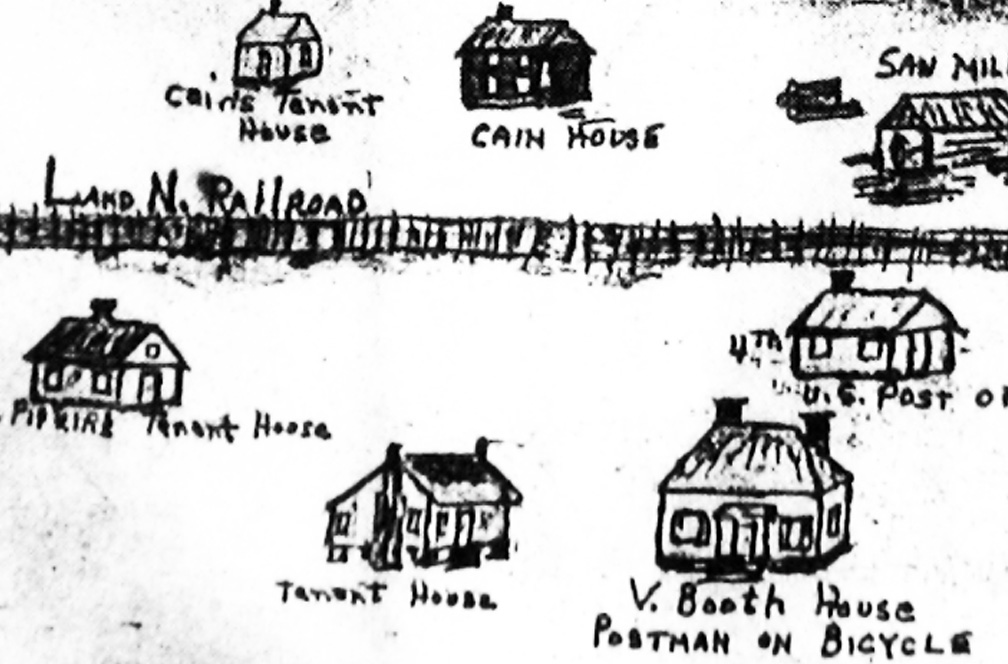
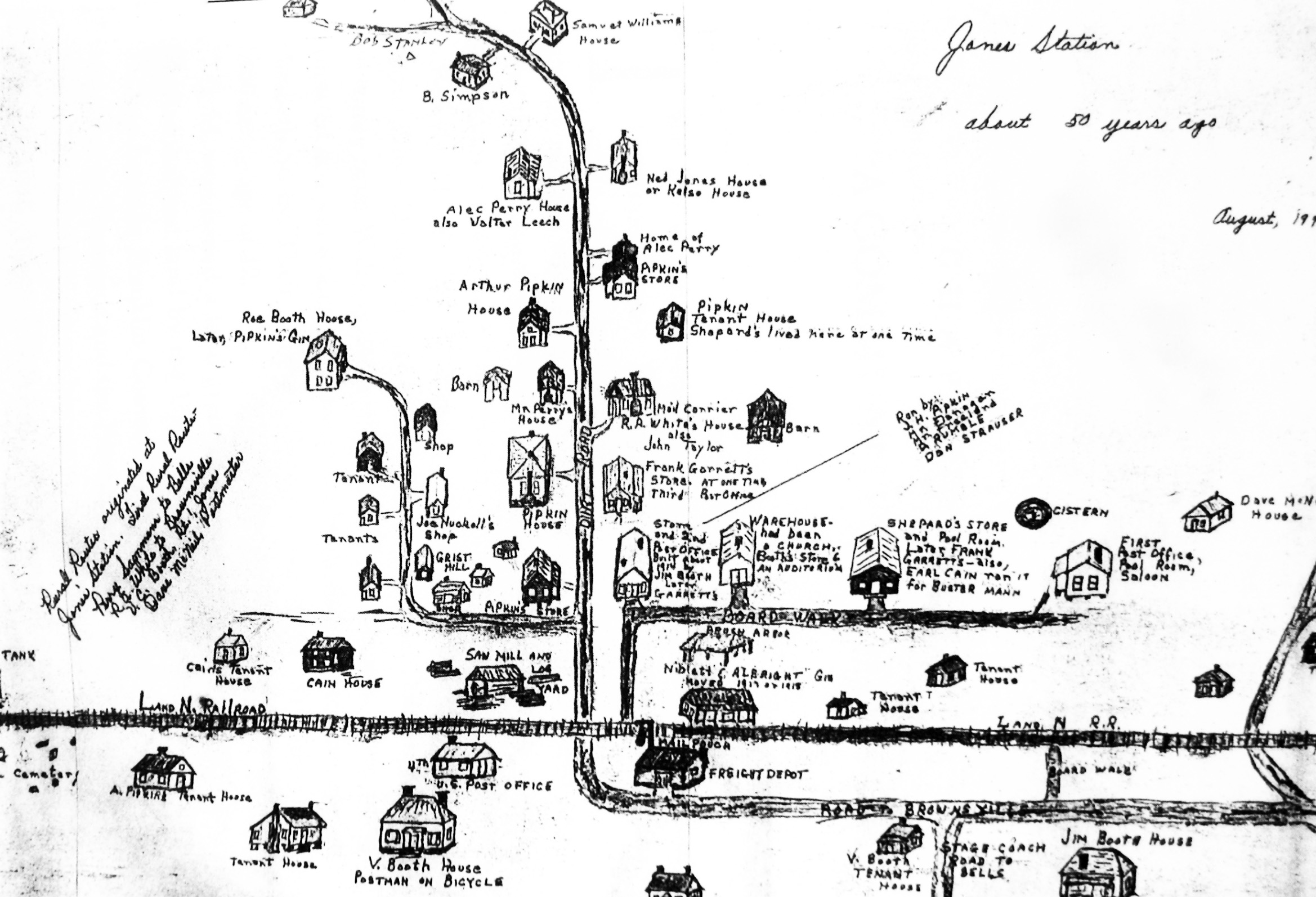
This historical hand-drawn map provides a detailed visual layout of the Jones Station community in Haywood County, Tennessee, illustrating the settlement as it existed roughly 50 years prior to its documentation. Created by Jim Booth and featured in Martha Jones’s book “Journey into Yesteryears,” the sketch serves as a valuable genealogical and historical record of the area.
It meticulously charts the Louisville & Nashville Railroad tracks cutting through town, flanked by vital infrastructure like the freight depot, a sawmill, and a gristmill. Beyond industrial landmarks, the map plots numerous family residences, tenant houses, local stores and post offices, capturing the fabric of a rural community in that era. Download a large verion of this map.

Jones Station became important enough by 1877 to appear on a map of Haywood County in District Five. Edward M. Jones’s (1848-1915) store and post office is noted. Edward was the son of Edward R. Jones who originally donated the land fot the depot. I have many other ancestors who appear on the map including Whites, Watridges, Cobbs, Castellaws and Rooks.
Jones Station also included several sawmills and shops that came and went through the years.
My father, Bob Williams, remembers my grandfather, Jesse Lloyd “Bo” Williams (1910-2008), once telling him that, when he was younger, my grandfather played baseball for a Jones Station team.
Today, the Jones community is a few houses and cotton fields along the highway between Brownsville and Bells.
Here is a bit more about a few members of the Booth family who made their home in Haywood County.
Vernon Clark Booth

Vernon C. Booth (1879-1963), delivering mail by bicycle at Jones Station.
In 1903, the first rural route in Haywood County began at Jones Station. My third great-grandmother Lena’s nephew, Vernon Clark Booth, delivered mail in the area by bicycle. Vernon delivered mail from Dec. 15, 1903, until Feb. 28, 1911, and later served as postmaster at Jones from Feb. 26, 1914, until Sept. 30, 1945.

The Haywood County History Museum in Brownsville includes an exhibit of what remains of the Jones community post office. It was donated to the museum by Marilyn Booth in memory of Vernon Booth.
| Vernon C. Booth Obituary Services for Vernon C. Booth, 83, will be Sunday at 3 p.m. at the Hollow Grove Baptist Church near Brownsville. Burial will be in the church cemetery with Brownsville Funeral Home in charge. Mr. Boothe, a landowner, farmer and retired merchant died Friday at the Haywood County Memorial Hospital after several years of illness. He was a life long resident of Haywood County and was postmaster of the Jones Post Office until it was discontinued in 1945. He was a member of the Holly Grove Baptist Church and the Haywood County Farm Bureau. He was a former director of the Farm Bureau and had been a member of the County Jury Commission. Survivors are, his wife, Mrs. Olive Mae Thomas Booth, two sons, Burnis O. Booth of McKenzie, Oma Booth of Harvey, IIl., one daughter, Mrs. Julius Sammons Jr. of Whiteville, one brother, James B. Booth of Brownsville, two sisters, Mrs. W. W. Crandell and Mrs. Gaston Powell of Brownsville, seven grandchildren and one great-grandchild. The Jackson Sun, Sun, July 28, 1963, 30. |
Vernon was buried in the Holly Grove Baptist Church Cemetery.
James Bemberry Booth

James Bembery Booth (1848-1916) with Eldorado Thomas Booth (1871-1962) with Mary Irene (1902-1994), Lela Mae (1906-1999) and James Membery Jr. (1907-2000) around 1908.
According to Martha Jones, Vernon and his father, James Bemberry Booth, one of Lena’s brothers, built a store at Jones Station. The store included a warehouse where church services were held on Sundays.
James’ third wife, Eldorado Thomas Booth, is said to have helped supervise a mission house in a converted pool hall after the pool hall was closed in 1919 by the Rev. G. B. Davis.
Albert Cicero “Roe” Booth
A local history account states that the first cotton gin at Jones Station was owned by Albert Cicero “Roe” Booth (1859-1924) in 1903 and operated there until the end of World War I. Roe Booth was the grandfather of one of my Dad’s childhood friends, Milton Booth. Milton also owns the property where my second great-grandfather, George D. Williams (1847-1919), is buried.
Albert was married first to Rebecca Manie Williams (1863-1868) then secondly to Sarah Francis “Sallie” Watridge (1869-1910).
He died in 1924 and was buried in Zion Baptist Church Cemetery.
James Booth
James Booth (1790-after 1850) is the first of my Booth ancestors I can document in Haywood County. He was married to Nancy Ann Milligan Booth (1794-1850) and first appears in Haywood County records by 1830. In the mid-1800s, he served as a school commissioner for the county. In 1847, he deeded one acre of land to the school commissioners for the purpose of building a schoolhouse. Booth made the transfer of real estate “for the good will that I entertain for the public school system.”
James and his family lived on a farm next to another branch of my family, Augustus Brantley (1811-1876) and Martha White Brantley (1812-1851). Sixty-six years later, in 1916, Augustus Brantley’s great-grandson, William Day “Willie” Brantley (1897-1969), married James Booth’s great-granddaughter, Allie Ern Marbury Brantley (1898-1995). One of their daughters was my maternal grandmother, Virginia Brantley Lovelace (1917-2007).
William G. “Billy” Booth
William G. “Billy” Booth (1816-1892), who moved to Haywood County as a boy with his father, James Booth, was a close friend of Sim Cobb, whose 1875 diary is included in “Nicholas Cobb Descendants, Neighbors and Relatives.” Billy is mentioned throughout Sim’s entries, and they give a good sense of what daily life was like in that part of Haywood County.
| 19 Jan. 1875: Tuesday, fair and cold; cut and burned brush in the field; moved W. G. Booth’s fence; John F. White came over in the morning; J. C. W. Cobb and W. G. Booth was with me at night until bedtime. 2 Feb. 1875: Tuesday, cloudy all day, rained during the day; split some wood and picked up trash in the new ground until dinner; after dinner, went to W. G. Booth and got my spade and worked on shelter by the smokehouse. 15 Feb. 1875: Monday, cloudy and cold; burned logs and trash and hauled and put up rails; Pink (Harriett Outlaw) and Agatha (Mrs. John Hardy Cobb) was here; Bet (his wife) went with them to W. G. Booth; J. E. Lott and W. G. Cobb came down at night to get some castor oil. 24 Feb. 1875: Wednesday, cloudy with some rain and warm; hauled manure in the garden and to the land for the Irish potatoes; caught a rabbit; Mrs. Booth (Mary Elizabeth “Eliza” White Booth) and Lott were here; Ed came. 5 April 1875: Monday; planted corn in the new ground next to W. G. Booth’s field. 2 May 1875: Sunday, fair, went to Sunday School; D. W. Watridge and family was here and stayed until after supper; W. G. Booth, Willie (William L. Booth), J. B. (James Bemberry Booth) Booth and Mittie (probably Margaret White) was here, and Roe Booth (Albert Cicero Booth) also. |
William D. “Willie” Brantley
Lastly, my closest family connection to the Jones commmunity was through my maternal great-grandparents.

The Jackson Sun, May 7, 1969, 27.

Allie Marbury Brantley and William “Willie” D. Brantley
My great-grandparents, Allie Marbury Brantley (1898-1995) and William Day Brantley (1897-1969) lived long enough that have memories of them. I remember sitting on this couch. Granddaddy Willie, as we called him, had an automobile accident and spent the last few years of his life paralyzed from the neck down.
For more of my genealogy research, visit rscottwilliams.info.


Leave a Reply