
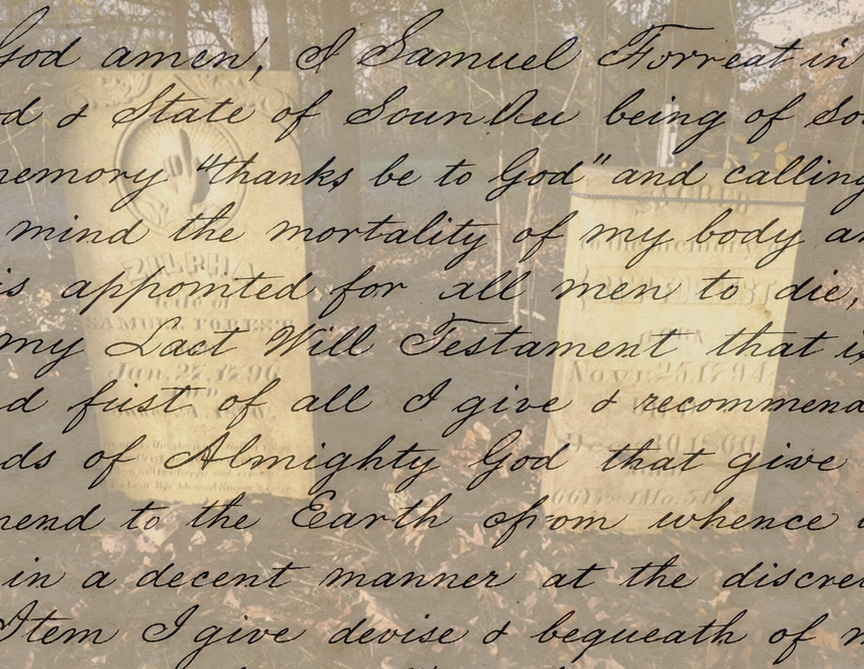
Thank goodness for wills. Ancestry.com says its U.S. wills and probate collection includes more than 170 million documents from all 50 states, spanning 1668 to 2005.
While researching the Forrest, Yelverton and Sherrod families, the will of Samuel Forrest 1 proved very helpful at confirming some of my direct ancestors, while also providing a snapshot of both his place in society and what was important to him.
Here are a few observations.
- He owned lmore than 127 acres. He “loaned” his wife Zilpha Forrest 127 acres for her use during widowhood, then gave “all the balance” of his land to Samuel Yelverton.
- For that time, he had some degree of wealth compared to others in his Haywood County community. The will lists land, enslaved people, livestock, farm tools, household furniture, food supplies and crops.
- He was an enslaver. The will names enslaved people and treats them as estate property to be loaned, inherited and transferred. In Tennessee in 1860, about 25% of families were slaveholders. About 19% enslaved at least one person and about 6% enslaved ten or more. 2 This puts Forrest in the upper tier of Tennessee slaveholders, but not among the largest planters. By comparison, the largest enslaver in Haywood County was James Bond (1793-1873), who owned approximately 220 enslaved people by 1859 and more than 17,000 acres, making him the county’s largest planter and landowner on the eve of the Civil War.3
- His farm was big. He mentions horses, mules, cattle, hogs, oxen, cart wheels, poultry, corn, fodder, wheat, oats, hams, coffee and farm tools. That suggests a working farm. Interestingly, it does not mention cotton, even though that was a major crop in Haywood County then
- The couple had the tools typcially owned by wealthier Haywood Countians. He noted a cupboard, trunk, folding-leaf table, dining chairs, dishes, looking glass, clock, pots, ovens, skillet, spinning wheels and other furnishings.
- He was probably regligious to some degree and could read. The opening — “In the name of God amen,” “sound mind and disposing memory,” and the recommendation of his soul to God — reflects religious belief (or at least acknowledgement). He was presenting himself as competent, orderly and prepared for death. His books and slate were important enough to be included in his will, so those meant something to him.
- He provided for Zilpha, but only conditionally. There were husband and wife for 26 years and had 11 children at the time of his death, but the stuff was his. Zilpha Forrest received land, household goods, provisions and the use of enslaved people “during her life a widow.” If she remarried, the property went to others listed, and she could not change the will in any way.
- The Yelverton family was central to his estate plan. Samuel Yelverton received major property and was named executor. Samuel Yelvertonds oldest sons, Samuel Forrest Yelverton and Etheldred H. Yelverton, also received bequests. The Forrests had no biological children, but Samuel and Annie Yelverton had lived with his aunt and uncle from at least 1850. Forrest appointed Yelverton executor and asked the court not to require bond or security. That means he trusted him completely and Forrest or his lawyer understood the probate process.
- The enslaved people named in the will are important to geneologists. Their names may be the only surviving records tying them to a particular household in Haywood County in 1859.
| The Will of Samuel Forrest In the name of God amen, I Samuel Forrest of the County of Haywood & State of Tennessee being of perfect sound mind & disposing memory thanks be to God for the same Calling to mind the mortality of my body and knowing that it is appointed for all men to die do make & ordain this my Last Will & testament that is to say principally and first of all I give recommend my Soul into the hands of Almighty God that gave it. As for my body I recommend to the Earth from whence it was taken to be buried in a decent manner at the discretion of my Executors. Item I give will & bequeath my estate in the following manner & form; Viz That is to say in the first place I desire all my just debts to be paid. Item I lend to my beloved wife Zilpha Forrest during her life or Widowhood, one hundred twenty seven acres of my Land to be run out most suitable for her convenience and so as to include all the buildings at my home together with six negroes loaned in the same manner, named as follows, one Woman by the name of Wineford, two boys Reuben and Moses, three girls Melissa, Mason and Violet, all my household & kitchen furniture consisting of beds bedsteads bedstands furniture, one folding leaf table, one common table, all my sitting chairs, two chests, one lady’s saddle, one clock, three pair fire irons, one block reel, all my books, one slate, one shot gun, one loom gears and frames, two spinning reels, two spinning wheels, all my castings, consisting of ovens, skillets, pots, pot frame and skillet, all my tools and farming utensils, plows, hoes, double and single trees, one [barshare?] plow, one sythe & cradle, one wheat fan, one cross cut saw, whip saw, one hand saw, and also as much of my stock as she may need, consisting horses, mules, cattle, hogs, one yoke of oxen, one cart, wheels, draw chains and oxen gear of all kind, also a sufficient quantity of corn, fodder, wheat and oats, plenty of bacon, and coffee, sugar, and all suitable provisions for herself & family. She is to have all of her table necessaries knives, forks and spoons, earthen ware, crockery and so on to her during her natural life or Widowhood. Item I give & bequeath to my beloved nephew Samuel Yelverton at my death all the balance of my land after the hundred & twenty seven acres is run out to my wife, together with two negro boys by the name of Peter & Needham, one scyth and cradle, all of said property, land and negroes as above mentioned, to be his the said Samuel Yelverton at my death to him & his heirs forever. Item I give & bequeath to my grand nephew Samuel F. Yelverton all the land I loaned to my beloved wife at her death or marriage to have & to hold forever. Item I give & bequeath to my grand nephew Etheldred H. Yelverton one thousand Dollars worth of my Estate at the death or marriage of my beloved wife. Item I give & bequeath to my above mentioned nephew Samuel Yelverton, all the property I loaned to my beloved wife at her death or marriage, except the land, all the negroes Wineford, Reuben, Moses, Melissa, Mason and Violet together with all the appurtenances thereunto appertaining or belonging and all the goods chattels Stock or that is belonging to the estate at that time. Should there be any money or notes in the house at my death I desire it equally divided between my wife Samuel Yelverton, after giving up the notes I hold against my nephew Samuel Yelverton to him. If there should be any of the above named property that the said Samuel Yelverton gets at the death or marriage of his aunt is to be his & his heirs forever. I hereunto constitute and appoint my nephew Samuel Yelverton Executor to my last Will & Testament, hereby revoking all other wills by me at any time heretofore made. In witness whereof I have hereunto set my hand & fixed my seal this the 19th of Aug in the year of our Lord one thousand Eight Hundred & fifty nine. The Court will please not call on the Executor for bond or security as I the Testator deem it not necessary. Samuel Forrest Signed sealed in presence of us. Simpson Walters James Harris |
Those mentioned in the will are:

Samuel Forrest — Samuel William Forrest (c. 1794-1860), formerly of Wayne County, North Carolina migrated west to Haywood County, Tennessee.
Samuel Forrest died Dec. 30, 1860, in Haywood County or Madison County, Tennessee and was buried in the “old” Forrest cemetery. Zilpha died a decade later, at age 73, on June 24, 1870, and was buried next to her husband.
The cemetery where they were buried was not maintained and was eventually destroyed by loggers. Thankfully, a group of individuals, including author and historian Billy King, relocated the headstones of Samuel, Zilpha and others that remained to the Forrest Cemetery off Rice Road in Madison County, Tennessee.
Zilpha Forrest — Zilpha Sherrod Forrest (1797-1870), Samuel’s wife. Her maiden name was Sherrod and she was named as a daughter in the 1841 Wayne County will of William Sherrod/Sherard (1765-1841).
Samuel Yelverton — Samuel W. Yelverton (1828-1876), Samuel Forrest’s nephew was my third great-grandfather. He was the son of my fourth great-grandparents, Mary A. Forrest Yelverton (1791-1862), Samuel Forrest’s sister, and Etheldred Yelverton (1784-1851). He was living in Samuel and Zilpha Forrest’s household in 1850 and eventually had 11 children with Ann “Annie” W. Sherrod (1834-1880) before his death in 1876 at the age of 48.
Samuel F. Yelverton — Samuel and Annie Sherrod Yelverton’s son Samuel Forrest Yelverton (1854-1929) who was named after his uncle. He would have been 6 when his uncle died and 22 when his father died.
Etheldred H. “Dred” Yelverton — Etheldred (1857-1936) was the next to oldest son of Samuel W. Yelverton and Annie Sherrod Yelverton. The name Etheldred/Ethelred can be seen in the Yelverton family line.
Ann “Annie” W. Sherrod Yelverton — Not named in the will, but central to understanding the dynamics of this family. She was a Sherrod relative of Zilpha, so its likely Zilpha’s niece married her husband’s nephew.”
The enslaved people named in the will appear to be:
Wineford/Winifred, Reuben, Moses, Melissa, Mason or Milly, Violet, Peter and Needham. These names matter because they may reappear in probate records, Freedmen’s Bureau records, labor contracts, census records after 1870 or records connected to the Forrest, Yelverton and Sherrod families.
For more of my genealogy research, visit rscottwilliams.info.
- Haywood County, Tennessee, Will Book C, pp. 281–285, will of Samuel Forrest, dated 19 August 1859, proved February 1861; Haywood County Clerk, Brownsville, Tennessee. Digital image, Ancestry ↩︎
- U.S. Census Office, Agriculture of the United States in 1860; Compiled from the Original Returns of the Eighth Census (Washington, DC: Government Printing Office, 1864), 239; U.S. Census Office, Population of the United States in 1860; Compiled from the Original Returns of the Eighth Census (Washington, DC: Government Printing Office, 1864), 456, 459; U.S. Census Office, Statistics of the United States (Including Mortality, Property, etc.) in 1860; Compiled from the Original Returns and Being the Final Exhibit of the Eighth Census (Washington, DC: Government Printing Office, 1866), 348. ↩︎
- McKenzie, Robert Tracy. “James Bond.” Tennessee Encyclopedia. Tennessee Historical Society. Last modified March 1, 2018. ↩︎


Leave a Reply