
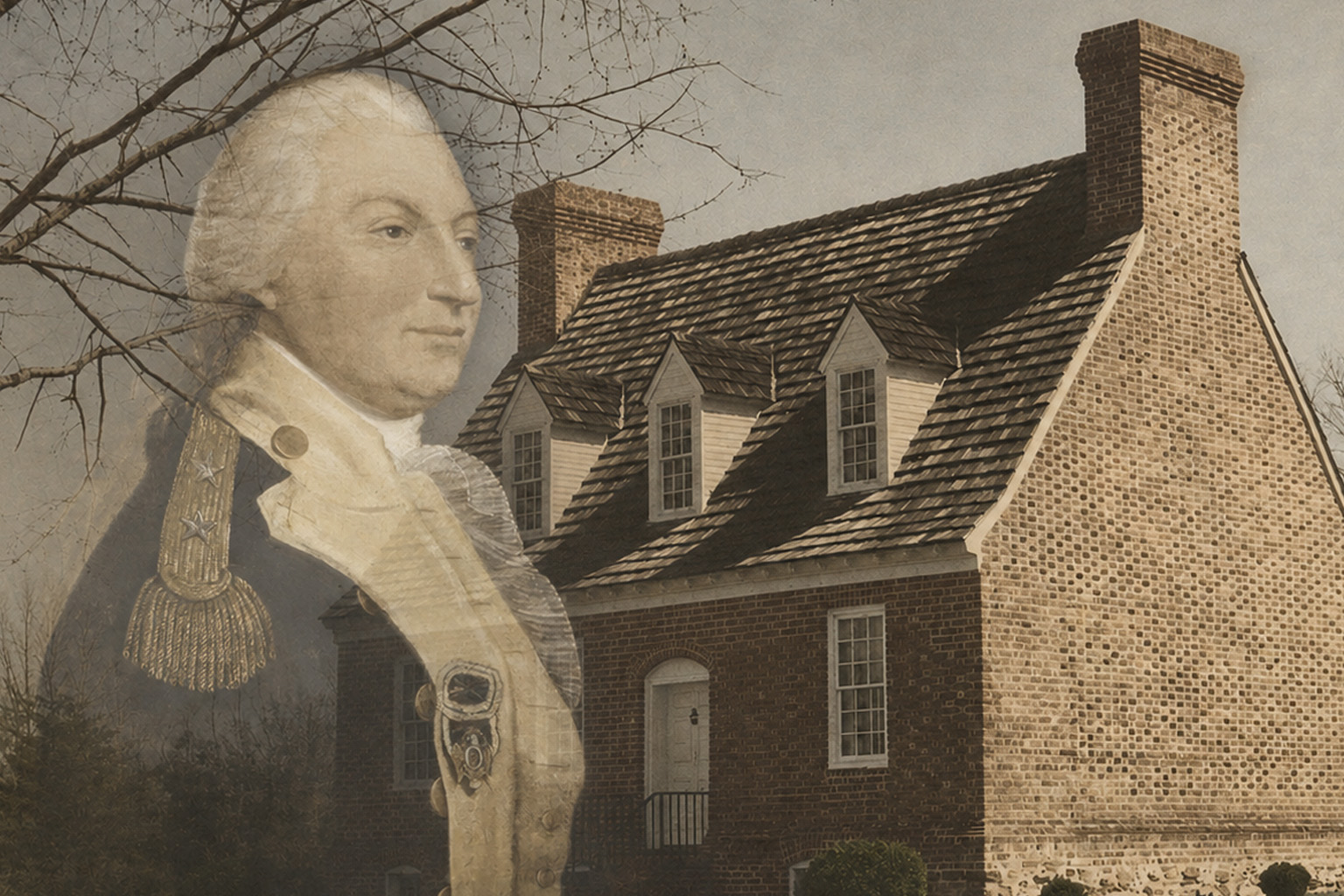
Early this morning, I was researching the Lovelace branch of my family tree when I came across a limb I had not explored. It was even more fascinating to learn that the home of one of the family’s most interesting members, Revolutionary War Maj. Gen. William Smallwood (1732-1792), was less than an hour away from my home in Arlington, Virginia at 2750 Sweden Point Rd., Marbury, Maryland.
A spur-of-the-moment road trip was in order.

Charles Willson Peale (1741-1827) painted this portrait of William Smallwood from life about 1781 or 1782. The portrait, now owned by Independence National Historical Park, shows Smallwood in military dress following his promotion to major general.
Second Cousin, Seven Times Removed
First, a little about how William Smallwood fits into my family tree.
My maternal grandfather was Guy Lovelace (1916-1997), the son of James Luther “Jim” Lovelace (1885-1968), the son of Charles Buchanan “Charlie” Lovelace (1858-1938), the son of Thomas A. Lovelace (1812-1876), the son of Thomas Lovelace (1772-1829).
Thomas Lovelace’s mother was Sarah Robey Lovelace (1731-1796), the daughter of Sarah Smallwood Robey (1708-1767), the daughter of Thomas Smallwood (about 1675-1735), the son of James Smallwood (about 1639-1714/15), my eighth great-grandfather.
James Smallwood’s son Prior Smallwood (1680-1734) was the father of Bayne Smallwood (about 1711-1768), who was the father of William Smallwood. Because my line descends through James’ son Thomas while William descended through Thomas’ brother Prior, William was my second cousin, seven times removed.
Like my Lovelace and Robey ancestors, the Smallwoods were among the early settlers of Charles County, Maryland, in the rolling Potomac River country. James Smallwood arrived in Maryland by 1663, possibly as an indentured servant. He later became a prosperous planter, Indian trader, militia officer, county justice and longtime member of the Maryland General Assembly.
William Smallwood
William Smallwood was likely born at his father’s plantation on Mattawoman Creek in Charles County. Some biographies report that he was sent to England, studied first at Kendal and later at Eton College, then served in the French and Indian War after returning to Maryland. However, researchers at the Maryland State Archives have found no surviving primary documentation confirming either his attendance at Eton or his service in the French and Indian War. Both claims may be correct, but they remain part of the traditional account of his life rather than firmly documented facts.1

“General George Washington Resigning His Commission” by John Trumbull. This painting shows William Smallwood as the third person standing behind Washington. Photo credit: Kids Encyclopedia Facts
William Smallwood entered Maryland politics in 1761 and became an early supporter of resistance to British rule. In 1776, Maryland appointed him colonel of the First Maryland Regiment, which gained lasting fame at the Battle of Long Island. Smallwood was absent during the battle’s opening phase, while Maj. Mordecai Gist (1743-1792) led the Marylanders in repeated attacks that helped cover the American retreat. Smallwood arrived later with reinforcements and artillery, so his regiment played a major role in helping save Washington’s army.
Promoted to brigadier general later that year, Smallwood was wounded at White Plains and later served at Germantown and Camden. He also became known for recruiting troops, securing supplies and organizing Maryland’s military forces. Congress promoted him to major general in 1780. Although some fellow officers considered him ambitious and difficult, he earned respect for his courage, administrative ability and loyalty to the Maryland troops under his command.

Triennial Meeting of the General Society of the Cincinnati, at Princeton, N.J., May 14, 1884; Photo credit: The Society of the Cincinnati Archives
After the war, Smallwood became the first president of the Maryland Society of the Cincinnati, an organization founded by former Continental Army officers. Maryland selected him as a delegate to the Continental Congress in 1784, but before he took his seat, the General Assembly elected him governor.
Smallwood served as Maryland’s fourth governor from 1785 to 1788. During his administration, Maryland ratified the U.S. Constitution and worked with Virginia to improve navigation along the Potomac River. Smallwood returned to public office in 1791 as a member and president of the Maryland Senate.2
Mattawoman Plantation
Smallwood never married and had no children. He spent his later years at Mattawoman Plantation, where his wealth and comfortable lifestyle depended heavily on the labor of enslaved African Americans.
The 1790 census recorded 56 enslaved people in Smallwood’s household. Most probably lived in quarters elsewhere on the plantation and worked in its tobacco fields, barns, workshops and domestic spaces. No buildings associated with the plantation’s enslaved community survive today.
Smallwood died in February 1792 while traveling home from Annapolis.
Although he was among the wealthiest landowners in Charles County, Smallwood also left substantial debts. His surviving relatives became involved in a lengthy Chancery Court case and eventually had to sell portions of his property to satisfy his creditors. Smallwood’s relatives retained the house and about 1,200 surrounding acres until 1868.

Smallwood had requested an unmarked burial. More than a century after his death, the Maryland Society of the Sons of the American Revolution erected a granite monument on July 4, 1898, near the estimated location of his grave on the hillside below his house.
Smallwood’s Retreat

Michelle in the garden at Smallwood’s Retreat
Built about 1760, Smallwood’s Retreat is a relatively modest Tidewater house, especially when compared with the grand Georgian mansions occupied by many of Maryland’s wealthiest planters. Its smaller size may have reflected Smallwood’s life as a bachelor who had no direct heirs.
After the Smallwood family sold the property, the house passed through several owners and was occupied largely by tenant farmers. Over time, it deteriorated until little more than a standing ruin remained.

Chesapeake Bay Region Architects Report, Spring 1961, 7.
In 1938, residents of Southern Maryland organized the Smallwood Foundation to acquire and preserve the house and about 10 surrounding acres. Their work continued for nearly 20 years. Maryland joined the preservation effort in 1957, accepted the property and established Smallwood State Park. The restoration was completed in 1958, and supporters continued raising money to furnish the house and landscape the grounds.
Some evidence of the extensive reconstruction remains visible. Darker brickwork at the corners shows how much of the structure had to be rebuilt during the restoration.

An early photograph of the restored Smallwood’s Retreat appeared in The Baltimore Sun on June 30, 1958.

Me in the front yard of Smallwood’s Retreat
Today, Smallwood State Park covers 628 acres along Mattawoman Creek. In addition to the Retreat House and Smallwood’s memorial, the park includes a detached kitchen, reconstructed outbuildings, a relocated 19th-century tobacco barn, a marina, boat ramps, campsites, cabins, picnic areas and nature trails.
Guided tours of the house and colonial cooking demonstrations are offered seasonally by Friends of Smallwood volunteers, but the schedule varies. Anyone planning a visit should check with the park or Friends of Smallwood before making the trip.
The house was closed when we arrived, but that did not stop us from touring the grounds, walking around the exterior and peeking through William Smallwood’s windows.
Not bad for a spur-of-the-moment road trip inspired by a newly discovered branch of the family tree.
Plan your own visit to Smallwood’s Retreat.
For more of my genealogy research, visit rscottwilliams.info.
Notes:
- James Schmitt, “William Smallwood (1732-1792),” Maryland State Archives Biographical Series, 2019. ↩︎
- Maryland State Archives, “William Smallwood, Governor of Maryland, 1785-1788,” adapted from Frank F. White Jr., The Governors of Maryland, 1777-1970 (Annapolis: Hall of Records Commission, 1970), 21-23; Papenfuse et al., Biographical Dictionary, 741. ↩︎


Leave a Reply