
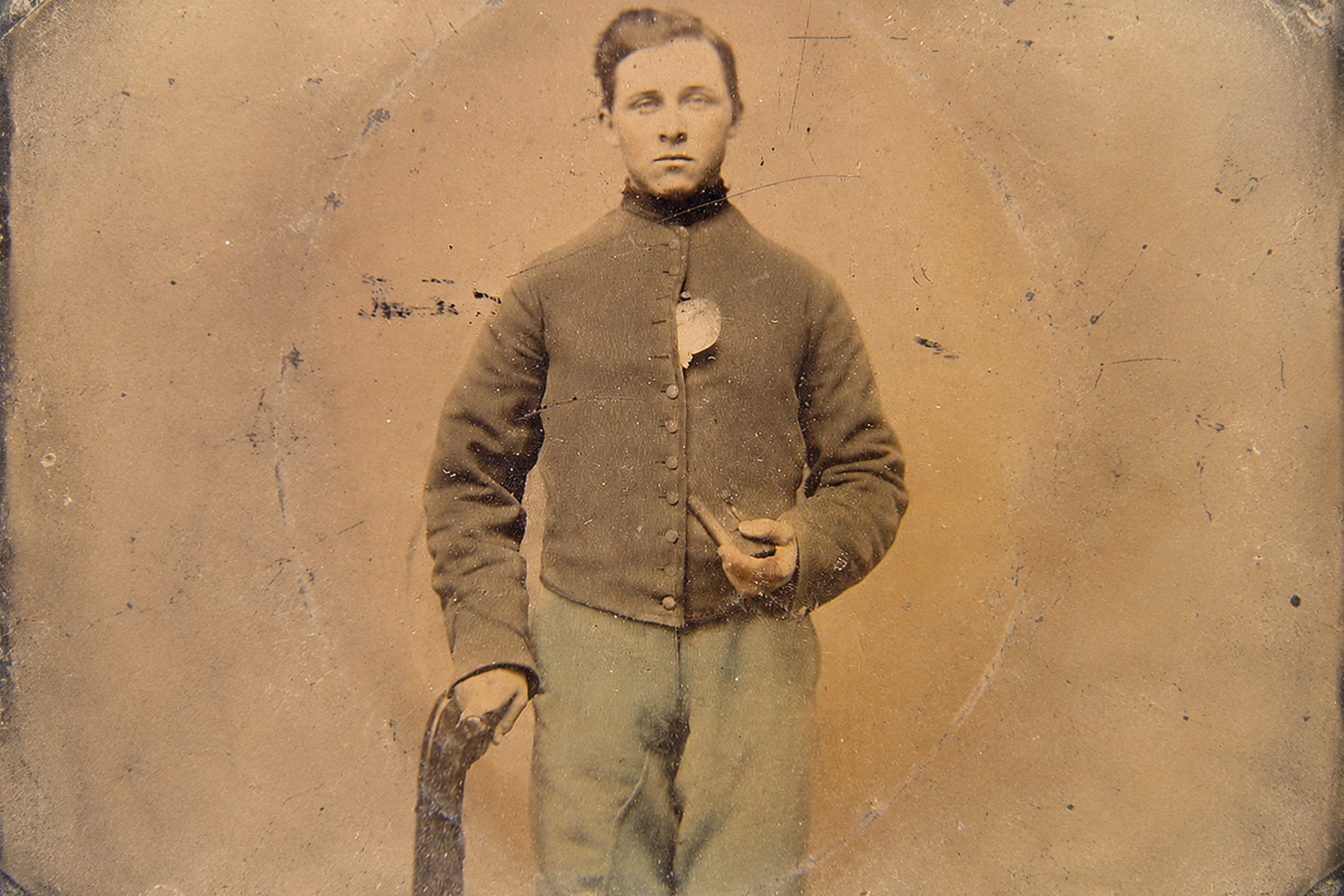
Photo: An unidentified Union soldier; Photo credit: Library of Congress, Liljenquist Family Collection of Civil War Photographs /
Could a Union officer from Obion County, Tennessee who commanded troops during one of the Civil War’s most notorious massacres be buried in an unmarked grave near Nixon Creek in Haywood County?
Rodney Wright, a longtime friend of my family, recently contacted me about a story that has been passed down for generations in the Poplar Corner Road community. It concerns land near the former home of Richard Nixon (1769-1831), Haywood County’s first permanent white settler, and an area where both Rodney’s family and mine have lived for generations.
Rodney’s father, Billy Wright, previously helped me locate the general site of Nixon’s cabin south of Poplar Corner Road and east of Nixon Creek. Nixon Creek crosses Poplar Corner Road about four miles east of Brownsville.
According to the oral tradition Rodney heard from his father, Confederate soldiers once camped on a hill near the old Nixon property. The soldiers reportedly had several Union prisoners with them. When one of the prisoners tried to escape, the Confederates shot and killed him and buried his body nearby.
Like me, Rodney enjoys investigating local history. While researching the Civil War, he came across the story of Maj. William F. Bradford (c. 1832-1864), a Tennessee Unionist who assumed command of Fort Pillow shortly before Confederate troops overran it on April 12, 1864. Bradford survived the battle but was captured and later shot somewhere outside Brownsville.
The similarities immediately caught Rodney’s attention. Could Bradford have been the Union prisoner remembered in the Poplar Corner Road story?
Who was William F. Bradford?
Some online memorials identify Bradford as William Frederick Bradford and give his birth date as Sept. 13, 1827. Historians John Cimprich and Robert C. Mainfort Jr., using the 1860 census and military service records, identified him as William F. Bradford, born about 1832.1
The 1860 census listed Bradford as a 28-year-old lawyer living in Obion County’s Troy postal district. That detail caught my attention because Troy is only a few miles from my current home here in Union City, Tennessee.
Bradford remained loyal to the United States after Tennessee joined the Confederacy in 1861. Such loyalty was dangerous in West Tennessee, where families and communities were divided between Union and Confederate sympathies. Southern Unionists who joined Federal regiments were often condemned by their Confederate neighbors as traitors, renegades or “home-made Yankees.”
Military records show that he began recruiting a Union battalion in late 1863. The unit was formally organized that December and stationed briefly at Paducah, Kentucky, before receiving orders to move to Fort Pillow in February 1864.2
The name “13th Tennessee Cavalry” also creates some confusion. Bradford’s unfinished regiment was generally known as Bradford’s Battalion or the 13th Tennessee Cavalry. After the disaster at Fort Pillow, its survivors were reorganized into other Tennessee Union cavalry units.
The Fort Pillow massacre
Fort Pillow stood on a high bluff overlooking the Mississippi River in Lauderdale County, about 50 miles north of Memphis. By April 1864, its garrison included Bradford’s white Tennessee Unionists and Black soldiers from the 6th U.S. Colored Heavy Artillery and Battery D of the 2nd U.S. Colored Light Artillery.
Maj. Lionel F. Booth (1838-1864), commander of the Black artillery battalion, held overall command of the fort. Bradford served as his second-in-command. The arrangement was potentially confusing because Booth had been ordered to consult Bradford, a lower-ranking officer who knew the surrounding country, before making important decisions.3
On the morning of April 12, 1864, Confederate forces commanded by Maj. Gen. Nathan Bedford Forrest (1821-1877) attacked Fort Pillow. A Confederate sharpshooter mortally wounded Booth shortly after 9 a.m., leaving Bradford in command.
The Confederates eventually demanded an unconditional surrender and warned that no quarter would be given if the garrison continued to resist. Bradford refused. Confederate troops stormed the fort that afternoon and drove the defenders down the bluff toward the Mississippi River.
What followed became known as the Fort Pillow massacre. Union survivors reported that Confederate troops continued killing Black and White soldiers who had dropped their weapons, raised their hands or attempted to surrender.

“The War in Tennessee — Rebel Massacre of the Union Troops After the Surrender at Fort Pillow, April 12,” from a sketch by Charles E.H. Bonwill, published May 7, 1864. The illustration reflects contemporary Northern reporting about the massacre; Photo credit: Library of Congress Prints and Photographs Division.
Modern research based on military service records estimates that between 585 and 605 Union troops were present. Between 277 and 297 were killed or mortally wounded — nearly half the garrison. About 64% of the Black troops died, compared with 31% to 34% of the white troops.4
Many men were killed while fleeing, attempting to surrender, lying wounded or hiding after organized resistance had collapsed. Contemporary Confederate accounts also acknowledged that Black soldiers begging for mercy were shot.

President Abraham Lincoln’s May 3, 1864, draft concerning the federal government’s response to the Fort Pillow massacre; Photo credit: Abraham Lincoln Papers, Library of Congress
| Sir: It is now quite certain that a large number of our colored soldiers, with their white officers, were, by the rebel force, massacred after they had surrendered at the recent capture of Fort Pillow. So much is known, though the evidence is not yet quite ready to be laid before me. Meanwhile I will thank you to prepare, and give me in writing your opinion as to what course the government should take in the case. Yours truly, A. Lincoln Lincoln originally wrote “in your judgment” after “what course,” but crossed it out and inserted “your opinion as to” above the line. |
The massacre caused outrage across the North. “Remember Fort Pillow” became a rallying cry, particularly among Black Union soldiers who understood that capture might mean death rather than treatment as prisoners of war.6

A section of The Fort Pillow Massacre, a color lithograph published by Kurz and Allison during the 1890s. The dramatic scene is a later artistic interpretation of the battle, not an eyewitness image; Photo credit: Tennessee Virtual Archive, Tennessee State Library and Archives.
Bradford’s capture and death
Accounts differ somewhat about what happened next with Bradford after Confederate troops overran the fort. Union witnesses reported that he attempted to escape into the Mississippi River while soldiers fired at him. He eventually returned to shore, surrendered and became a prisoner.
By the evening of April 12, Bradford had been taken to Covington, Tennessee. He apparently removed his uniform and attempted to conceal his identity because he feared Confederate soldiers from West Tennessee would recognize him as a local Unionist.
The strongest evidence concerning Bradford’s death comes from W. R. McLagan, a Tennessee-born fur trader who was forcibly conscripted into Confederate service at Covington immediately after the battle. McLagan later escaped and gave sworn testimony to the congressional committee investigating Fort Pillow.5
McLagan said Bradford and about 30 conscripts were taken from Covington to Brownsville on April 13. The following evening, April 14, their guards started toward Jackson.
After traveling about five miles from Brownsville, the Confederate column stopped. Five guards took Bradford approximately 50 yards away from the road. Bradford pleaded to be treated as a prisoner of war. Three guards then fired on him, killing him immediately. What McLagan described was a deliberate execution.

Confederate Col. William L. Duckworth
Bradford’s killers reportedly justified the shooting by calling him a Tennessee traitor who had joined the Union Army. McLagan believed the order may have come from Confederate Col. William L. Duckworth (1834-1915), commander of the 7th Tennessee Cavalry, but he did not hear Duckworth issue such an order. The guards left Bradford’s body where he fell.
| Testimony of W. R. McLagan “He simply said that he had fought them honorably and as a brave man, and wished to be treated as a prisoner of war. He was taken prisoner at Fort Pillow, and was then sent to Covington, to the custody of a Colonel Duckworth, commanding the 7th Tennessee rebel cavalry, and from that place he was sent under guard, with about thirty of us conscripts. We arrived at Brownsville on the 13th; we started out on the evening of the 14th instant, about dusk. Previous to our leaving Brownsville, five of the guards were ordered back to Duckworth’s headquarters. Those five guards seemed to have received special instructions about something, I don’t know what. After marching about five miles from Brownsville, we halted, that is, the two companies of the rebels. These five guards then took Major Bradford out about fifty yards from the road. He seemed to understand what they were going to do with him. He asked for mercy, and said that he had fought them manfully, and wished to be treated as a prisoner of war. Three of the five guards shot him. One shot struck him about in the temple; a second in the left breast, and the third shot went through the thick part of the thigh. He was killed instantly. They left his body lying there. I escaped from the rebels at Jackson. I left on the Friday morning about 2 o’clock, and Saturday night about 12 o’clock I came back where the murder was committed, and saw his body there, yet unburied. The moon was shining brightly, and it seemed to me that the buzzards had eaten his face considerably.”6 |
You can read the entire testimony here.
Could the location have been near Nixon Creek?
McLagan placed Bradford’s death approximately five miles outside Brownsville on the route toward Jackson. Nixon Creek crosses Poplar Corner Road about four miles from Brownsville, and the former Nixon property lies in the same general area east of town.
However, proximity alone is not proof. I need to establish the precise course of the Brownsville-to-Jackson road in April 1864 and determine whether the Confederate column could have passed through or close to the Nixon Creek property. I am also curious what of Nixon’s original cabin and brick yard remained in 1864. That was, afterall, only 30 years after his death. If there was some sort of cabin still standing, it would have been a logical place for them to spend the night. I had Lovelace, Shirley and Jacocks ancestors living all around that area, so there were people nearby who could have provided the soldiers food and drink.
What happened to Bradford’s body?
Bradford has sometimes been listed online as buried in Nashville National Cemetery. Rodney contacted the cemetery and learned that its staff could not verify such a burial.
The cemetery’s official 1869 Roll of Honor contains records for more than 16,000 Union graves, including identified and unidentified soldiers transferred from numerous burial grounds. William F. Bradford does not appear among the identified burials. The only person named Bradford in the published roll is Alexander Bradford of the 6th Indiana Infantry.7
That absence does not conclusively prove Bradford is not in Nashville. He could theoretically have been reinterred as an unknown soldier. However, there is no known documentation showing that his remains were recovered, identified or transferred there.
Historian Charles L. Lufkin summarized Bradford’s fate in a 1986 article about the 13th Tennessee Cavalry, writing that Bradford was murdered by his captors while being escorted from Brownsville toward Jackson. Lufkin described the circumstances as controversial but did not identify a burial place.8
Its possible some local residents saw the body, dug a hole and buried him. For now, Bradford’s final resting place remains unknown.
So, is Bradford buried near Poplar Corner Road?
The evidence points to the fact that William F. Bradford was very likely killed in the general vicinity of Nixon Creek and Poplar Corner Road. The distance given by an eyewitness is remarkably close to the location remembered by the local stories.
But I cannot confidently say that Bradford was buried there.
What I can say for sure is somewhere about five miles outside Brownsville, Confederate guards murdered Maj. William F. Bradford, a Tennessee lawyer and Union officer who had survived the Fort Pillow massacre only two days earlier. Whether his remains still lie beneath the soil near Nixon Creek is a question that will probably never be answered..
- John Cimprich and Robert C. Mainfort Jr., “Dr. Fitch’s Report on the Fort Pillow Massacre,” Tennessee Historical Quarterly 44, no. 1 (Spring 1985): 28n6. The authors identify Bradford as an Obion County lawyer born about 1832, based on the 1860 census and military records. The census transcription lists a 28-year-old lawyer named Bradford in the Troy postal district. ↩︎
- National Park Service, “Bradford’s Battalion, 13th Regiment, Tennessee Cavalry,” Civil War Battle Unit Details. The unit was organized in December 1863 and ordered to Fort Pillow in February 1864. ↩︎
- Colin A. Strickland and Timothy S. Huebner, From Civil War Fort to State Park: A History of Fort Pillow (Rhodes College and Tennessee Civil War National Heritage Area, n.d.), 18-21. ↩︎
- John Cimprich and Robert C. Mainfort Jr., “The Fort Pillow Massacre: A Statistical Note,” Journal of American History 76, no. 3 (December 1989): 835-37. ↩︎
- U.S. Congress, Joint Committee on the Conduct of the War, Fort Pillow Massacre, Senate Report No. 63, 38th Cong., 1st sess. (Washington, DC: Government Printing Office, 1864), 101-4. McLagan testified under oath that he saw Bradford shot. ↩︎
- U.S. Congress, Fort Pillow Massacre, 102-4. McLagan stated that Bradford was killed on April 14 about five miles from Brownsville. He saw the body still unburied while returning from Jackson on the night of April 23. ↩︎
- Quartermaster General’s Office, Roll of Honor, No. XXII: Names of Soldiers Who Died in Defense of the American Union, Interred in the National Cemetery at Nashville, Tennessee (Washington, DC: Government Printing Office, 1869). ↩︎
- Charles L. Lufkin, “‘Not Heard From Since April 12, 1864’: The Thirteenth Tennessee Cavalry, U.S.A.,” Tennessee Historical Quarterly 45, no. 2 (Summer 1986): 133-51, especially 142-43. ↩︎


Leave a Reply