
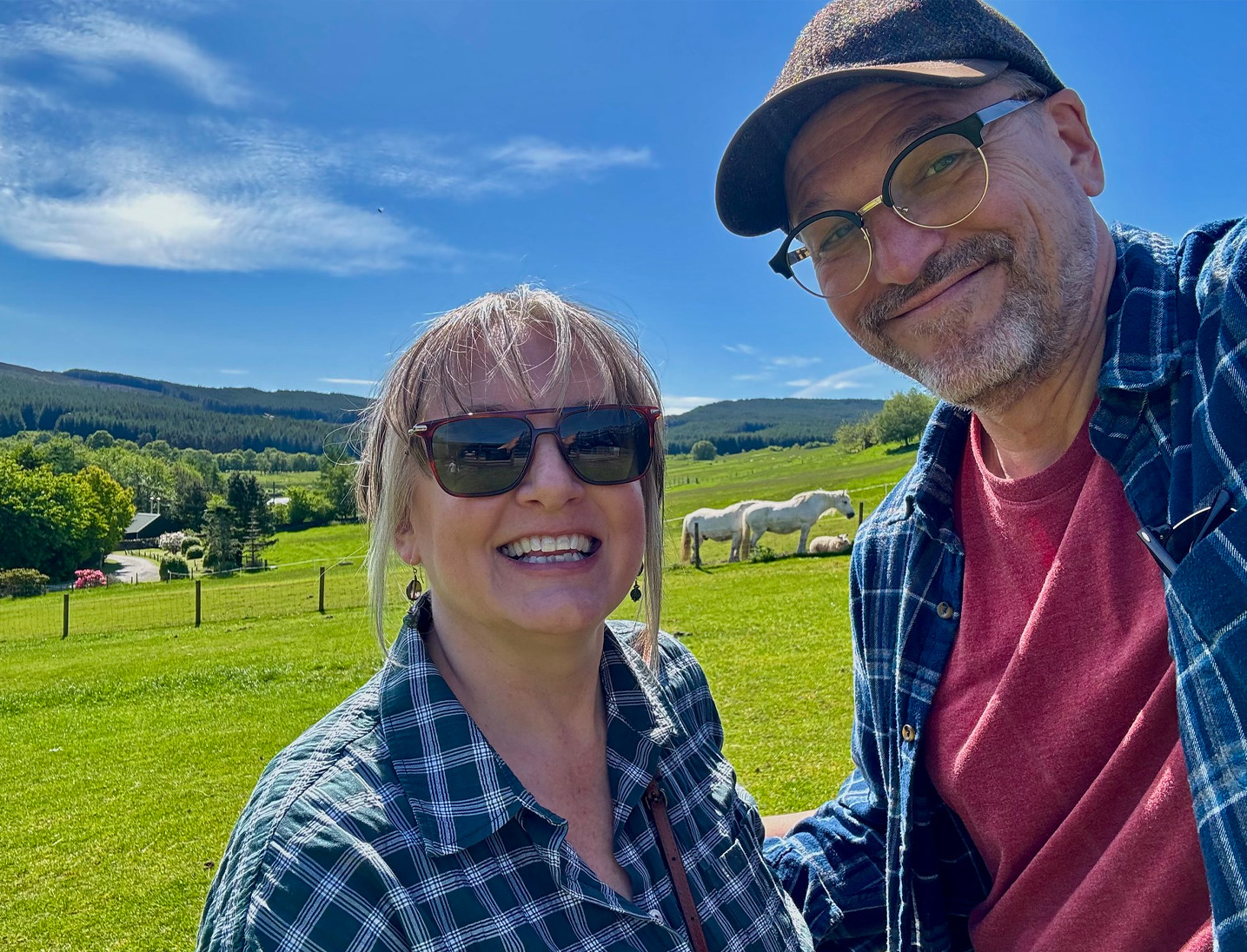
Isle of Skye

The Cluanie Inn
For the next few days, our home base was The Cluanie Inn. It was our favorite hotel of the trip.
Calling it “remote” does not adequately describe its solitude, and the inn is surrounded by hiking trails.
| Helpful hint: Take the well-marked Cluanie Estate path. As soon as you see a stack of rocks beside a narrow path, head up the hill for an incredible view from the top. |
Our room had the best linens and pillows of the trip — an important distinction for me at any hotel. The food was delicious, and the staff’s service and hospitality were outstanding. Had I known how much we would enjoy the area, I would have included an additional day there.

Me on my way up the mountain at The Cluanie Inn
On our way to Eilean Donan Castle, we stopped at my wife’s favorite store of the trip, Kintail Crafts. The small, family-run antiques store in Glen Shiel has been operating since 1989.
For me, Eilean Donan Castle provided the quintessential Scottish experience. The parking lot was nearly full, although additional parking was available a short distance away, and the castle was crowded. However, the site is large enough to accommodate even many more visitors.
It was a cool, windy and misty day, and a young man was playing bagpipes at the entrance to the bridge leading to the castle. I had been watching him for a while when a £5 note blew out of his tip case. Although he saw it, he never flinched and continued playing. I retrieved it for him and now know you can smile and play the bagpipes at the same time.

A bagpiper at Eilean Donan Castle
The original castle was built in the 13th century and became a stronghold of Clan Mackenzie and its allies, Clan MacRae. In response to the Mackenzies’ involvement in the Jacobite rebellions of the early 18th century, government ships heavily damaged the castle in 1719.
It is such a castle with a capital “C” that it has appeared in films including “Highlander,” “Made of Honor,” “Elizabeth: The Golden Age” and the James Bond movie “The World Is Not Enough.”
What impressed me most about Eilean Donan was the story of how it remained in ruins for about 200 years. Lt. Col. John MacRae-Gilstrap purchased the island in 1911 and began restoring the castle to its former glory. After 20 years of work, it reopened in 1932. Members of the MacRae family continue to manage and operate the castle through a charitable trust.

Michael Smith’s Michelin-starred Loch Bay restaurant in Waternish on the Isle of Skye.
We then headed to the Isle of Skye. One highlight of our visit was exploring the Waternish peninsula and Skyeskyns Waternish Tannery.
Visitors can take a free tour of the tannery to learn about the techniques and handiwork involved in processing each sheepskin. The skins are treated to soften the leather, and the wool is combed using a variety of tools. The entire process takes about two and a half weeks and results in the soft rugs the company sells in its store and online.
The business was founded by the late Clive Hartwell and his wife, Linda, and is now run by their daughter. You can learn more about how this unique operation began in this video.
| Helpful hint: If your budget allows, make a reservation just down the hill at Michael Smith’s Michelin-starred Loch Bay in Stein, a historic 18th-century fishing village in Waternish designed by Thomas Telford. |
Dinner costs £145 per person and features “contemporary Scottish with classic French influences.” Food lovers might also enjoy this interview with Smith. Although we did not get to eat at his restaurant, we enjoyed peeking through the window, which was free.
Let’s Go to Glasgow
The next day, we headed south to Glasgow for the final days of our visit. After passing Ben Nevis, the highest mountain in Scotland, we made a quick pit stop in Fort William at Old Inverlochy Castle. It was surrounded by fencing because repairs were underway.
We also visited the nearby Highland Soap Co. The soap store was where I found the best scone of the trip, and we picked up several gifts for friends and family back home.
Although all of Scotland is exceptionally beautiful, the scenic drive along the A82 through Glencoe Valley toward Glasgow feels like another world.
A spur-of-the-moment decision to stop at the Glencoe Visitor Centre resulted in my first live “coo” sighting. Highland cattle, commonly known as Highland coos, are the shaggy ginger-colored cows with long horns and bangs.
We spent about an hour touring the impressive center, which includes information about the area, a film and several exhibits.
Helpful hint: We did not have time, but I wish we could have taken a chairlift up Glencoe Mountain.

The view from our room at the Apex City of Glasgow Hotel
For the final days of our trip, our home base was the Apex City of Glasgow Hotel. The hotel was comfortable and included everything we needed. Our room on the top floor had the best shower of the trip and incredible views of the city.
It was a bit of a shock to leave the peace and tranquility of the Highlands and the Isle of Skye for Glasgow’s metropolitan energy and gritty character.
Our visit to The Burrell Collection resulted in even more Highland coo sightings.

A Highland coo in Pollok Country Park on Glasgow’s south side, near The Burrell Collection
My wife has forgiven me for the insect bites she sustained while standing in the bushes as I attempted to get a good photograph of the Burrell’s Highland cattle.
We also saw the temporary exhibition “Discovering Degas: Collecting in the Time of William Burrell.” The experience was even more enjoyable for me because I visited with my own personal art history teacher.

Michelle thinks about “The Thinker” by Auguste Rodin at The Burrell Collection
Of course, when visiting Glasgow, you must make time for the Kelvingrove Art Gallery and Museum. It is like a Noah’s Ark of the world, except it contains far more than two of everything. I am fairly certain we saw at least one work by everyone who ever picked up a brush or chisel.
| Helpful hint: Be sure to visit the difficult-to-describe Sharmanka Kinetic Theatre while in Glasgow. Sharmanka was founded in Russia by sculptor-mechanic Eduard Bersudsky and theater director Tatyana Jakovskaya before moving to Scotland in the mid-1990s. It is mesmerizing and unlike anything you are likely to experience elsewhere. |

Michelle touches the unicorn’s horn on a staircase at the University of Glasgow for good luck
My sixth-great-grandfather, James Castellaw, attended the University of Glasgow in 1703 before leaving school and heading to America, so I wanted to see a little of what he might have seen.
We took a guided tour that was supposed to last about an hour but continued for nearly two because everyone was so engaged. I resisted the urge to ask questions about Harry Potter, although it did feel as though we had landed in the pages of one of the books.
Bookstore and Sir Walter Scott
If you enjoy books as much as we do, another essential stop is Voltaire and Rousseau, where visitors can find an enormous selection of affordable secondhand, thirdhand, fourthhand and antiquarian books.
The store is on a cobbled backstreet that feels slightly sketchy, but once inside, you will be amazed by the number of affordable books packed into its small rooms.

Voltaire and Rousseau bookstore in Glasgow
What better souvenir of a trip to Scotland than a very old book of poetry by Sir Walter Scott?
I also purchased an 1875 first-edition copy of “The Scottish War of Independence” by historian William Burns. It is inscribed, “To Alexander Storie from Mrs. Burns as a reminder of her husband and as a personal token. Belmont, 24th January, 1879.”
Burns (1809-1876) was a Scottish lawyer and historian who led the campaign to create the Wallace Monument, which, ironically, we did not get to visit.
Speaking of writers, on our final day, we took a detour through the Scottish Borders on our way back to Edinburgh. Our first stop was The Great Tapestry of Scotland.
To be honest, we were so tired that we almost skipped it, but I am glad we did not. I had no idea what to expect and had added it to our list of things to do if we had time.
The tapestry is one of the world’s largest community arts projects and was hand-stitched by about 1,000 people from across Scotland. It visually represents the country’s history through 160 linen panels and incorporates hundreds of miles of wool — enough to stretch the length of Scotland.

Michelle and me with Caroline Scott and Margaret Burgess, who worked on the D-Day panel of The Great Tapestry of Scotland
We happened to visit on the 80th anniversary of D-Day and had the unique opportunity to meet Caroline Scott and Margaret Burgess, two of the people who worked on the tapestry’s D-Day panel.
They graciously shared firsthand stories and small details about the project that visitors could never learn from a short exhibit label.
The Original Tourism Brand Marketer
We were so captivated that we barely made it to our next stop, Abbotsford.
The home and gardens of novelist, poet, playwright and historian Sir Walter Scott are in Melrose in the Scottish Borders. Through his writing, Scott blended historical facts with romantic fiction to depict Scotland in a way that thrilled readers around the world.

A portrait of Sir Walter Scott at Abbotsford
In 1822, Scott organized King George IV’s visit to Scotland. The event featured Highland clothing, ceremonies and customs that were reported around the world.
Following the Jacobite rising of 1745, the British government restricted the wearing of Highland dress and attempted to suppress other expressions of Highland culture. King George’s visit, combined with Scott’s enthusiastic promotion of Scotland’s romantic history and traditions, helped shape the country’s international image and contributed to the development of its modern tourism industry.
Scott was the original tourism brand marketer.
The luxurious mansion he built was state-of-the-art for its time and a fitting home for one of the era’s most successful and celebrated authors.

Castlelaw Hill Fort
Castlelaw Hill Fort
Our last stop was more personal and is unlikely to appear on many travelers’ bucket lists.
My paternal grandmother’s maiden name was Castellaw, and that branch of our family came from Scotland. That connection inspired my desire to visit the country in the first place.
My seventh-great-grandfather, Thomas Castellaw, was a minister who preached in the Presbytery of Dunfermline after graduating from the University of Edinburgh in 1663 — 300 years before I was born.
As mentioned earlier, his son James entered the University of Glasgow in 1703, although there is no record that he graduated. James was the Castellaw who left Scotland for America and made a name for himself in Bertie County, North Carolina.
Although the Castellaw name appears to have died out in Scotland, a possible echo of it remains on a hill southwest of Fairmilehead in the Pentland Hills of Midlothian at Castlelaw Hill Fort.
No family connection to the site has been discovered, but it is an interesting place to visit. The hill fort was established about 2,500 years ago but was not excavated until the 1930s. A concrete roof was later built over part of the structure, with glass panels added to allow natural light into the interior.

Counting sheep at Castlelaw Hill Fort
Farewell, Scotland
For our final evening in Scotland, Michelle and I unloaded the rental car at the Moxy Edinburgh Airport hotel. I then returned the car to Hertz, which was a short walk across the road from the hotel.
This arrangement allowed me to walk back to the Moxy and gave us only a five-minute walk to the airport for our 9:30 a.m. flight the next morning. It was especially helpful when our departure was delayed until 10:30 a.m. Thankfully, we received the message before leaving our room, so we had a comfortable place to wait.
Since beginning my ancestry research, I have felt a kinship with Scotland, although I knew little about its history beyond what I could remember from various movies and television programs.
Our visit gave me a greater appreciation for the country’s history and culture, although I know we barely scratched the surface.
I had better start planning our return to Scotland.
Check out photos and videos from our trip to Scotland.
For more of my genealogy research, visit rscottwilliams.info.


Leave a Reply