
I am trying to determine the identity of the parents of my 4th great-grandfather, Rev. George S. Williams of Madison County, Tenn. but it has proven difficult. I decided to see what I could discover by working with the line of his wife, Nancy. I still have work to do on the mystery of George’s parents but spending some time researching Nancy added some detail to an ancestor I knew nothing about until yesterday: John Williford (c. 1750s–1833), my 5th great-grandfather.

John was the father of Nancy F. Williford Williams (c. 1795–after 1866), the wife of Rev. George S. Williams (1797–1852), making Nancy my 4th great-grandmother. George and Nancy left Bertie and moved to Madison County, Tenn. where George served as the first pastor of Zion Baptist Church in Haywood County, Tenn.

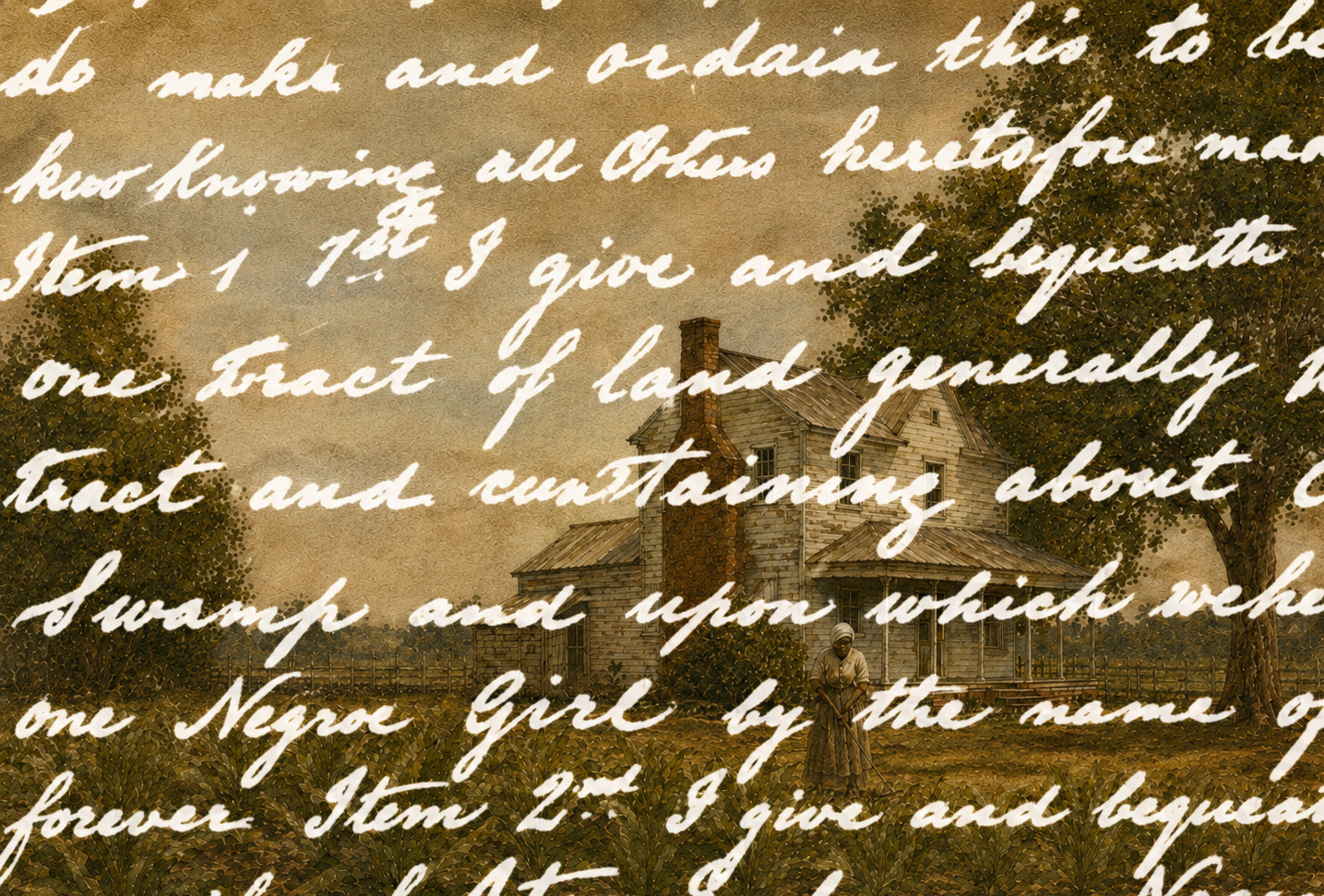
On May 22, 1833, John Williford sat down in Bertie County and began dividing the property he had accumulated over his very long and fruitful life. When he reached his fourth bequest, he wrote:
“I give and bequeath unto my Daughter Nancy wife of George Williams one Negro Girl by the name of Harriett…”
While acknowledging the horrors of slavery, that sentence also connects Nancy to her father, John, and to her husband George Williams.
The Willifords of Bertie County
John was born into a Williford family that was well established in Bertie County as his family had been there for many generations and aquired a great deal of land.

Bertie County on John Collet’s A Compleat Map of North-Carolina from an Actual Survey, published in London in 1770. The remarkably detailed map identifies rivers, roads, settlements and even individual rural landowners in northeastern North Carolina during the period when the Williford and Williams families were living there. Image: Library of Congress, Geography and Map Division. Download
John’s father was Richard Williford Jr. (before 1737–1808), a landowner and planter who appears frequently in the old Bertie County records. Richard’s wife and John’s mother was Mary Ella Barnes (1734-1782). Richard and Mary are my 6th great-grandparents.
Richard began transferring property to John long before he died in 1808. In 1782, a Bertie County deed specifically identified John as Richard’s son. Other transfers followed in 1789 and 1799.
In his will written in 1801, Richard left money to some of his children and grandchildren, but John received considerably more than others. Richard left him six enslaved people: Rhane, Tener, Hannah, Jacob, George and Arthur, along with everything else in the estate that had not already been given away. He also made John executor.
John inherited property his father had accumulated during his lifetime in Bertie County, and by then, John had already been acquiring property of his own.
Revolutionary War Service
During the American Revolution, Richard served as a juror for Bertie County in 1781. The Daughters of the American Revolution recognizes him for that civil service as Patriot Ancestor A214877.
DAR counts this as Revolutionary patriotic service because by 1781 North Carolina was no longer operating as a British colony. It was an independent state fighting the Revolution. By serving as a juror, Richard was “carrying out an official public duty under the authority of the new American state government.” The DAR specifically recognizes service as a juror during the Revolution as qualifying civil service, along with positions such as sheriff, constable, judge and justice of the peace.
There is no evidence I have found that Richard fought as a soldier. His service was with the civil government of North Carolina. So while John was growing up, his father was participating in the new government of a state that was fighting for independence from Great Britain.
Building an legacy
By the 1790s, John was steadily adding to his property. In 1793, he purchased an enslaved person for £130 from the executors of George Wynns. The following year he received a North Carolina land grant for 34 acres adjoining Aaron Askew and Josiah Perry. In 1797, Josiah Perry sold John another 288 acres adjoining John’s father’s property. In 1798, John Early and his wife Sally sold John 100 acres on the west side of Cashy Road. The following year, Reuben Cook sold John another 100 acres.
The same Bertie County names show up over and over — Early, Wynns, Perry, Cook, Askew, Mitchell, Morris, Williams and Williford. They bought land from one another, witnessed one another’s deeds, served together in county affairs and eventually married into one another’s families.
It was a small world, and it seems John did very well in it.
Documented Marriage
On Jan. 19, 1804, John married Mary “Polly” Freeman (birth year uncertain–after 1833) in Bertie County. He would have been around 45 to 50 years old when he married Polly. Since he had already been conducting business and receiving land for more than 20 years, and already had children, the logical conclusion is Polly was his second wife.
There is a 1791 Bertie County marriage record for a John Watford and Rachel Cowand that has sometimes been connected to John Williford. Perhaps that is his first wife, but I will save that research for another day.

Bertie County Courthouse, Windsor, North Carolina, in an early postcard view. The courthouse pictured here was built in 1887, decades after John Williford’s death, but it stands in the county seat where generations of Bertie County residents recorded deeds, settled estates and appeared before the county court. John Williford’s will was proved in Bertie County Court in 1833 and recorded in Will Book G.
Life on a Bertie County plantation
The census records show John’s household and property growing. In 1800, 10 enslaved people were living in his household. John’s father died in 1808, leaving him six specifically named enslaved people as well as the remainder of his estate. By the 1810 census, John’s household included 24 enslaved people. By 1830, John was an elderly man living with Polly and a number of younger people, surrounded by a very large enslaved population.
John had become what is considered as “extensive planter.”
By the end of his life, John owned large tracts of land, mills, livestock, household and kitchen furniture and even a brandy still. One tract he left to his son William contained approximately 800 acres near Beaver Dam Swamp.
Fortunately for anyone trying to reconstruct this family nearly 200 years later, John named his children in his will.
They included:
- William B. Williford: c. 1809–c. 1840
- Sarah Williford Early: c. 1811–1884
- Mary Ann Williford Wynns: 1806–1887
- Nancy F. Williford Williams: c. 1795–after 1866
- Adaline Williford Tyler: c. 1814–after 1866
- Elizabeth Williford Porter: birth unknown–after 1833
- Jethro B. Williford: c. 1805–c. 1855
- Richard T. Williford: c. 1808–1874
- John Williford: probably c. 1820s–after 1833
- Ophelia Williford: c. 1823–after 1833
Nancy Williford Williams
Of course, the child I am most interested in is Nancy. John’s will tells us that by May 1833 she was already the wife of George Williams.
That is especially useful because my research eventually picks up George and Nancy in Tennessee. They would leave Bertie County and become part of that westward migration that carried thousands of families from Virginia and North Carolina through Tennessee and beyond during the first half of the 19th century.
Another of John’s daughters provides confirmation that I have made the right family connections.
When John wrote his will in May 1833, he referred to Adaline Williford Tyler (c. 1814–date unknown) as his daughter Adaline. She was not yet married, but, a few months later, on Sept. 3, 1833, she married Calvin C. Tyler (dates unknown) in Bertie County.
Years later, after Nancy Williford Williams had moved to Tennessee, she wrote her own will. In it, she referred to Adaline Tyler as her “beloved sister.” Adaline’s son Lucius A. Tyler later appears in records connected with “my” Rev. George Williams in Madison County, Tennessee.
The people John enslaved
John’s will also brings up something uncomfortable but important about his life and the era in which he lived. Much of his wealth depended on slavery. While the federal censuses tell us how many people enslavers enslaved, they do not tell us their names. that’swhere wills come in.
Among the enslaved people named in the document are Mariah, Tempy, Harriett, Louisa, Jenny, George, Jim, Arthur, Isaac, Stephen, Rhoda, Gillian and Andrew.
Harriett was the young woman John “left to” to Nancy Williams. If Nancy lived long enough, she made the trek to Haywood County. Others were divided among his children. Some were left for Polly’s use during her lifetime or widowhood. Others were to be sold and the proceeds divided among John’s heirs. Imagine the horrors experienced by those enslaved family units as they were torn apart.
For John, the document was about making certain his property went where he wanted it to go after his death. For the enslaved people named in the same pages, his decisions could determine whether husbands and wives stayed together, whether children remained with their parents and where they some of them would spend the rest of their lives. If Harriett did make the journey to Haywood County with her enslaver Nancy Williams, I wonder who she left behoind.
John Williford’s last summer
John wrote his will on May 22, 1833 and apparently died not long afterward.
At the August term of the Bertie County Court, two of the witnesses to his will, Wright Mitchell and William D. Mitchell, appeared in open court and testified that it was John’s last will and testament. The court ordered it recorded in Bertie County Will Book G, page 228. So John died sometime between May 22 and the August court session of 1833.
Considering the amount of land his family owned and the customs of the time, I would not be surprised if he was buried in a family cemetery somewhere on or near the old Williford property. That is another mystery for another day.
John Willford’s ancestry
Look back even further, you find John’s father, Richard Williford Sr. (birth year unknown–1766) buying and selling property in Bertie County during the first half of the 18th century. The older Richard’s wife was Abigail Williford (birth year unknown–after 1734).
Some family trees carry the Williford back through colonial Virginia and eventually to a prominent Wilsford family in England. Some of those people definitely existed, and there may be a connection. However, after spending some time digging through those trees, I have already found several people who have been mixed together. For example, there were two Virginia men named Thomas Wilsford who have frequently been combined into one person in some trees even though one died in 1667 and the other was alive a decade later.
So for now, I would rather stop where the records are good and tackle this family’s later years after I have spent some time researching them.
From Bertie County to West Tennessee
By the 1830s, George and Nancy were establishing themselves in Madison County, Tennessee, where George served his Baptist congregation, farmed and where their children and grandchildren would become part of my West Tennessee family.
My line from John runs through Nancy F. Williford Williams. Her son, George S. Williams (1797-1852), was the father of George S. Williams (1820–1864), who was the father of George D. Williams (1846–1919), who was the father of William L. Williams (1888–1962), who was the father of Jesse L. “Bo” Williams (1910–2008), who was the father of my father, Robert L. Williams (1940–present).
That makes John Williford my fifth great-grandfather.
I started looking at the Willifords because I was trying to solve a Williams mystery. Instead, I found an entire family I had barely noticed before. And the document that opened the door was John’s will. Now I know where he lived. I know some of the land he owned. I know the names of his children. I know something about the community around him. I know the names of some of the enslaved people whose labor helped build his wealth.
And, most important to me personally, I know that sometime before May 1833 his daughter Nancy married a man named George Williams. That discovery brings me right back to the mystery that started all of this.
Who were George Williams’ parents?
I’m still looking.


Leave a Reply