
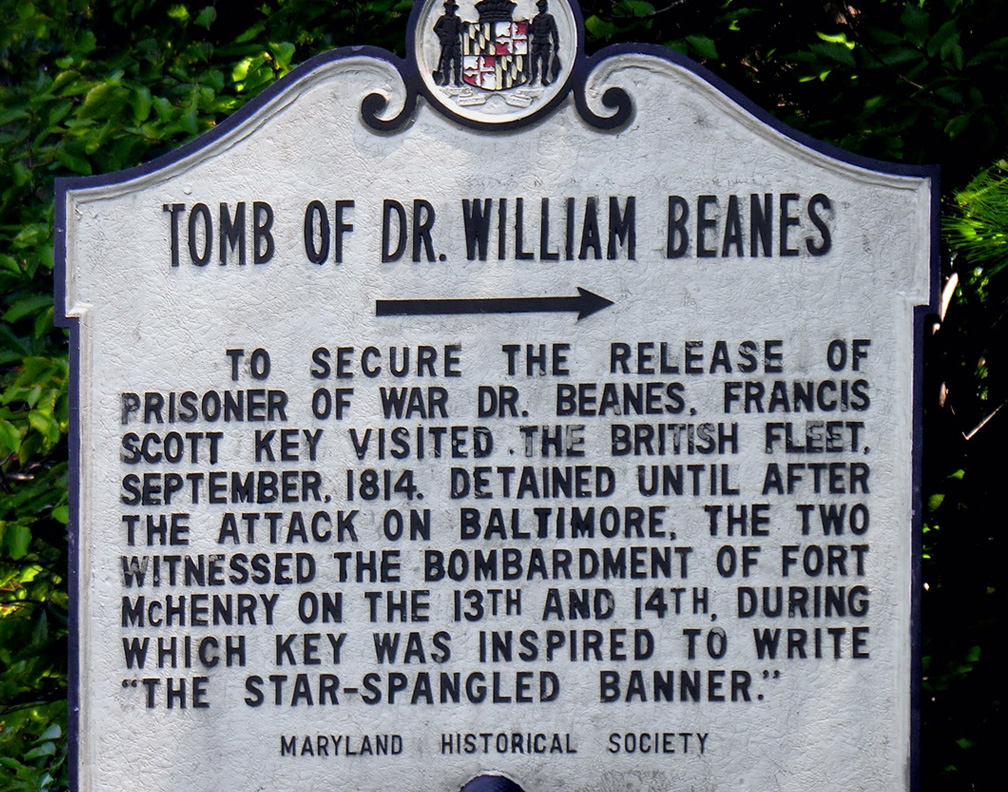
While Dr. William Beanes is not a direct ancestor of mine, he was closely connected to the Marbury family and is now one of those people I will think about every time I hear “The Star-Spangled Banner.”
Leonard Marbury was my sixth great-grandfather. He had a brother named Luke Marbury Sr. Luke Sr.’s son, also named Luke Marbury, became a colonel during the Revolutionary War. According to Marbury family material, Dr. William Beanes was Col. Luke Marbury’s first cousin on his mother’s side and one of his close friends.
When Luke married Beanes’ sister Elizabeth, the two men also became brothers-in-law.
Dr. Beanes was a Maryland physician and Revolutionary War veteran who later married Sarah Hawkins Hanson. She was a niece of John Hanson, who served as President of Congress under the Articles of Confederation.
One of the more colorful stories preserved in the family archives comes from Col. Marbury’s granddaughter, Jane Contee Marbury Penn. Writing years later in The Patriotic Marylander, she wrote that Dr. Beanes and Col. Marbury were devoted friends, that both were with the Maryland troops at the Battle of Long Island and that they were among the few Maryland men who escaped, reportedly by “swimming across Long Island.”1 Whether every detail can be proved today or not, it is a story the family clearly remembered and has passed down through the generations.

In the Dawn’s Early Light
What places Dr. Beanes in the larger American story, however, is what happened during the War of 1812. Effie Gwynn Bowie Effie Gwynn Bowie was a Maryland local historian and genealogical writer from Prince George’s County. She is best known as the author of Across the Years in Prince George’s County, a major 1947 county history and family genealogy reference that is still cited today. Bowie shared the story of Dr. Beanes in a way that neatly connects him to the writing of the national anthem.
She wrote that after British officers used Beanes’ house as headquarters on their march to Washington, they carried him off in retaliation for helping capture some of their men. Friends then sent Francis Scott Key under a flag of truce to seek his release. Key was not allowed to leave before the attack on Baltimore, and from the vessel where he was held he watched the bombardment of Fort McHenry. As Bowie put it, “in the dawn’s early light,” Key saw that the American flag was still flying and was inspired to write the words that became “The Star Spangled Banner.”2
Bowie wrote:
Dr. Beanes was seized by the British after helping capture some of their soldiers, friends quickly worked to obtain his release and Francis Scott Key was sent to negotiate with Admiral Cockburn. Forced to remain with the fleet during the bombardment of Fort McHenry, Key witnessed the attack and, seeing the flag still flying the next morning, wrote the words that became the national anthem. That is quite a legacy for a country doctor with ties to my extended family. 3
After his release, Dr. Beanes returned to Upper Marlboro, where he spent the rest of his life. He died there in 1828.
Through the Marbury family, Dr. William Beanes was close enough to a branch of my tree to catch my attention, and his story turned out to be far bigger than I realized. A cousin and friend of the Marburys, a physician, a Revolutionary War veteran and the man whose arrest helped place Francis Scott Key in the right place at the right time, Beanes now feels like one more unexpected figure standing quietly in the background of my family history.
Whitney Houston’s 1991 performance of “The Star-Spangled Banner” at Super Bowl XXV is often regarded as the gold standard for modern national anthem performances because it combined vocal control, emotional force and perfect timing at a moment when the country was on edge during the Gulf War. Critics and pop culture writers have repeatedly described it as iconic, legendary and even the standard others have tried to match, while Billboard ranked it No. 1 on its list of the greatest national anthem performances. Part of what made it so memorable was that Houston did not over-sing it. She delivered it with clarity, power and restraint, turning a familiar song into something that felt both patriotic and genuinely moving.
- “The Star-Spangled Banner.” The Patriotic Marylander 1 (1914): 7–15. ↩︎
- Effie Gwynn Bowie, Across the Years in Prince George’s County: A Genealogical and Biographical History of Some Prince George’s County, Maryland and Allied Families (Richmond, VA: Garrett and Massie, 1947), 663–64. ↩︎
- Effie Gwynn Bowie, Across the Years in Prince George’s County: A Genealogical and Biographical History of Some Prince George’s County, Maryland and Allied Families (Richmond, VA: Garrett and Massie, 1947), 663–64. ↩︎


Leave a Reply