
Since this is Thanksgiving, it seems fitting to mention the research I’ve been doing on my possible ninth great-grandfather, Joseph S. Cobb (1588-1654).

He arrived in Virginia in 1613 on the Treasurer, seven years before the Pilgrims reached Plymouth in 1620. As I have worked my way through the Cobb family, I have been struck by how early Joseph was in colonial America.

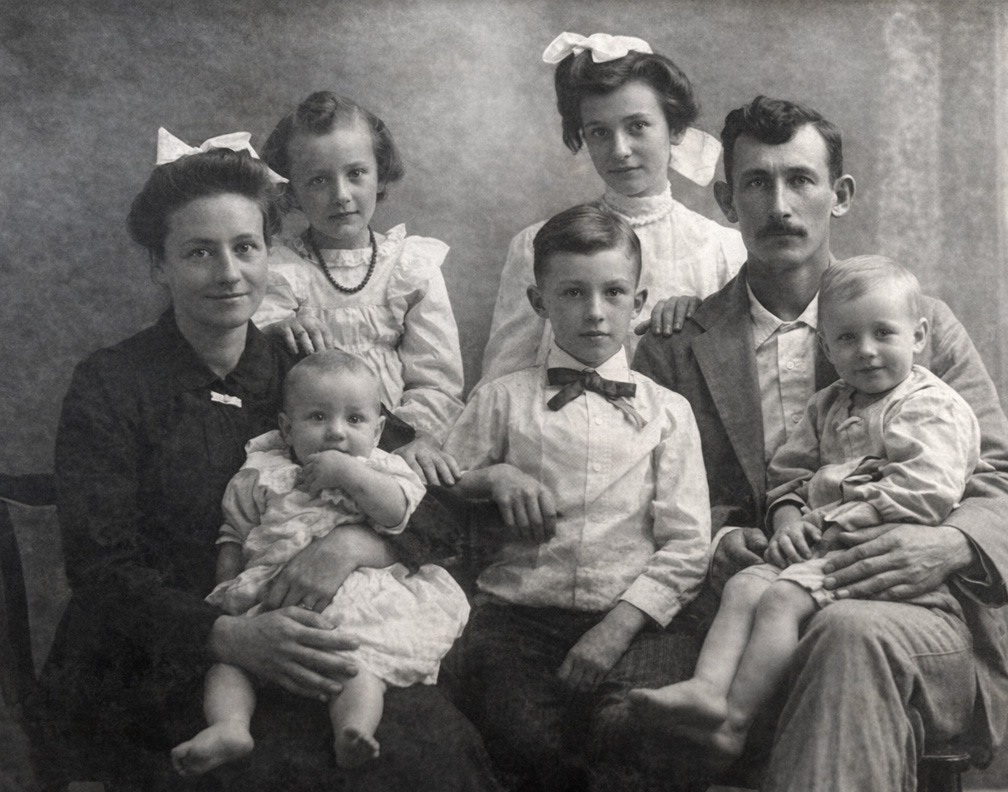
Preston and Mary Etta Cobb Brantley with their children Clara and Gladys (standing in back), Mary (held by Mary Etta), my great-grandfather Willie (middle) and Guy (held by Preston). Image enhance by AI.
His line appears to connect to me this way: Joseph S. Cobb (1588-1654) was the father of Nicholas Cobb (around 1630-1686) who was the father of Edward Cobb (1664-1731) who was the father of Henry Cobb (1700-1763) who was the father of John Charles Cobb (1750-1809) who was the father of John Hardy Cobb (1798-1880) who was the father of William Thomas “Tom” Cobb (1833-1898) who was the father of Mary Etta Cobb Brantley (1871-1935) who was the mother of Willie Day Brantley (1897-1969) who was the father of Virginia Brantley Lovelace (1917-2007) who was my maternal grandmother.
The one important caveat is that the Joseph-to-Nicholas link is not proven outright in a surviving document. However, researcher Joe H. Cobb and others considered it the most plausible conclusion that Nicholas was one of the unnamed children referenced in Joseph’s will, but it is also acknowledged that no known record says so directly.

This image is from a 1619 engraving, published by Johann Theodor de Bry as plate VII in Americae pars decima. It depicts the capture of Pocahontas by the English in Virginia. The Treasurer can be seen in the right of the image.
The connection alone would make Joseph interesting to me, but the ship that brought him over makes him even more so. The Treasurer was a 130-ton armed ship associated with Captain Samuel Argall (1580-1626). Argall’s 1612 voyage to Virginia on that ship was recorded as unusually fast for the time.
The Treasurer later became tied to one of the most famous episodes in early Virginia history: the 1613 seizure of Pocahontas (c. 1596-1617), who was lured aboard and taken captive as part of English efforts to pressure Powhatan. The ship was also used in military action against French settlements in Acadia. In other words, Joseph did not sail quietly into a sleepy colony. He arrived on a vessel already woven into the rough, opportunistic and often violent story of England’s early American foothold.
Joseph himself was part of that very early generation of colonists later known as “Ancient Planters,” those who came to Virginia before 1616, stayed at least three years and paid their own way. By the 1624/25 muster, he was listed at Elizabeth City, and later records place him on land east of the James River and then in what became Isle of Wight County. His wife, Elizabeth Flinton (unknown-1671), and sons Benjamin Cobb (unknown-unknown) and Joseph Cobb Jr. (unknown-1654) came later on the Bonnie Bess, which is another reminder that these family migrations often happened in stages rather than all at once.
A nod to his family as we remember all we have to be thankful for in 2010.


Leave a Reply