
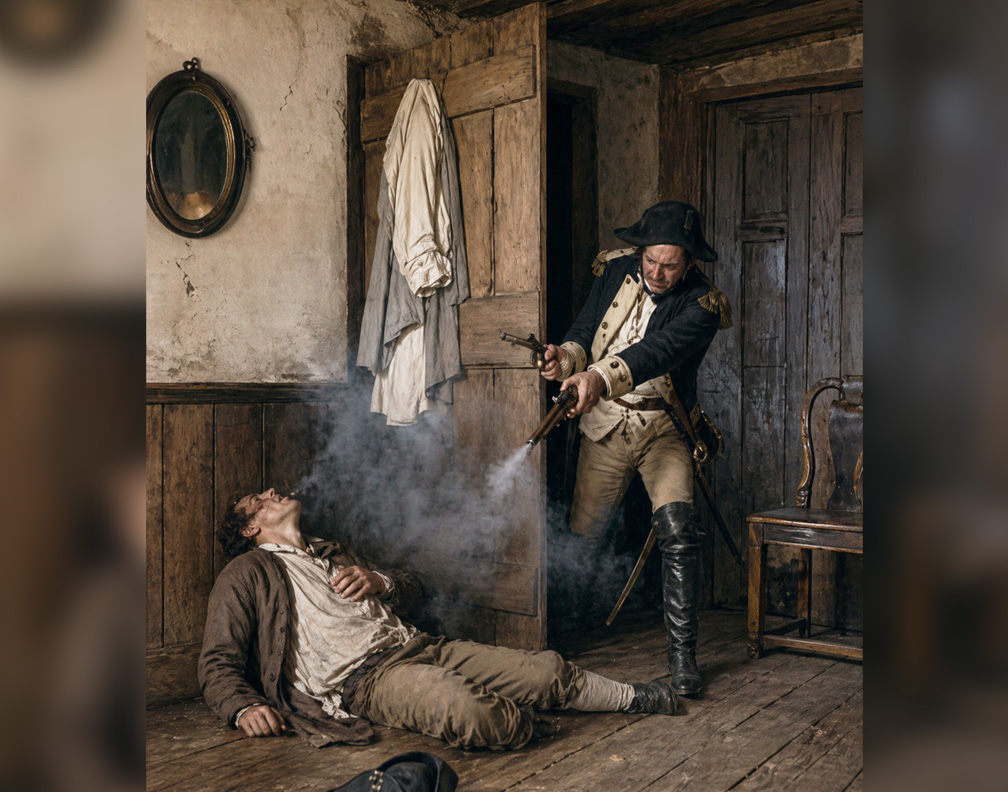
Image inspired by “Fanning’s Atrocity: Murder of an American Planter,” an undated black-and-white lithograph from Cassell’s History of the United States, published by Cassell, Petter & Galpin, c. 1900. Depicted is David Fanning’s March 1782 raid in Randolph County, North Carolina, and the shooting of Patriot officer John Bryan after Fanning ordered Bryan’s house set on fire.
In every family tree, there are people whose names survive even when most of the details of their lives have disappeared. Mary Kerr Dougan (1726-1824) is one of those ancestors for me. She was not a public official, a soldier or a person whose life was recorded in impressive biographies. Yet one violent episode during the American Revolution placed her in the written record and preserved a glimpse of the challenges of a Randolph County, North Carolina widow.
Mary was my fifth great-grandmother. My line runs from Mary Kerr Dougan and her husband, Thomas Hill Dougan (1719-1769), through their son the Rev. Robert Linn Dougan (1765-1837). Robert’s daughter, Eleanora Harriet Dougan (1818-1860), married Beverly M. Williamson (1813-1877), and they became my third great-grandparents. Their daughter, Janie E. Williamson (1887-1914), married William “Will” Williams (1888-1962), and they were the parents of my paternal grandfather, Jesse Lloyd “Bo” Williams (1910-2008). Through that line, Mary Kerr Dougan’s story becomes part of my own family’s history.
Mary’s husband, Thomas Hill Dougan, died before the end of the Revolutionary War, leaving her a widow in Randolph County, North Carolina. The Dougan family. Their sons served in the Revolutionary War, and the family found itself in the path of one of the most violent men in the backcountry, Loyalist leader David Fanning.
Fanning participated in many fights and skirmishes. In 1781, he captured the Governor of North Carolina, Thomas Burke, from the temporary capital at Hillsborough.
In March 1782, months after Cornwallis had surrendered at Yorktown, the war was still not over for families in Randolph County. Mary’s son, John Dougan (1763-1850), later recalled in his Revolutionary War pension application that Fanning and “40 or 50 Tories” came and “ravaged the Country, killed Lt. Col. Andrew Balfour and Capt. John Bryan in their own homes and burned my mother’s house and barn,” adding in parentheses, “she being a widow.” 1
In 1890, early historian J. A. Blair included Mary Dougan among the women of Randolph County whose courage deserved to be remembered. He wrote:
“The name of Mary Dougan, Elizabeth Balfour, Jane Millikan, Ruth Farlow, Nancy Clark, Mattie Bell and others, should be held in lasting veneration as the heroines of Randolph County in the struggle for liberty and life. It was these noble women and their compeers who moulded opinion and shaped the thought and sentiment that directed the march of progress.” 2
“The name of Mary Dougan, Elizabeth Balfour, Jane Millikan, Ruth Farlow, Nancy Clark, Mattie Bell and others, should be held in lasting veneration as the heroines of Randolph County in the struggle for liberty and life.” —J. A. Blair
Blair noted that history often recognizes men for public deeds, military action and political leadership, while giving too little credit to women who endured hardship, shaped opinion and helped sustain communities during difficult times.
The Dougan family’s connection to the Revolution did not end with Mary’s burned home. Her son John Dougan served in the North Carolina militia and later described a series of short but dangerous actions against Loyalist forces in the Randolph County area. 3 Another Dougan connected to this family line, James Dougan (1752-1832), also served in the Revolutionary War and is my ancestor who later moved to Tennessee. 4 These records place the family in the middle of the divided and often brutal conflict that marked the Revolution in the Carolinas.
As with any family line this far back, I am proceeding with caution. Some of these links are better documented than others, and I am continuing to look for records that prove each step.
Even with those cautions, Mary Kerr Dougan’s story is fascinating and a reminder that the war was lived not only by the men whose names appear on pension rolls, but also by women who tried to hold families together while the world around them came apart.
For those interested in “the rest of the story,” after the war, Fanning fled to Canada, where he was elected to the Legislative Assembly of New Brunswick from 1791 to 1801. After being convicted of rape in 1801, Fanning was expelled from New Brunswick, and settled in Nova Scotia, where he lived the remainder of his life.
More:
Revolutionary Randolph: Col. David Fanning and the War at Home
Video: Historian Ryan Beeson traces the rise of the notorious Tory partisan commander David Fanning and his exploits in Randolph County, North Carolina, and the surrounding area, in 1781-1782.
Footnotes
- John Dougan, Revolutionary War pension application W9836, Southern Campaigns Revolutionary War Pension Statements & Rosters, transcription by Will Graves, in which Dougan states that Fanning’s men “burned my mother’s house and barn,” identifying her as a widow. The pension transcription also states that John Dougan was born Jan. 9, 1763, in Lancaster County, Pennsylvania, and later lived in Randolph County, North Carolina. ↩︎
- J. A. Blair, Reminiscences of Randolph County (Greensboro, N.C.: Reece & Elam, 1890), 25. ↩︎
- John Dougan, Revolutionary War pension application W9836, Southern Campaigns Revolutionary War Pension Statements & Rosters. Dougan described service in Randolph County, including guard duty, actions against Loyalist forces and pursuit of Fanning’s men. ↩︎
- James Dougan, Revolutionary War pension application S3306, Southern Campaigns Revolutionary War Pension Statements & Rosters. ↩︎


Leave a Reply