
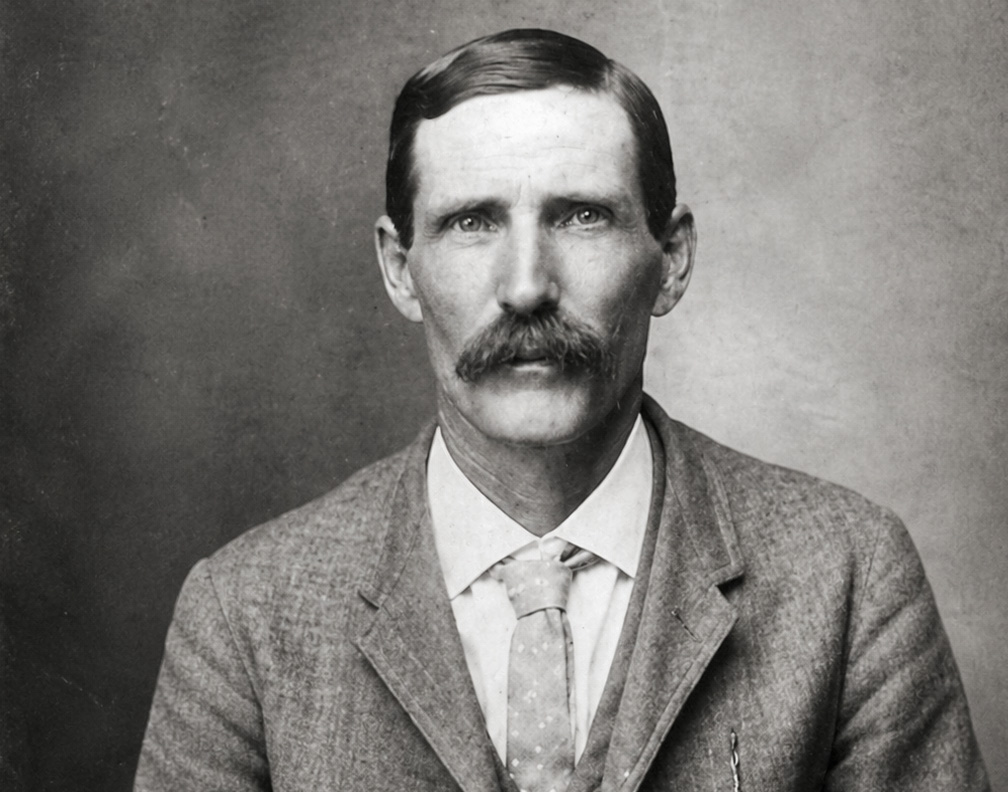
Photo: My third great-grandfather, Henry Day Brantley, (1845-1918)
The country is currently marking the 150th anniversary of the beginning of the The Civil War. A few nights ago, I was flipping through channels and stumbled across Ken Burns’ documentary “The Civil War” on PBS. It caught my attention because I recently discovered Solomon Norman Brantley’s Tennessee Civil War Veterans Questionnaire. He is my third great-uncle.
I have Civil War soldiers on several branches of my family tree. Some fought for the Confederacy, others the Union. Some died in battle or from disease, while others lived to share their experiences.
My third great-grandfather Henry Day Brantley (1845-1918) was too young to serve, but three of his brothers did, and they did not all fight on the same side. In that family, the phrase “brother against brother” was not just a figure of speech.
Daniel Brantley (1833-1864), Henry’s oldest brother, enlisted in the Union Army on Jan. 3, 1863. He served in Company G of the 52nd Indiana Infantry. Daniel died Sept. 7, 1864, and is buried in Alexandria National Cemetery in Louisiana, Section B, Site 1027. 1
Julius Brantley (1842-1863), another of Henry’s brothers, enlisted in the Confederate Army on July 10, 1863, about seven months after Daniel joined the Union Army. Julius served in the 12th Tennessee Cavalry, C.S.A. He died in service Dec. 18, 1863, at Fort Pillow, Tennessee. 2
Solomon Norman Brantley (1848-1927), another brother, enlisted in the Confederate Army at Brownsville on Oct. 1, 1863. He served in Company L of the 7th Tennessee Cavalry, which he referred to as “Forrest’s Command.” He was discharged at Gainesville, Alabama, in May 1865. 3
Solomon’s own words survive because he completed a Tennessee Civil War Veterans Questionnaire. We have Tennessee state archivist Dr. Gus Dyer to thank for those. In 1914, he sent questionnaires to known living Tennessee Civil War veterans. John Trotwood Moore later continued the project through the Tennessee Historical Commission and the Tennessee State Library and Archives. By 1922, 1,650 completed questionnaires had been returned. 4
Those questionnaires are useful, but they should be read carefully. Historian Fred Arthur Bailey has written that the questions themselves often reflected the assumptions and agendas of the men collecting the information. Many of the questions were designed to gather evidence about class, work, slavery, education and social life in Tennessee before the war. 5 Propeganda aside, they can be invaluable for those researching their geneaology.
Solomon completed his questionnaire when he was 75 and living on Route 2 in Halls, Tennessee. He wrote he was born in Haywood County. His father was Augustus Brantley (1811-1876), a farmer born in Bertie County, North Carolina. His mother was Martha Elizabeth White Brantley (1812-1851), the daughter of Solomon White and Barbara White, also of Bertie County.
Solomon said his father owned 320 acres and 5 enslaved people at the opening of the war. He valued his parents’ property at about $16,000. He described growing up in a four-room frame house with front and back porches. He also made it clear that he had worked on the farm himself. “I was an expert with a hoe,” he wrote. He remembered cutting wheat with a cradle, trampling it out with horses and cleaning it by hand with a fan.
The questionnaire gives a glimpse of how Solomon remembered his community before the war. He wrote farm work was considered honorable, that white men generally worked, that slaveholders and non-slaveholders mixed socially and that ambitious poor men were encouraged. Those answers are important, but they are also memories written nearly 60 years after the war by an elderly Confederate veteran responding to a questionnaire shaped by early 20th-century concerns about class and memory. 6
Solomon attended country schools in Haywood County, including Allen’s School and Spring Hill School. He wrote he left school at 16 to join the Confederate Army. After enlisting in Brownsville, his company was first sent to Oxford, Mississippi. About six months later, he saw his first major battle, which he called the Battle of Tishamingo Creek.

“Get the Bulge on Them,” by historical artist Rick Reeves, depicts Confederate Gen. Nathan Bedford Forrest leading his troops at the Battle of Brice’s Crossroads on June 10, 1864. Reeves is known for his detailed and historically accurate paintings of American military history, especially scenes from the Civil War.
The battle Solomon described is better known today as the Battle of Brice’s Cross Roads, fought June 10, 1864, near Baldwyn, Mississippi. Confederate Maj. Gen. Nathan Bedford Forrest’s smaller cavalry force defeated a larger Union force under Brig. Gen. Samuel D. Sturgis. The National Park Service lists estimated casualties at 3,103 total, with 2,610 Union casualties and 493 Confederate casualties. 7
Solomon’s account is vivid, if not always accurate in detail. He remembered Sturgis coming down from Memphis “to find Gen. Forrest and his men,” and wrote that when Sturgis found Forrest, “we went on them like a nest of hornets.” He described cannon balls and shells flying over the Confederate line “singing like bumble bees.” He also claimed that Forrest’s men chased the Union troops toward Ripley, Mississippi, capturing artillery, medical wagons, ambulances, forage wagons and prisoners.
One of the most revealing parts of Solomon’s account comes near the end. He wrote he was detailed to guard a captured Federal doctor who had a fine gold watch. Solomon wrote that he could have taken it, but did not, because he “never robbed a prisoner under no circumstances.” He closed the letter, “Sincerely yours in Peace.”
“Peace” was likely an intentional choice of words considering he had just been writing down his memories of war.
The Brantleys were not the only Civil War soldiers I have found in my family research.
Robert Deward “Bob” Williamson (1839-1903), a son of my third great-grandfather Beverly M. Williamson (1811-1877), served in Company F of the 31st Tennessee Infantry, known as the “Knights of the Forked Deer.” According to family history recorded by Martha Jones, Bob left for the war before he could marry Callie Stanfield (1844-1892). He and his friend William J. “Billy” Shaw were together when Bob was wounded and believed to be dying. Bob gave Billy the ring he had intended for Callie and asked him to take it home to her. When Billy finally returned, he found that Bob had survived and had already married Callie. Bob later ran a general store and post office near Providence Methodist Church in Madison County. 8
Benjamin W. Dougan (1836-1900) was likely the “B.W. Dougan” listed among the Knights of the Forked Deer. He was a nephew of my third great-grandparents Beverly M. Williamson and Eleanor Harriet Dougan Williamson (1812-1860). Through Eleanor, my Dougan line reaches back to Thomas Dougan, who came from Donegal, Ireland, and was in Paxtang, Pennsylvania, by 1731. 9

Josias “Joe” Chambers (1837-1907), another survivor of the Knights of the Forked Deer, returned to Madison County after the war and married Sarah Joyner (1845-1919). Sarah was the sister of Mary Elizabeth Joyner Williamson (1862-1898), my second great-grandmother. Josias’ twin brother, Francis Chambers (1837-1862), was killed at the Battle of Perryville in Kentucky on Oct. 8, 1862. The two brothers now share a headstone at Providence Methodist Church Cemetery.
James Williams Castellaw (1839-1918) also served in the Civil War in Company L of the 7th Tennessee Cavalry, C.S.A. He was a son of my third great-grandfather Thomas Jefferson “T.J.” Castellaw (1808-1878) and Marah Elisar Castellaw (unknown-1840), which makes him my half third great-uncle.
Thomas Jefferson “Tom” Castellaw Jr. (1841-1879), my second great-grandfather, also appears to have served in the same general cavalry command associated with Duckworth’s 7th Tennessee Cavalry. After the war, Tom married Nancy Miranda Johnson (1844-1921), my second great-grandmother.¹⁷
Charles Randall Johnson (about 1803-1864), Nancy’s father and my third great-grandfather, adds another layer to the story. Records connected to the Southern Claims Commission indicate that his estate later received payment for property taken or supplied to the U.S. Army. The commission was created to reimburse loyal Unionists in the South, which makes his story more complicated than a simple Confederate or Union label. He may have been both a slave owner and a Union sympathizer in Confederate West Tennessee.¹ 10 I need to research his story further.
More:
Solomon Norman Brantley’s Tennessee Civil War Questionnaire
The Battle of Brice’s Cross Roads, Warefare History Network, August 2008
Footnotes
- U.S. Department of Veterans Affairs, Nationwide Gravesite Locator, entry for Daniel Brantley, Alexandria National Cemetery, Pineville, Louisiana; National Park Service, Civil War Soldiers and Sailors System, entry for Daniel Brantley, Company G, 52nd Indiana Infantry. ↩︎
- Waldon Loving, Coming Like Hell! The Story of the 12th Tennessee Cavalry, Richardson’s Brigade, Forrest’s Cavalry Corps, Confederate States Army, 1862-1865 (n.p.: n.p., 1995); National Park Service, Civil War Soldiers and Sailors System, entry for Julius Brantley. ↩︎
- Solomon Norman Brantley, Tennessee Civil War Veterans Questionnaire, 1922, Record Group 55, Tennessee Civil War Veterans Questionnaires, Tennessee State Library and Archives, Nashville. ↩︎
- Tennessee State Library and Archives, “Tennessee Civil War Veterans’ Questionnaires,” Tennessee Secretary of State, accessed March 29, 2011, https://sos.tn.gov/tsla/guides/tennessee-civil-war-veterans-questionnaires. ↩︎
- Fred Arthur Bailey, Class and Tennessee’s Confederate Generation (Chapel Hill: University of North Carolina Press, 1987). ↩︎
- Bailey, Class and Tennessee’s Confederate Generation; Brantley, Tennessee Civil War Veterans Questionnaire. ↩︎
- National Park Service, “Battle Detail: Brices Cross Roads,” The Civil War, accessed March 29, 2011, https://www.nps.gov/civilwar/search-battles-detail.htm?battleCode=ms014. ↩︎
- Martha Jones, A Journey Into Yesteryears (publication information not yet confirmed); National Park Service, Civil War Soldiers and Sailors System, entry for Robert D. Williamson, 31st Tennessee Infantry. ↩︎
- National Park Service, Civil War Soldiers and Sailors System, entry for B.W. Dougan, 31st Tennessee Infantry; 1850 U.S. census, Haywood County, Tennessee, population schedule, Dougan and Williamson households. ↩︎
- Southern Claims Commission, approved claims and barred/disallowed case files, claim of the estate of Charles Randall Johnson, Tennessee; “Southern Claims Commission,” National Archives, accessed March 28, 2011. https://www.archives.gov/research/military/civil-war/southern-claims-commission. ↩︎


Leave a Reply