
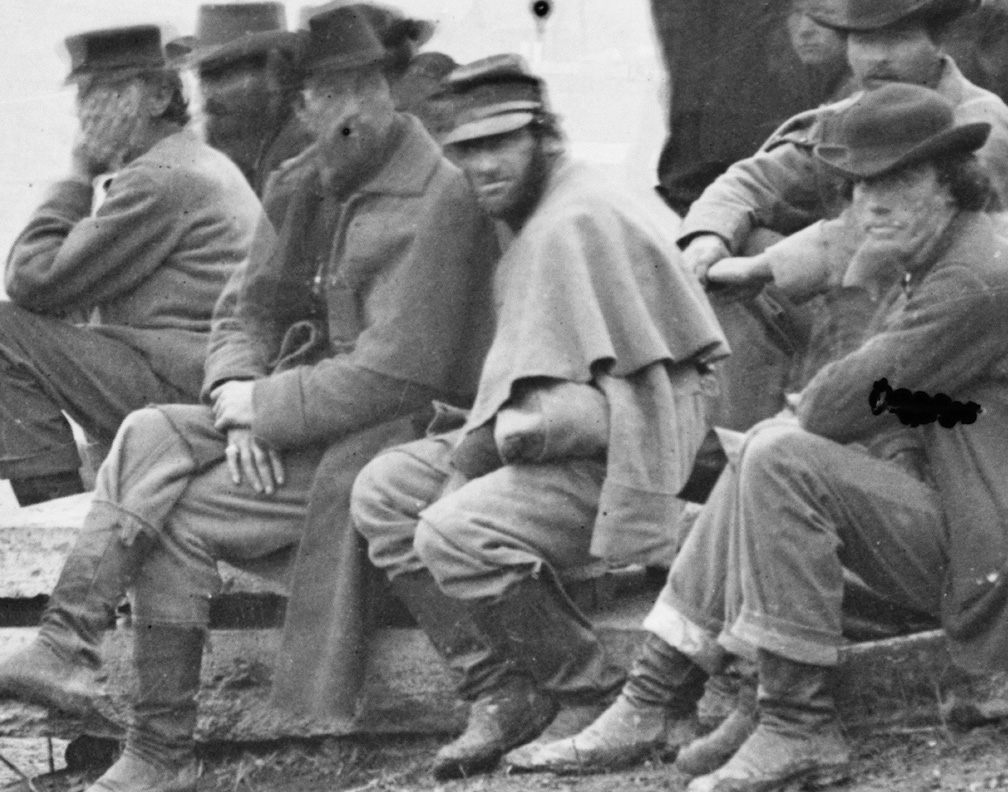
Photo: Soldiers and spectators watching the Battle of Nashville between the forces of Confederate Gen. John Bell Hood and Union Maj. Gen. George H. Thomas, Nashville, Tennessee, Dec. 15, 1864. Photograph attributed to J.F. Coonley. Library of Congress, Prints and Photographs Division, Civil War Glass Negatives and Related Prints Collection.
The Tennessee Civil War Veterans Questionnaires
The Tennessee Civil War Veterans Questionnaires were created to preserve the memories of men who had lived through the war and its aftermath. The effort began in 1914, when Dr. Gus Dyer, Tennessee state archivist, developed a questionnaire and sent it to known living Tennessee Civil War veterans, asking them to complete the form and return it to Nashville. In 1920, the project was continued by John Trotwood Moore of the Tennessee Historical Commission, who also served as state librarian and archivist. By 1922, about 1,650 completed questionnaires had been returned.
The completed forms are now preserved at the Tennessee State Library and Archives and have been microfilmed as Microfilm No. 484.
About Solomon Norman Brantley
Solomon Norman Brantley (1847-1927) was my third great-granduncle, the younger brother of my third great-grandfather, Henry Day Brantley (1845-1918). He was born in Haywood County, Tennessee, the son of Augustus Brantley (1811-1876) and Martha Elizabeth White Brantley (1812-1851). His father had moved from Bertie County, North Carolina, to Haywood County around 1833, joining a group of families who came west from Capeharts Baptist Church. They settled in the area of present-day Zion Baptist Church and Holly Grove Baptist Church in Brownsville.
Brantley’s survey answers give a rare firsthand glimpse into farm life in Haywood County before the Civil War. As a boy, Solomon said he did “general farm work” and described himself as “an expert with a hoe.” He remembered cutting wheat with a cradle, trampling it out with horses and cleaning it by hand with a fan. He attended country schools in Haywood County, including Allen’s School and Spring Hill School, and said he left school at 16 to join the Confederate Army.
After the war, Solomon married Nancy A. Abernathy Brantley. Their children included Augustus L. Brantley (1869-unknown), Alsia Brantley (1871-unknown), Emmett Aaron Brantley (1878-1960), an infant Brantley (1881-unknown), William L. Brantley (1885-unknown), Emma Clay Brantley (unknown) and Raymond Brantley (unknown). By 1910, Solomon and Nancy were living in District 7 of Lauderdale County, Tennessee, with their daughter Emma Clay Brantley still at home.

Solomon Norman Brantley died Feb. 12, 1927, in Lauderdale County, Tennessee, at age 80. He was buried at Dry Hill Cemetery in Lauderdale County next to his wife who had died seven years earlier.

Solomon’s questionnaire is valuable not because every memory in it is perfectly accurate, but because it preserves the voice of a Haywood County farm boy during an era where first-hand accounts are rare.
Solomon Normon Brantley’s Tennessee Civil War Questionnaire
1.) State your full name and present post office address. Solomon Norman Brantley, Halls, Tenn. Route 2
2.) State your age now: 75 years old
3.) In what State and County were you born? Haywood County, TN
4.) Were you a Confederate or Federal soldier? Confederate Soldier
5.) Name of your Company? Company L. 7th Reg. Forrests Command
6.) What was the occupation of your father? Farmer
7.) Give the full name of your father: Augustus Brantley, born at Bertie co. North Carolina
8.) Maiden name in full of your mother: Martha Elizabeth White; She was the daughter of Solomon White and Barbra White; who lived at: Bertie North Carolina
9.) Question about ancestry was left blank
10.) Did you own land or other property at the opening of the war? None
11.) Did you or your parents own slaves? If so, how many? My father owned 5 slaves
12.) If your parents owned land, state about how many acres: 320 acres
13.) State as near as you can the value of all the property owned by your parents when the war opened: About $16,000 dollars
14.) What kind of house did your parents occupy? Frame house, 4 rooms 2 walls front and back porch
15.) As a boy and young man, state what kind of work you did. If you worked on a farm, state to what extent you plowed, worked with a hoe and did other kinds of similar work. (Certain historians claim that white men would not do this sort of work before the war.) General farm work. I was an expert with a hoe. We cut wheat with a cradle. Tramped it out with horses and cleaned same with a fan by hand.
16.) State clearly what kind of work your father did and what the duties of your mother were: My father run the farm. My mother run the house and was Boss over the negro women who done the cooking, spinning and weaving.
17.) Did your parents keep servants? If so how many? 5
18.) How was honest toil – as plowing, hauling and other sorts of honest work in this class – regarded in your community? Was such work considered respectable and honorable? It was considered honorable.
19.) Did the white men in your community generally engage in such work? Yes Sir
20.) To what extent were there white men in your community leading lives of idleness and having others do their work for them? None that I know of.
21.) Did the men who owned slaves mingle freely with those who did not own slaves? We all associated with one another
22.) At the churches, at the schools, at public gatherings did the slaveholders and non-slaveholders mingle on a footing of equality? Yes Sir
23.) What were the feelings between slave holders and non slaveholders in your community? All friendly
24.) In a political contest would the fact that a candidate owned slaves help in winning the contest? No
25.) Were the opportunities good in your community for a poor man, honest and industrious, to save up enough to buy a farm or go into business for himself? Yes Sir
26.) Were poor, honest, industrious, young men who were ambitious to make something of themselves encouraged or discouraged by slaveholders? Encouraged
27.) What kind of school did you attend? Country School
28.) About how long did you go to school? I quit school at the age of 16 yrs. And enlisted in the Confederate army
29.) How far was it to the nearest school? About 2 miles
30.) What schools were in operation in your neighborhood? Allen’s school and Spring Hill School, both in Haywood co., Tenn
31.) Was the school in your community private or public? Private
32.) How many months in the year did it run? Six months in year.
33.) Did boys and girls in your community attend school pretty regularly? Yes Sir
34.) Was the teacher in the school you attended a man or a woman? Man
35.) In what year and month and at what place did you enlist in the service of the Confederacy or of the Federal Government? Brownsville, Tenn. Oct. the 1st 1863
36.) After enlistment, where was your company sent first? Oxford, Miss.
37.) How long after enlistment before your company engaged in battle? About 6 months
38.) What was the first battle you engaged in? Tishamingo Creek, Miss
39.) State in your own way your experience in the War from this time on to its close: Our adjustment General Pope was killed in this battle at Tishamingo Creek. His home was in Memphis, Tenn. I was standing near him when he was killed. We had a fine time in general camp. We had a battle at Harrisburg, Miss.
40.) When and where were you discharged? Gainsville, Alabama, May 1865
41.) Tell something of your trip home: Had a jolly good time wasent scared at all. Dident have to do picket duty or shoot at Yankees.
42.) Give a sketch of your life since the Civil War: Building up what the Yankees tore down on my father’s farm.
43.) What kind of work did you take up when you came back home? Farming – Have lived in Tenn. All my life. I am a member of the Baptist Church.
44.) Give names of some of the great men you have known in your time: Blank
45.) Give the names of all the members of your Company you can remember: Gen. N. B. Forrest, Col. Bill Duckworth and Capt. Aleck Duckworth (brothers); Lt. Chas. Tollivar, and Lt. Will Pugh, 3rd Lt. Will Weatherspoon; Privates: John Herring, J.H. White, R.D. White, T. Sutton, A. Rainey. T. Owens, W. Lynn, Tom Cobb, Sim Cobb, John Thomas, Albert Thomas, Running Trailor, Sam Taylor, Jim Hopkins, Sam Grover, Dick Grover, Dick Hotchkiss, Luther Coleman, Tom Nelson, Joe Clay, Hugh Branch, Ben Hughes, Bill Hughes, Bill Powell. This is about all the Old Boys I can remember just not but I want to say that Forrests Command was a fighting Piece of Machinery as you will find out in the letter I am going to write you when Gen. Sturgess and his Co. of Negroes came out from Memphis to capture Forrest and his men.
46.) Give the name and post office address of any living Veterans of the Civil War: J.W. Dunnivant, Mr. Goins, Billie Duttan. (more names are listed)
(Following are extra pages written by Mr. Brantley)
I will relate to you the battle of Tishamingo Creek, Miss. May 15 1864 as I saw it. Gen. Sturgess with 8,000 men black and white came doen from Memphis, Tenn. to find Gen. Forrest and his men and when Sturgess found Forrest and got him stirred up we went on them like a nest of hornets. Forrest had 3000 men. Sturgess and his men had formed a line on top of a hill in the woods. Forrests men when given orders to charge had to cross a field in open view of the enemy and we kept going and the enemy was so excited that they was shooting too high and cannon balls and bombs was flying over our heads singing like bumble bees. In the midst of the battle Gen. Forrest with 60 men flanked Gen. Sturgess on the left wing scattering his company of negroes to the fore winds of the earth. And that is when we had some fun. We captured all of the artillery medical wagons and ambulance and forage wagons. We run them all the way from the field of battle to Ripley, Miss. A distance of 60 miles. We capture white prisoners all along but no negro prisoners were taken. The negroes throwed down their guns and then their coats and last of all their shoes and run back towards Memphis much faster than when they come out to meet us and I venture to say that if any of those negroes are living today they will tell you that they didn’t even have time to start a crap game in Miss. This battle was fought about 4 hours before we got the enemy stamples. Our losses in battle were very light while the enemy lost very near everything with a heavy loss of life. I should say about 5000 Yankees were killed and a few prisoners taken. I was detailed to guard a Federal doctor that we captured, but have forgotten his name. I know he had a very fine gold watch which I could have taken but wouldn’t do it and if he is living I would like for him to write me. As I know he recollects the incident that happened to him later on. I never robbed a prisoner under no circumstances as I never thought it was right. Hoping this may be of some benefit to you in the near future, I beg to remain, Sincerely yours in Peace, S.N. Brantley, Halls, Tenn. Rt. 2 P.S. Please publish this letter in the Lauderdale Co, Enterprise at Ripley, Tenn.


Leave a Reply