
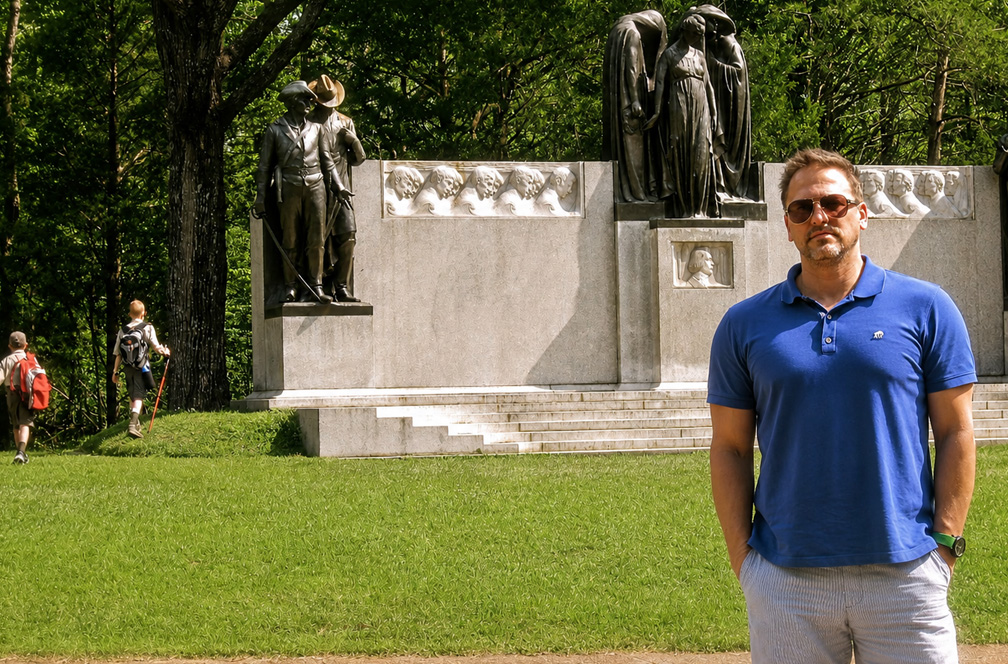
Last Sunday, my family and I took a slight detour on our way home to Memphis from Middle Tennessee and visited Shiloh National Military Park.
I already knew the park had several special events planned because the 150th anniversary of the battle fell later that week. I did not, however, plan well enough to get there in time for the reenactment, which means I still cannot cross “attend a Civil War reenactment” off my list.
The Battle of Shiloh took place April 6 and 7, 1862, near Pittsburg Landing on the Tennessee River. The battle took its name from Shiloh Church, a small log meetinghouse near the center of the fighting. That detail will probably be on the test.
Ulysses S. Grant (1822-1885) had moved a Union army deep into Tennessee and camped near Pittsburg Landing. Confederate forces under Albert Sidney Johnston (1803-1862) and P.G.T. Beauregard (1818-1893) launched a surprise attack on April 6. The Confederates drove the Union army back during the first day, but Grant counterattacked the next morning after reinforcements arrived. By the end of April 7, Beauregard withdrew toward Corinth, Mississippi.
Shiloh shocked both sides. The two armies suffered roughly 23,000 to 23,800 casualties, including those killed, wounded, captured or missing. The battle gave Americans a brutal preview of how long and bloody the Civil War would become.
Before our visit, I knew the basic outline of the battle, but I did not know the ground. That changed quickly. Shiloh does not feel like a small historic site with a few markers scattered around a field. It feels vast. The National Park Service now preserves more than 5,200 acres at Shiloh, including the battlefield, Shiloh National Cemetery and other historic sites connected to the campaign.

Because we made a last-minute stop, we missed the main reenactment. I felt pretty bummed about that, but we did see a few of the soldiers dusting off, packing up and loading out. We also had time to visit several monuments, the cemetery and a few of the places where the fighting changed the course of the battle.
One place that especially interested me stood inside what now forms part of Shiloh National Cemetery. A monument marks the spot where Grant spent the rainy night after the first day of battle. In his memoirs, Grant wrote, “During the night, rain fell in torrents and our troops were exposed without shelter. I made my headquarters under a tree a few hundred yards back from the river bank.” According to the marker, a cyclone destroyed that oak tree in 1909.
Something about standing in the spot where Grant spent that night makes history feel less like a chapter in a textbook and more like something that happened to real people in real weather, on real ground, under real fear.
We also stopped at the Confederate Memorial, one of the most striking monuments in the park. The memorial stands more than 18 feet high and represents what its designers called “defeated victory.” The central figure surrenders the wreath of victory to Death and Night, symbolizing the death of Johnston and the arrival of Union reinforcements after dark.
Throughout the battlefield, monuments rise out of open fields and quiet woods. They sit in places where men fought, fell, regrouped and tried to make sense of chaos. The contrast between the beauty of the landscape and the violence that happened there makes the place feel even more powerful.
I also checked HaywoodCountyLine.com to see whether I had already written about any family connection to Shiloh. I did not find proof that one of my direct ancestors fought in the battle. I did find one possible family connection worth more research: William Sherrod, who appears in my Sherrod family research, reportedly served in the 6th Tennessee Division during the Civil War and lost a finger at Shiloh. I also found James Edward Sumner, who lived with my Yelverton ancestors in Haywood County in 1860 and later served in the 14th Tennessee Cavalry before his capture in 1863. That gives me at least two leads to follow before I say for certain whether someone in my family stood on that battlefield in April 1862.
We ran out of time before we could explore even a small part of Shiloh. I am a sucker for a good monument, and Shiloh has plenty of them. More importantly, it has the kind of landscape that forces you to slow down and imagine what happened there.
We will have to go back. Hopefully, we will make it before the 200th anniversary.


Leave a Reply