
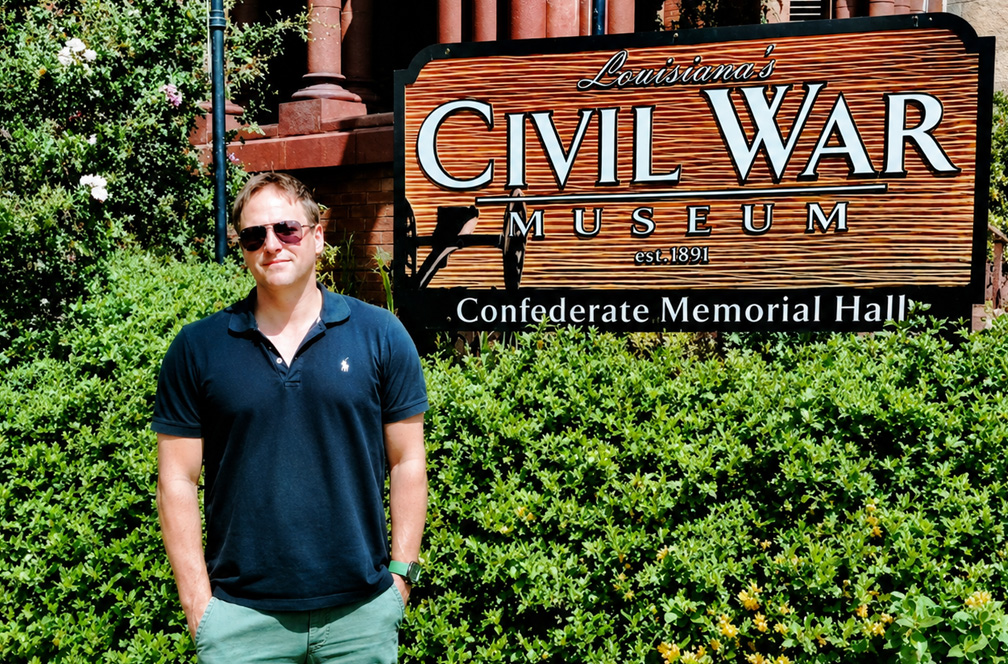
We were just in New Orleans and had a few hours before our train left for Memphis, so my wife and I checked out Louisiana’s Civil War Museum and the Robert E. Lee Monument.
Having just visited Shiloh a week earlier, we are now one step away from throwing on period clothes and reenacting.
Robert E. Lee Monument
Our first stop was the Robert E. Lee Monument, which stood next to the museum in the center of Lee Circle near the Pontchartrain Expressway at the end of St. Charles Avenue. The city dedicated the monument on Feb. 22, 1884, Washington’s birthday, 19 years after the end of the Civil War. Architect John Roy designed the column using Tennessee marble, and sculptor Alexander Doyle created the statue of Lee.
According to information I found at the time, the monument stood 60 feet tall, and Lee’s statue measured 16 1/2 feet tall.
Four staircases led up to the monument, and at the base of each staircase sat a boulder on what looked like an old warehouse skid. Each boulder held a different capital letter. The whole thing looked a little like modern art and seemed out of place. We puzzled over the “E,” then moved immediately north to the next staircase and found an “N.” Had we walked all the way around, I am fairly certain we would have found the other letters marking north, south, east and west.
The Robert E. Lee Monument was not just a neutral memorial to the past. New Orleans dedicated it in 1884, only a few years after Reconstruction ended and during a period when white Southerners were building monuments, rewriting the meaning of the Civil War and reasserting political and social control over Black citizens. Whatever artistic or historical interest the monument had, it also stood as part of the Lost Cause version of history, which romanticized the Confederacy and ignored the central role of slavery.
Louisiana’s Civil War Museum
Next, we visited Louisiana’s Civil War Museum. The museum sits just nine blocks from the French Quarter. The building looks old and a little churchy, especially since it sits across the street from the much more modern National WWII Museum and next to the Ogden Museum of Southern Art. We have now added both of those to our bucket list because we only had time for one stop.
We picked up an information sheet at the front desk that explained that the museum, also known as Confederate Memorial Hall, opened on Jan. 8, 1891, making it the oldest operating museum in Louisiana. Frank T. Howard donated the building in memory of his father, Charles T. Howard.
History of Confederate Hall
My wife struck up a conversation with the gentleman behind the counter. When he heard we were from Tennessee, he told us he had just come from Shiloh the weekend before. Of course, we had to tell him we had been there too.
Louisiana residents donated many of the items in the museum’s collection. Varina Banks Howell Davis, the widow of Jefferson Davis, donated a large group of Davis artifacts. On May 29, 1893, more than 60,000 people reportedly visited Memorial Hall to pay their last respects to Davis before his remains went to Richmond, Virginia, for reburial.
The exhibits include uniforms, guns, bullets, shells, swords, paintings, letters, photographs and personal items connected to those who fought in the war.
A couple of things jumped out at me during my very hurried visit.

Always looking for fellow Tennesseans, I was happy to see William Crumm Darrah “Billy” Vaught looking down at me from a hallway in the museum.
Vaught was born in Tennessee but later moved to New Orleans, where he became a clerk for the Washington Artillery. He served as a second lieutenant in battles at Shiloh, Corinth and Farmington and commanded troops in several other battles. A nearby shell explosion injured him and damaged his hearing for the rest of his life—which was not long. He surrendered with the rest of his company at Meridian, Mississippi, on May 10, 1865.
William Crumm Darrah “Billy” Vaught of Tennessee

Vaught drowned on Aug. 21, 1870, in Natchez, Mississippi. His saber and spurs were also on display in the museum.
P.G.T. Beauregard
Having just blogged about P.G.T. Beauregard and his surprise attack on Grant at Shiloh, I enjoyed seeing personal items that belonged to the Louisiana-born military officer.
After the war, Beauregard resisted asking for amnesty as a former Confederate officer, but Robert E. Lee and Joseph E. Johnston encouraged him to take the oath of loyalty. He did so before the mayor of New Orleans on Sept. 16, 1865. President Andrew Johnson included Beauregard in a mass pardon of former Confederates on July 4, 1868. Congress later restored his right to hold public office, and President Ulysses S. Grant signed the bill on July 24, 1876.
Beauregard remained involved in public service until his death in 1893. He was interred in the Army of Tennessee vault in historic Metairie Cemetery in New Orleans.
Those are just two examples of the hundreds of stories represented by the artifacts on display.
I have always been drawn to Civil War and Southern history, but that interest does not require me to romanticize the Confederacy or ignore what caused the war. I can appreciate old photographs, battlefield landscapes, family stories, uniforms, monuments and documents while still recognizing that slavery was a brutal system that destroyed families, denied human freedom and shaped nearly every part of Southern life before the war. I can also stand on a battlefield and feel the pull of history while remembering that hundreds of thousands of Americans died because the nation could not peacefully resolve the moral catastrophe of slavery. For me, studying this history does not mean celebrating it. It means trying to understand the people, places, choices and consequences that shaped the world my ancestors lived in and the country we inherited.
For more of my genealogy research, visit rscottwilliams.info.
| Update: Since I first wrote this, New Orleans has removed the Robert E. Lee statue from the top of the monument. After years of debate and legal challenges, city crews took the statue down on May 19, 2017, along with other Confederate monuments the city no longer wanted to honor in public space. The decision acknowledged what those monuments represented: not simply Civil War memory, but the Lost Cause version of that history and the white supremacist politics that shaped public memory after Reconstruction. The statue went into storage, the column remained empty and, in 2022, the park inside the former Lee Circle was renamed Harmony Circle. In my opinion, the change does not erase Lee or the Civil War from history. It changes who the city chooses to celebrate from one of its most visible public spaces. |


Leave a Reply