
I have long been fascinated by the years immediately following the Civil War and how they affected the lives of my West Tennessee ancestors.
In just a few days, April 9, 2015 will mark 150 years since Confederate Gen. Robert E. Lee surrendered the Army of Northern Virginia to Union Lt. Gen. Ulysses S. Grant at Appomattox Court House, Virginia. Although other Confederate forces remained in the field, Lee’s surrender became the defining symbol of the war’s end.
As the nation commemorates the final months of the Civil War and the approaching 150th anniversary of Abraham Lincoln’s assassination, much has been written about the conflict, the horrors of slavery and the events surrounding Lincoln’s death.

“President Lincoln Is Dead: The New York Herald Reports the Assassination” is open now through Jan. 10, 2016.
The museum where I get to work every day, the Newseum, is marking the anniversary with an extraordinary exhibition that features an unparalleled collection of all seven editions issued by the Herald on April 15, 1865, chronicling the shooting of the president at Ford’s Theatre, his death, the hunt for his assassin and the swearing-in of the new president.

Displayed together for the first time since 1865, the collection begins with the 2 a.m. edition, which contained the first Associated Press report that Lincoln had been shot. The exhibit also includes a recently discovered 8:45 a.m. “extra” that was one of the first newspapers to report the president’s death.
If you get to DC before Jan. 10, 2016, you really need to see it.
Slavery, the Civil War and the aftermath also has direct implications for my own genealogy. In researching my four primary family lines — Williams, Lovelace, Castellaw and Brantley — I have found that members of all four families migrated from Bertie County, North Carolina, to Haywood County, Tennessee, during the early 1830s. Some of them brought enslaved people with them and relied on their forced labor to establish farms on land the United States had acquired from the Chickasaw Nation in 1818.
By the outbreak of the Civil War, members of all four families remained neighbors, farming the same area with enslaved labor.
Because the details of these family lines are available now on my blog, I have even been contacted a couple of times by people who are likely descended from individuals my ancestors enslaved.
Knowing that my family had such close ties to such a horrible institution frequently makes me wonder what my ancestors were thinking at the time.

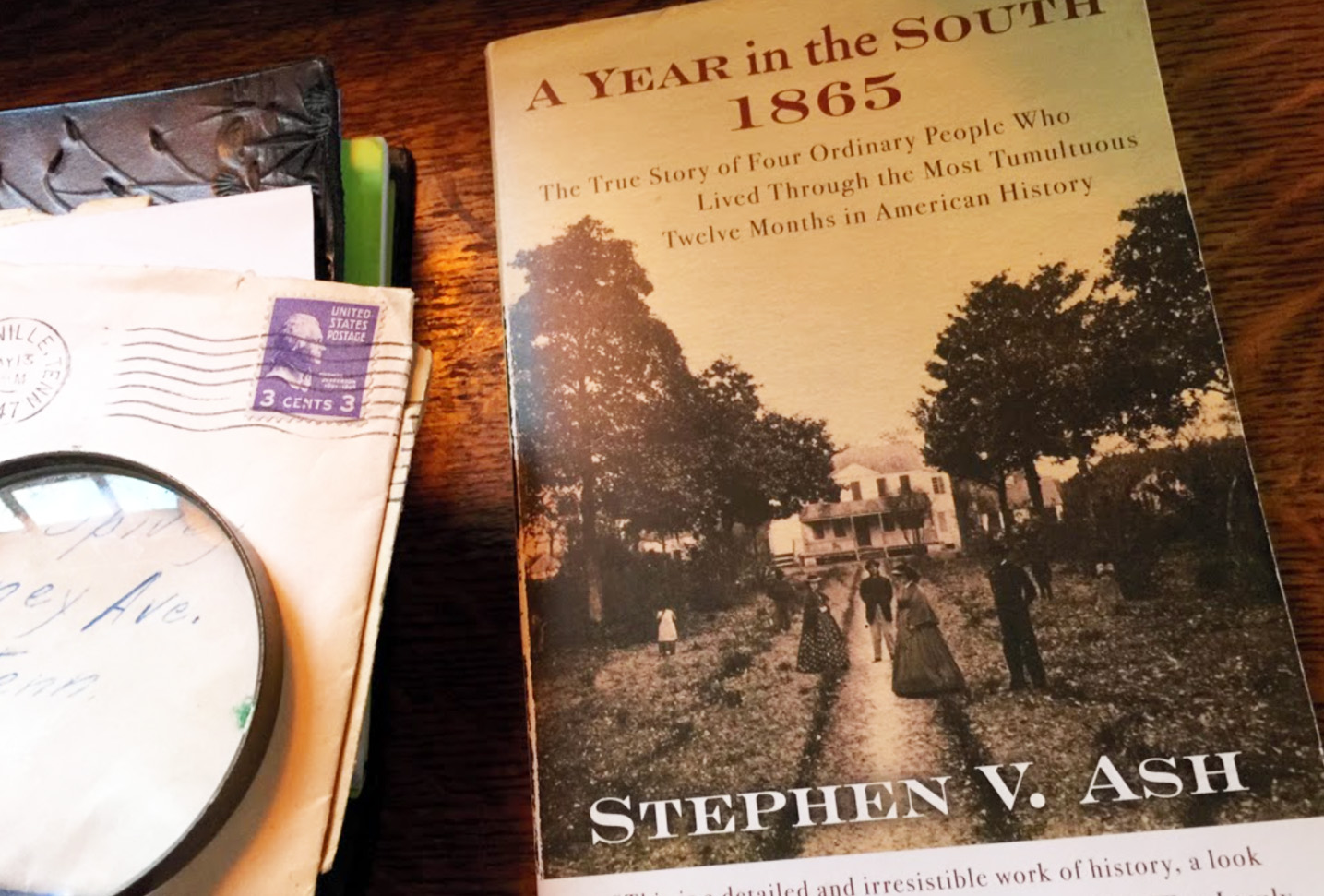
During a recent 15-hour flight to China, I finally had time to read a book that had been on my list for quite a while: “A Year in the South, 1865: The True Story of Four Ordinary People Who Lived Through the Most Tumultuous Twelve Months in American History.”
Written by Stephen V. Ash, a professor emeritus of history at the University of Tennessee, the work was first published in 2002 as “A Year in the South: Four Lives in 1865.” The paperback edition I read was published in 2004 under the longer title.
I purchased the book based on the title alone, so I was pleasantly surprised to discover that it included considerable material about West Tennessee and the surrounding region.
The four “ordinary people” referenced in the title left behind detailed first-person accounts that Ash used to examine how slavery, emancipation and the war transformed their lives.
The book follows Cornelia McDonald, a once-prosperous Confederate widow reduced to extreme poverty as she struggles to care for her seven children; Louis Hughes, an enslaved man who learned to read, pursued several business ventures and repeatedly risked his life seeking freedom; Samuel Agnew, a Mississippi minister and planter wrestling with questions of faith and a collapsing social order; and John Robertson, a former Confederate soldier trying to build a new life in a rapidly changing world.

Memphis riverfront during the Civil War, as depicted in Harper’s Weekly, July 5, 1862 From “A Year in the South, 1865.”
Especially relevant to my interests were the book’s frequent references to my hometown of Memphis.
One passage takes place shortly after the war. Hughes escaped from the Mississippi plantation where he and his family continued to be held in slavery and made his way to Union-occupied Memphis. Once there, he sought help returning for his wife, Matilda, and others who were still being held against their will.
“It was almost sunset when the car pulled into Memphis. Lou looked around in wonder. The city had grown and changed so much in the three years since he had left that it was hardly recognizable. Black people were everywhere, for the city had become a mecca for fugitives from the plantations of northern Mississippi, western Tennessee, and eastern Arkansas. Lou saw some he knew, earlier escapees from Panola or Bolivar. Like him, they were slaves no longer. … Memphis has drawn not only hordes of blacks but also white refugees in great numbers, not to mention Yankee soldiers and citizens. The city was now home to 40,000 people, maybe 60,000 — nobody knew for sure.”1
Hughes eventually returned to Mississippi with two Union soldiers. He rescued his wife and helped several other enslaved people escape to Memphis.
The book is divided into seasons and offers insight into the lives of its subjects before, during and after the Civil War.
The oppression and cruelty they endure, and, in some cases, attempt to justify, remain unmistakable. However, Ash also reveals glimpses of hope, compassion and the seeds of the significant cultural changes that were beginning to take root.
If you are interested in the varied Southern experiences of the Civil War, emancipation and the beginning of Reconstruction, I highly recommend adding this book to your collection.
- Stephen V. Ash, A Year in the South, 1865: The True Story of Four Ordinary People Who Lived Through the Most Tumultuous Twelve Months in American History (New York: Harper Perennial, 2004), 130. ↩︎


Leave a Reply