
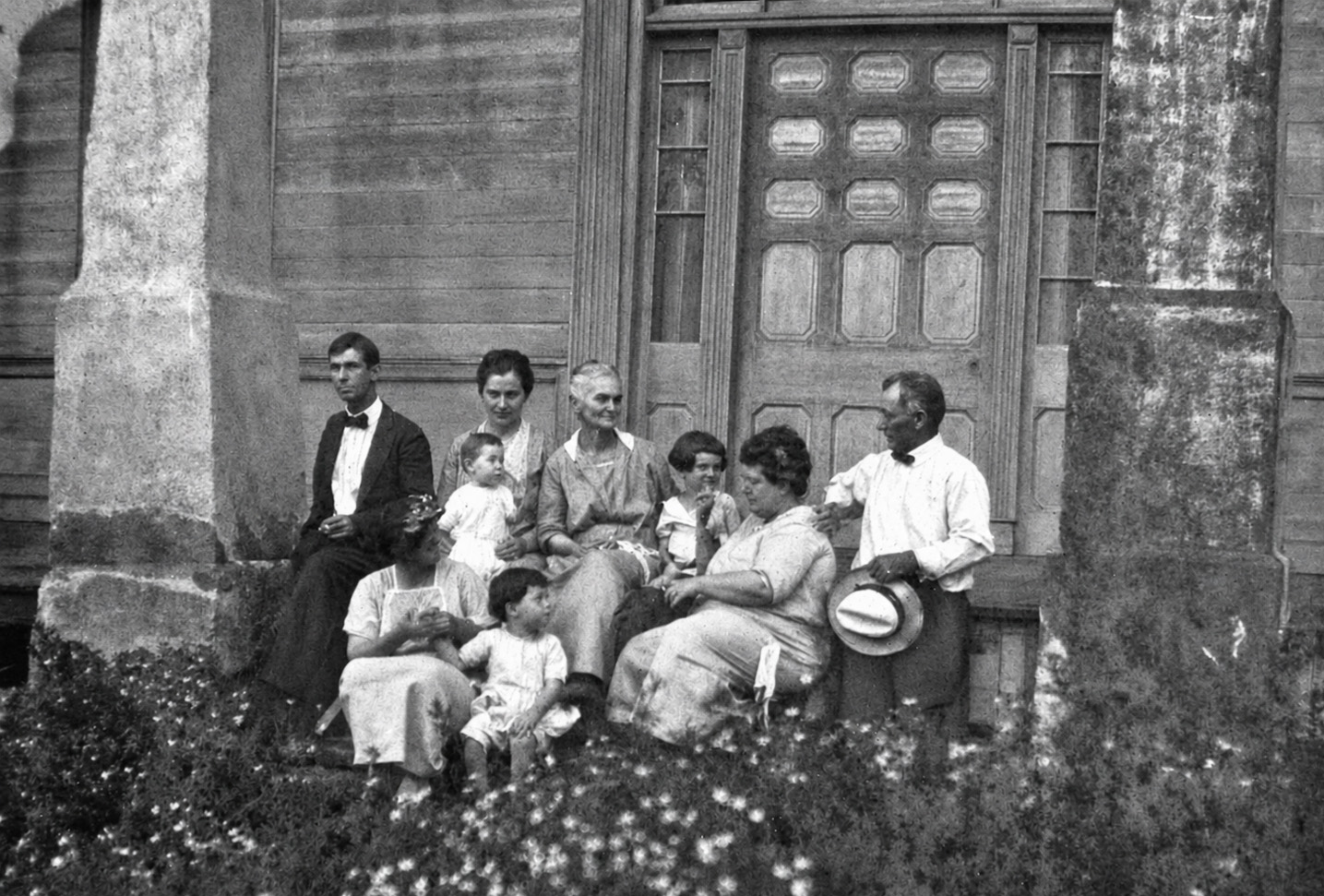
Photo: Descendants of Hiram Bradford. Back row, from left: Charles Wesley Anderson Jr.; his sister, Marion Bradford Anderson Glass, wife of T. Hugh Glass; their mother, Iowa “Ivy” Scott Bradford Anderson, wife of Charles Wesley Anderson Sr.; and possibly Laura and Alsey. Middle row: Ann Bradford Glass Gaffron, wife of Winston B. Gaffron Sr., and Grace Anderson Rogers, wife of Edward Rogers and daughter of Charles Wesley Anderson Jr. Front row: Grace Anderson, wife of Charles Wesley Anderson Jr., and their son, Charles Wesley Anderson III. Iowa was the daughter of George Washington Bradford, who was killed in fighting at Fort Pillow, and Marion Emily Bradford.
I love it when technology allows complete strangers to work together to solve mysteries involving people who died generations ago.
I recently wrote about the photo above, which was apparently taken in September 1924 at “The Old Bradford Place,” about five miles west of Brownsville. The people pictured were descendants of Hiram Simon Bradford (1797-1862), one of Brownsville’s earliest and most influential merchants.

A bust of Hiram Bradford by photographer and sculptor Tommy Lynn on display in the Haywood County Museum.
Bradford purchased one of the first lots near Brownsville’s public square, built a small store and later established the first cotton gin in Haywood County. He also operated a sawmill at Bradford’s Landing and constructed Brownsville’s first wood-frame hotel.
In my earlier post, I noted that I could find no information online identifying the exact location of the cemetery where Bradford and several members of his family were buried.
That changed this week when I received a phone call from Jered Olds who had stumbled across what proved to be the Bradford Family Cemetery. Covered in weeds, vines and undergrowth, the cemetery had apparently remained hidden from public view for many years.

Bradford Family Cemetery, photo credit: Jered Olds
Olds and his cousin, Rodney Reynolds, were turkey hunting about four miles west of Brownsville, near Tennessee 54, when they entered a heavily wooded area and discovered several headstones.
They pulled away enough weeds and debris to read some of the inscriptions. Olds then used his phone to photograph the markers so he could research the names after returning home.

Headstone of Hiram Simon Bradford, photo credit Jered Olds
Olds’ online search led him to my original blog post, where he learned more about the people buried in the long-forgotten family cemetery.

Headstone of Alsey Bradford, photo credit Jered Olds
The discovery is a perfect example of how genealogy research often works today. Someone encounters an old photograph, document or cemetery. Another person places information online. Years later, a search engine connects the two.
A 2001 genealogy message-board post listed the following people as being buried in the cemetery:
- Hiram Simon Bradford (1797-1862)
- Alsey Bradford (1855-1864), son of Hiram Scott Bradford and Mary Jane Stephens Bradford
- Bascom Bradford (1851-1852), son of Alsey High Bradford and Mary Ellen Wilson Bradford
- Emily Allen Bradford (1854-1855), daughter of Alsey High Bradford and Mary Ellen Wilson Bradford
- Mary Tillman Bradford (1850-1852), daughter of Alsey High Bradford and Mary Ellen Wilson Bradford
- Emily “Milly” Allen Bradford (1797-1867), wife of Hiram Simon Bradford
- Susan J. Bradford (about 1833-1852), first wife of Hiram Scott Bradford
- Willie Bradford (1857-1861), son of Hiram Scott Bradford and Mary Jane Stephens Bradford
- An unnamed infant son of Hiram Scott Bradford and Mary Jane Stephens Bradford who lived one day
- An unidentified Bradford infant (1859-1859) who also reportedly lived one day
Additional unmarked graves may exist, markers may have disappeared and the two entries for one-day-old infants could refer to separate children or could represent a duplicate or incomplete transcription. The surviving list nevertheless indicates that the known burials occurred during a remarkably short period, from 1852 to 1867.
At least three members of the family died in 1852. Bascom Bradford and Mary Tillman Bradford, both very young children, were the son and daughter of Confederate Col. Alsey High Bradford (1822-1906) and Mary Ellen Wilson Bradford (1825-1900). Susan J. Bradford, the 19-year-old wife of Hiram Scott Bradford, also died that year. Mary Ellen Wilson Bradford’s birth, marriage and death information appears in a Bradford-Wilson family record preserved through the Works Progress Administration.
Alsey High Bradford and his wife buried another child in the cemetery when their daughter Emily Allen Bradford died in 1855 at about a year old. The three small markers provide a sobering reminder of the high rate of childhood death in the mid-19th century.
Alsey High Bradford later became one of Haywood County’s best-known Confederate officers. He began his service as captain of Company D and became colonel of the 31st Tennessee Infantry Regiment. The regiment was organized at Camp Trenton in Gibson County in October 1861 with soldiers recruited from Haywood, Weakley, McNairy, Gibson, Madison and Decatur counties. It had 765 officers and enlisted men in April 1862.
Bradford also temporarily commanded troops associated with Hilliard’s Alabama Legion while the unit served in East Tennessee. The formation was organized in Alabama by Henry Washington Hilliard (1808-1892) and served for a time under Confederate Gen. John Porter McCown (1815-1879).
Another son, George Washington Bradford (1836-1862), died during the early fighting around Fort Pillow in 1862.
After the war, Bradford returned to Haywood County. In 1870, he helped organize the Brownsville and Ohio Railroad, an ambitious project intended to extend north from Brownsville. Grading began toward Friendship, but the original project stalled.

Historical marker on College Street in Brownsville, Tenn.
Bradford died Aug. 6, 1906, and was buried in Oakwood Cemetery in Brownsville. A Tennessee historical marker on College Street recognizes him and other Haywood County Confederate colonels.
His younger brother, Hiram Scott Bradford (1830-1873), also experienced a series of devastating family losses.
His first wife, Susan J. Bradford, died Sept. 14, 1852, at age 19. Her marker is reportedly the most ornate surviving stone in the family cemetery.
Hiram Scott Bradford later married Mary Jane Stephens Bradford (1832-1916). According to the 2001 cemetery list, they buried at least three children there: Willie Bradford, who died in 1861 at about age 4; Alsey Bradford, who died in 1864 at about age 9; and an unnamed son who lived only one day. The separate 1859 infant entry might represent another child, but the available transcription does not identify the parents conclusively.
The latest dated burial on the list is that of family matriarch Emily “Milly” Allen Bradford, who died March 21, 1867. She and Hiram Simon Bradford were the parents of a large family that included Phredonia Bradford Mann (1815-1866), Alsey High Bradford, Hiram Scott Bradford and Sarah Elizabeth Bradford Young (1831-1890).

Tennessee historical marker for Bradford’s Landing
As it turns out, another Haywood County site commemorates the Bradford family’s influence.
A Tennessee historical marker near the intersection of U.S. 70 and River Bend Road identifies Bradford’s Landing. According to the marker, Hiram Simon Bradford and his brother, Miles Bradford (dates unavailable), established the landing in 1824. Together with Brownsville Landing, about 10 miles upriver, it served as an important river terminal for early settlers and commerce.
The Hatchie River was an essential transportation route before railroads reached the area. In 1827, the Red Rover reportedly became the first steamboat to travel between Brownsville Landing and Bradford’s Landing. Hiram Bradford also operated a hand-powered sawmill at the landing, allowing him to supply lumber for the growing community.
The next time you are traveling near Brownsville, look for the Bradford’s Landing marker. The marker and the newly documented cemetery help preserve the story of a family closely connected to the earliest development of Brownsville and Haywood County.
I am grateful to Jered Olds for sharing his photographs and allowing me to post them here. They should be especially valuable to people researching the Bradford family, early Haywood County history or the experiences of West Tennessee families during the Civil War era.
The discovery also demonstrates why preserving photographs, inscriptions and family research online matters. A photograph taken in 1924, a cemetery list posted in 2001, a blog entry written decades later and a hunter carrying a cellphone all became pieces of the same historical puzzle.
For more of my genealogy research, visit rscottwilliams.info.


Leave a Reply