
And the father is…
‘Thanks to my cousin Betsy and her genealogical detective work, we recently participated in a DNA project that provided strong evidence connecting our branch of the Brantley family to the paternal line associated with Edward Brantly (about 1615-1688), who was living in colonial Virginia by 1638.
It appears Edward Brantley is my tenth great-grandfather.
The Y-DNA of our Brantley relative matched the genetic pattern found among other men in the project whose documented paternal lines trace to the early Virginia Brantley family. The DNA evidence supports the traditional genealogical research connecting those branches.
The project was organized by Ken Brantley, founder of The Brantley Association, using tests conducted through FamilyTreeDNA.
Y-DNA testing examines portions of the Y chromosome, which passes from father to son along the direct paternal line. It is inherited almost unchanged, although small mutations occur over time. By comparing those mutations, researchers can determine whether two men probably share a paternal ancestor and estimate how far back that connection may be. Y-DNA testing is particularly useful in surname projects because, in many families, both the surname and the Y chromosome traditionally passed from father to son.
Because neither Betsy nor I carry a Brantley Y chromosome, we could not take the test ourselves. Betsy located a distant male relative in our direct Brantley line who generously agreed to provide a DNA sample.
His results placed our branch within the larger Brantley paternal group associated with Edward Brantly.
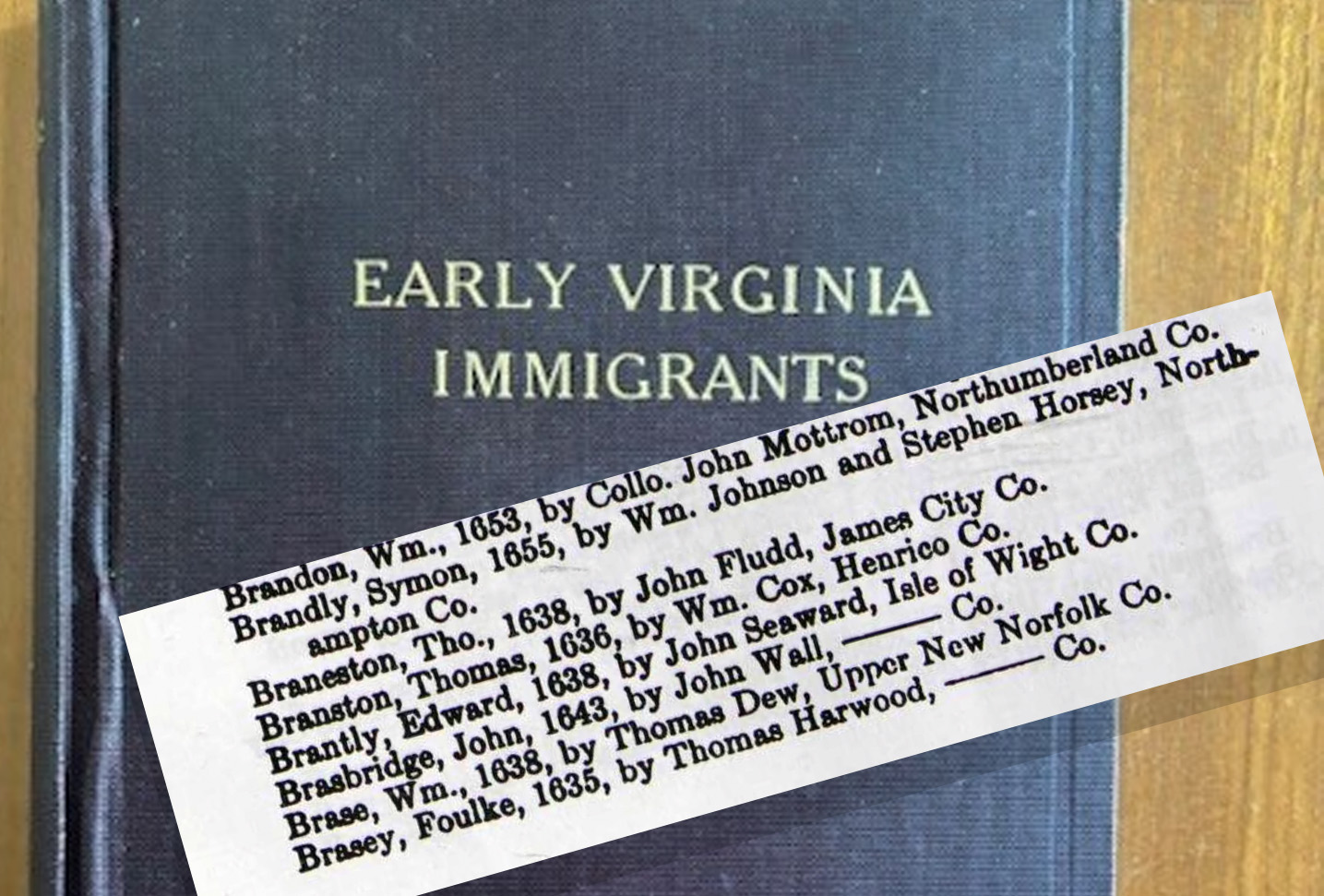
Edward Brantly appears in Virginia in 1638

Mention of Edward Brantly in “Cavaliers and Pioneers,” page 85
The earliest known Virginia record involving Edward dates to June 18, 1638. A land patent awarded John Seaward 400 acres in what became Isle of Wight County for the transportation of Edward Brantly and seven other people to Virginia.
The record confirms that someone named Edward Brantly had arrived in Virginia by that date. It does not, however, prove that he came from England or that he was an indentured servant. Colonial headright records credited people with land for financing or claiming responsibility for another person’s transportation, but they did not always specify the traveler’s country of origin, financial arrangement or legal status.
At the time my first Brantley ancestor arrived, the area, previously known as Warrosquyoake, had only recently been renamed. It was one of Virginia’s original shires, created in 1634, and became Isle of Wight County in 1637. In 1749, the portion of Isle of Wight County west of the Blackwater River became Southampton County. Some of the early Brantley family’s land later became part of Southampton County.
Edward apparently remained in Isle of Wight County and died there around 1688. The Brantley Association’s reconstructed family line identifies Philip Brantley (about 1651-1727) as one of his sons. Philip’s son, another Edward Brantley (about 1672-1737), left a will naming sons James Brantley, Lewis Brantley, Joseph Brantley and John Brantley.
Those sons helped carry the family name into North Carolina.
Now this is just supposition and unproven, but its possible, my line descends from is son Edward. Edward Jr. (1648-1720) was born and died at age 72 in Isle of Wright. He was the father of Edward Brantley III (1675-1736) who was the fther of James Allen Brantley (1695-1741) who was the father of Edward Brantley Sr. (1714-1765) who was the father of Edward Brantley Jr. (1760-1837) who was born and died in Bertie County, N.C. This Edward was my fifth great-grandfather, and I plan to look into his life more later.
The precise father of Edward Brantley (about 1760-1837) of Bertie County has not been conclusively identified. The Y-DNA results strongly suggest that his paternal line belonged to the larger family associated with Edward Brantly of 1638, but they do not reveal the specific names of the missing generations.
The 1790 census places “my” Edward in Bertie County in a household of seven free people. Because early federal censuses listed only the head of the household by name, the record does not prove that the remaining household members were his wife and children.
A May 12, 1832, marriage record connects Edward to Clarissa Cole Brantley. His surviving will names Clarissa as his wife, Augustus Brantley (1811-1876) as his son and Margaret Brantley Sorrell as his daughter.
From Bertie County to Haywood County
Augustus, my fourth great-grandfather, left Bertie County and joined the migration of northeastern North Carolina families to West Tennessee.
The birthplaces of his children help narrow the family’s arrival. His oldest son, Daniel E. Brantley (1833-1863), was born in North Carolina, while his son Robert Brantley (about 1837-date unknown) was born in Tennessee. That suggests Augustus moved to Haywood County between about 1834 and 1837.
By the 1840 census, Augustus was living in Haywood County. His household included five people counted by the census as “free white persons” and one enslaved female between ages 10 and 23. Her name was not recorded.
The 1860 slave schedule later listed three enslaved people under Augustus’ name: a 37-year-old woman and two boys, ages 15 and 8. His son Solomon Norman Brantley (1847-1927) later recalled that his father’s farm included 320 acres and five enslaved people around the beginning of the Civil War.
Augustus first married Martha White Brantley (1812-1852), who was the mother of six of his children. He later married Zilpha King Brantley (1823-1893), with whom he had at least one daughter.
Other families from Bertie County settled nearby, creating a network of relatives, neighbors and fellow church members who had traveled west during the same period.

Six generations, from left: Henry Day Brantley, Henry Preston Brantley, William “Willie” Day Brantley, Virginia Brantley Lovelace, Shirley Lovelace Williams and me.
Augustus was the father of Henry Day Brantley (1845-1918), who was the father of Henry Preston Brantley (1872-1956). Henry Preston was the father of William “Willie” Day Brantley (1897-1969), who was the father of my maternal grandmother, Virginia Brantley Lovelace (1917-2007), who was the mother of Shirley Lovelace Williams (1939-present) who was my mother.
The family line still contains many unanswered questions to be proven, particularly concerning the father of Edward Brantley of Bertie County. However, the Y-DNA results give us something our census records, wills and deeds could not provide on their own: genetic evidence that our Haywood County Brantleys belong to the same broad paternal family associated with the Virginia immigrant who first appeared in the records in 1638.
For more of my genealogy research, visit rscottwilliams.info.


Leave a Reply