
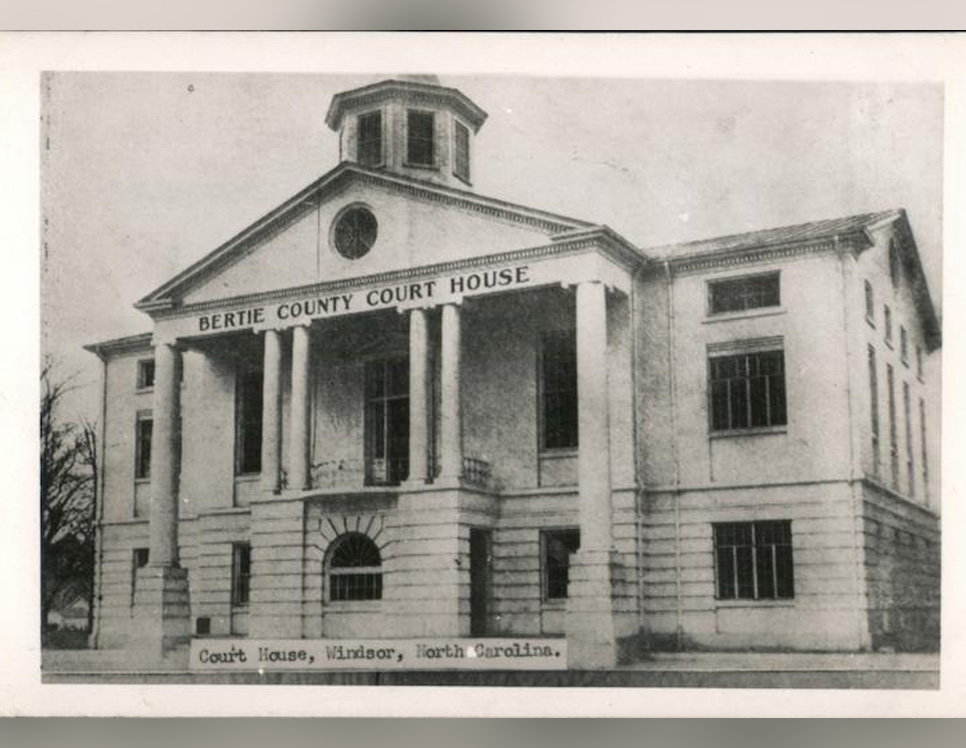
Photo: The Bertie County Courthouse in Windsor, photographed in the early 20th century. Built in 1889, the courthouse stands about two miles downstream from the earlier colonial courthouse site established on or near James Castellaw’s Cashie River plantation. /
Some ancestors leave behind nothing more than a name, a marriage date and a line in a census or two. Fortunately, the earliest documented member of my Castellaw line in America left behind much more. The more I dig into the colonial records of North Carolina, the more I find my sixth great-grandfather, James Castellaw (c. 1685-1749). I find him appearing in courtrooms, council meetings, land transactions and political disputes. He served on juries, acquired thousands of acres of land, challenged public officials and participated in disputes that foreshadowed the later struggle between elected colonial assemblies and royal authority.
From Scotland to North Carolina
James Castellaw is believed to have been born near Paisley in Renfrewshire, Scotland. Family research has long identified him as the “Jacobus Castellaw” recorded at the University of Glasgow in 1703.
The university register does contain a student under that name, and “Jacobus” is the Latin form of James. The record places him in the third class under the direction of John Loudoun, professor of logic and rhetoric at Glasgow from 1701-1750. No record exists showing that Castellaw graduated.
No passenger list or immigration record has surfaced showing when Castellaw crossed the Atlantic, on what ship he traveled or where he first landed. By the early 1720s, however, he was firmly established in the Albemarle region of North Carolina.
One early record places him with Thomas Pollock (1654-1722), one of the colony’s wealthiest landowners and a former acting North Carolina governor. Pollock was a lawyer, planter and colonial official. A native of Glasgow, Scotland, he was a descendant of Pollok of Balgray, who, according to legend, saved the life of James IV of Scotland from an attack by a wild boar.
Pollock signed his will Aug. 8, 1721. When Bertie Precinct Court convened in February 1722, Castellaw appeared and swore that he had seen Pollock sign and publish the will and testified that several additions written between the lines were already present when Pollock signed it.1
Being selected as a witness to the will of one of the colony’s most powerful men suggests Castellaw was already considered trustworthy and respectable within the community. That would not be the last time he appeared in a colonial courtroom.
Castellaw also became involved in the controversy over North Carolina’s so-called blank patents. In an April 24, 1731, deposition, he testified that he had seen land patents in George Pollock’s possession on which the acreage had been left blank (George was Thomas Pollock’s son). The practice allowed acreage to be inserted later and became part of a wider investigation into irregular and potentially fraudulent land grants.2
Juror, Justice and Political Agitator
Castellaw also found himself at the center of a heated political dispute. In 1726, a Bertie County grand jury indicted James Castellaw and fellow planter John Nairne for a misdemeanor. Colonial prosecutors alleged that they had organized meetings, encouraged residents to sign petitions criticizing the government, obstructed Receiver General William Little (1691-1734) and circulated what the indictment called a “false Scandalous & Seditious Libell.”3
The language sounds like an accusation of attempted revolution, but colonial authorities used the term seditious libel broadly for written criticism they believed undermined the government or brought its officials into contempt.
The prosecution was also unusually personal. Little served simultaneously as receiver general—the official James allegedly obstructed—and attorney general, making him both the victim and the prosecutor. Castellaw and Nairne initially failed to appear, and the court issued orders compelling their attendance. The record later states, however, that Little would not prosecute Castellaw any further. The government effectively dropped the case against him, and there is no evidence that Castellaw was tried or convicted.4

The Moseley manuscript map is a previously unknown map of Colonial-era North Carolina that appeared for sale at auction in 2007 with unknown origins.
James Castellaw’s willingness to challenge colonial officials surfaced again several years later. Gov. George Burrington (c. 1680-1759) complained that Castellaw and Assembly Speaker Edward Moseley (c. 1682-1749) pressed him to approve legislation confirming laws enacted in 1729.
Castellaw was again in good company. Edward Moseley was a politician, surveyor, book collector, vestryman, planter and attorney. The map of North Carolina dated 1733 bears his name. While serving as the colony’s surveyor general, he compiled the geographic data and the surveys used to create it.
Burrington later described Castellaw as “a very factious assembly man.” An assembly man was an elected member of the lower house of North Carolina’s colonial legislature, in Castellaw’s case, a representative of Bertie County. In the political language of the period, “factious” meant partisan, contentious and aligned with an opposition faction. Coming from an angry governor, the description may reveal as much about Castellaw’s political influence as it does about his temperament..5
Castellaw represented Bertie County in the North Carolina General Assembly and served on committees dealing with public claims and grievances. In 1744, he filed a formal complaint against Macrora Scarborough (1693-1752), an assistant justice, legislator and county treasurer.
Castellaw accused Scarborough of buying public claims from their original holders at steep discounts, sometimes paying only 60% to 80% of their value. He argued that the practice harmed both the people selling the claims and the colony’s public credit. James asked the House to investigate and, should it confirm the allegations, remove Scarborough from office and expel him from the Assembly.
Castellaw was also appointed a justice of the peace for Bertie County. In colonial North Carolina, justices conducted much of the county’s business. They heard minor civil and criminal cases, administered estates, approved deeds, levied taxes and supervised roads and other public matters. Serving as a justice placed James near the center of local government.6
Home on the Cashie River
Some of Castellaw’s political influence came from his land ownership.
An account of unpaid Crown quit rents covering the period from 1729 to 1732 lists James as owning 2,335 acres in Bertie Precinct. That figure may represent several separate tracts rather than one enormous plantation, but it establishes him as a substantial landholder.7

“Sans Souci Ferry,” painted in 1965 by North Carolina artist Francis Speight (1896-1989), depicts the ferry crossing along the Cashie River in Bertie County. Photo credit: The North Carolina Museum of Art.
Deed abstracts also place James Castellaw and his wife, Sarah, whose maiden name may have been Williams, living along the Cashie River. In February 1723, James and Sarah conveyed 550 acres on the Cashie River to Thomas Williamson. Because Sarah could not personally appear in court, she appointed Edward Moore to acknowledge the transaction on her behalf.8

Hoggard’s Mill was established by James Castellaw in 1736 and purchased by William Hoggard in 1800. The property, which has remained in the same family since 1928, once included a water-powered gristmill, a water-powered sawmill and a covered bridge. From 1722 to 1769, the area also served as the Bertie County seat and included the county’s first courthouse, public warehouses, jail and several commercial buildings, making it one of the county’s most historically significant sites.
Castellaw’s land became more than a plantation. It helped form the center of a small community known as Cashy. After Northampton County was separated from Bertie, the General Assembly directed that Bertie’s courthouse, prison and stocks be placed between Cashie Bridge and Will’s Quarter Bridge on or near Castellaw’s property. A water-powered mill he established in 1736 became a fixture of the community and was named by later owners Hoggard’s Mill. The concentration of government buildings, commercial activity and river transportation made Cashy an important local center before Windsor emerged as the permanent county seat.
The James and Sarah Castellaw family
The clearest surviving snapshot of James and Sarah’s family comes not from James’s will but from the will of their son William Castellaw (birth year unknown-1749).
William signed his will June 18, 1749. He named his mother, Sarah, and his brothers John, James and Thomas. He also named his sisters Bathiah, Sarah and Katherine. He appointed his mother and Thomas Whitmell as executors.
William did not name his father. That omission, combined with Bertie County estate proceedings from the same period, strongly suggests James had already died by 1749. Thomas subsequently administered James’s estate. Therefore, James appears to have died sometime in early 1749, probably between his last recorded court service and the writing of William’s will in June.9
James Castellaw’s burial place is unknown. He may have been interred in a now-lost family graveyard on or near his plantation along the Cashie River, but no gravestone or contemporary burial record has been found.
A Castellaw Cemetery survives near Colerain, but it has not been connected to James. The oldest recorded marked grave there appears to be that of James Raleigh Castellaw (1885-1914), a later descendant of James.
- Walter Clark, ed., The State Records of North Carolina, vol. 22 (Goldsboro, NC: Nash Brothers, 1907), 294-95. ↩︎
- Deposition of James Castellaw, April 24, 1731, in William L. Saunders, ed., The Colonial Records of North Carolina, vol. 3 (Raleigh: P. M. Hale, Printer to the State, 1886), 216-19. ↩︎
- North Carolina General Court, “Minutes of the General Court of North Carolina,” March 29-April 2, 1726, in William L. Saunders, ed., The Colonial Records of North Carolina, vol. 2 (Raleigh: P.M. Hale, Printer to the State, 1886), 646. ↩︎
- William L. Saunders, ed., The Colonial Records of North Carolina, vol. 2 (Raleigh: P. M. Hale, Printer to the State, 1886), 652, 662, 671, 700. ↩︎
- George Burrington to the Board of Trade, Nov. 14, 1732, in William L. Saunders, ed., The Colonial Records of North Carolina, vol. 3 (Raleigh: P. M. Hale, Printer to the State, 1886), 331-33. ↩︎
- William L. Saunders, ed., The Colonial Records of North Carolina, vol. 4 (Raleigh: P.M. Hale, Printer to the State, 1886), 344, 724, 728-29, 737-38, 746. ↩︎
- Clark, State Records, 22:240-41. ↩︎
- Bertie County, North Carolina, Deed Book A, 346, deed of James and Sarah Castellaw to Thomas Williamson, Feb. 21, 1723; abstract transcribed in collected Bertie County deed research. ↩︎
- J. Bryan Grimes, ed., Abstract of North Carolina Wills Compiled from Original and Recorded Wills in the Office of the Secretary of State (Raleigh: E.M. Uzzell & Co., 1910), 66; Bertie County Court Minutes, Nov. 14, 1749. ↩︎


Leave a Reply