
I traveled back to Tennessee last week for a reunion of the descendants of Thomas Jefferson Castellaw (1808-1878), and the gathering reminded me of the important role storytelling plays in passing family history from one generation to the next.
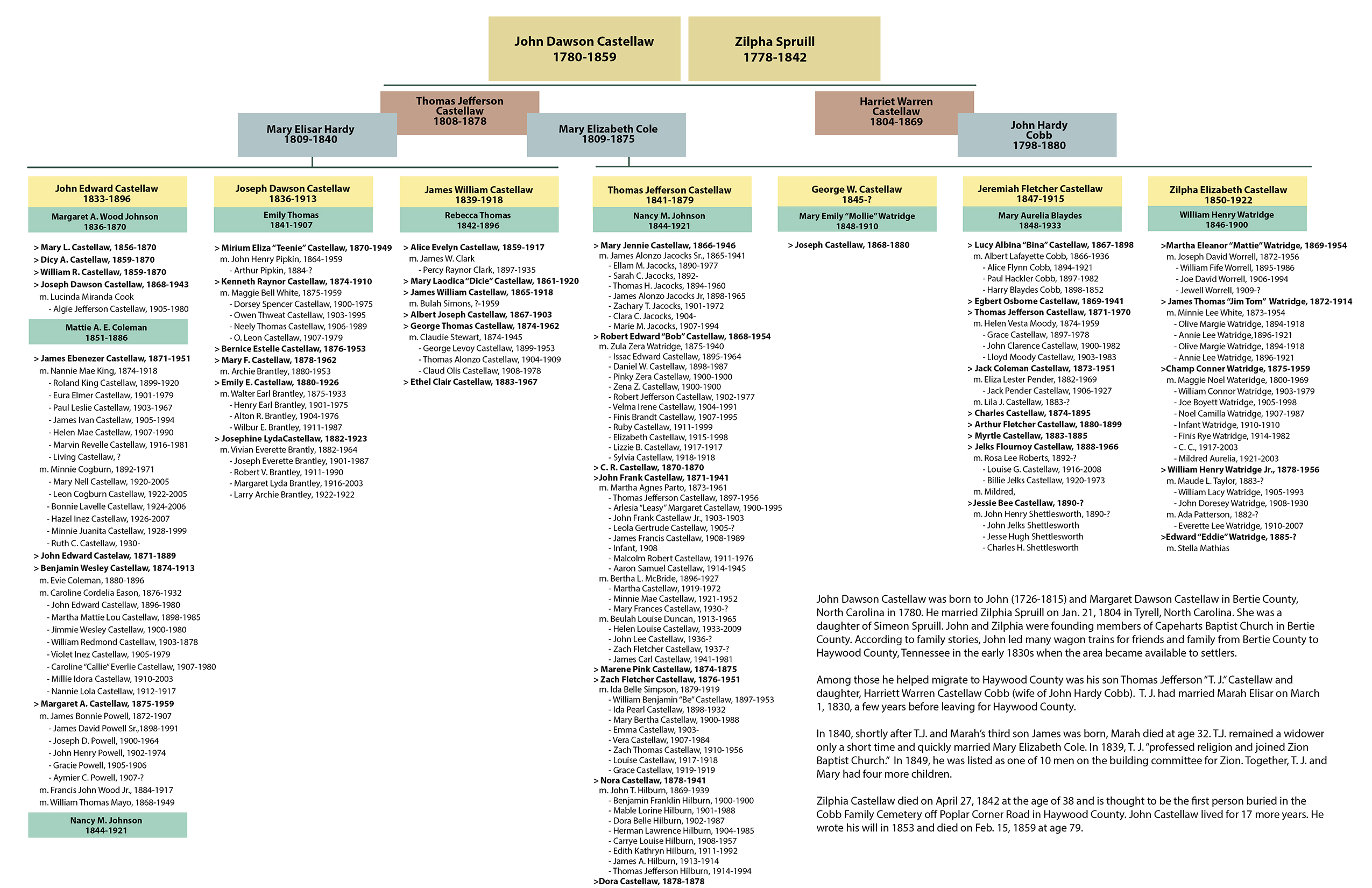
I have long been fascinated by the story of Thomas Jefferson Castellaw. With his two wives, Mary Elisar Hardy Castellaw (1809-1840) and Mary Elizabeth Cole Castellaw (1809-1875), he fathered six sons and one daughter. Everyone at the reunion descended from one of those seven siblings.
About 40 people attended. While immediate family members certainly knew one another, many of us were meeting for the first time.
To help everyone understand which sibling they descended from, I prepared a Castellaw family cheat sheet. It may also be useful to others researching these family lines.

Download a high-resolution version
Thomas Jefferson Castellaw was among the early settlers of Haywood County during the 1830s. His father, John Dawson Castellaw (1780-1859), is said to have led wagon trains from the family’s home in Bertie County, North Carolina, to Haywood County, Tennessee.
John Dawson Castellaw’s daughter Harriet Warren Castellaw Cobb (1804-1869) and her husband, John Hardy Cobb (1789-1880), also migrated to Haywood County. Both the Castellaw and Cobb families became active in the new community.
I found it remarkable that, more than 180 years later, so many of us could gather in the same county and connect through our shared ancestry.
It was even better that we could do it over some great Southern cooking from Olympic Steakhouse in Haywood County.
I left the reunion with new photographs, interesting stories about Castellaw cousins from the past and many new Castellaw cousins in the present.

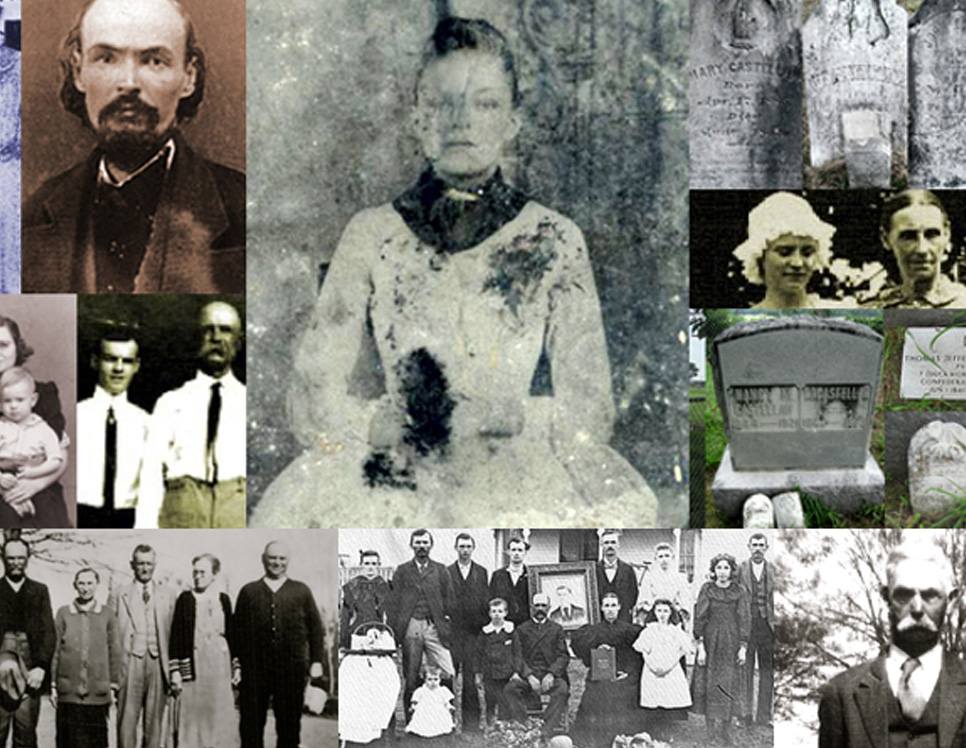
You can see photographs of earlier generations of Castellaws in this gallery. Anyone with additional photographs is welcome to email them to me at [email protected], and I will add them.
You can also see some of my photographs from the reunion here.

Stories From Bertie County
Ed Castellaw has researched the Castellaw family for decades and shared some of the information he has gathered through the years. He talked about visiting Bertie County, North Carolina, and attending the national Castellaw family reunion in 1977.
He also brought a brick he had pulled from the ground at the site of the old Castellaw plantation.

Ed’s daughter and son-in-law, Christy and Brent Perkins, discovered another connection to the family name during a visit to Scotland. Brent shared details about their visit to Castelaw Hill Fort and prepared a poster about the site for the reunion.
The Castellaw Brothers and the Civil War
Jonathan Castellaw and I had recently discussed the service in the Confederate Army of several Castellaw brothers who were listed as deserters. That made it especially interesting when Glad Castellaw shared family stories that had been passed down about the same subject.

Glad knows something about military service. During a 36-year career in the U.S. Marine Corps, he served with the United Nations during the Siege of Sarajevo, commanded the American force participating in the multinational security and stabilization operation in East Timor and served as chief of staff of U.S. Central Command during the wars in Iraq and Afghanistan.
He also commanded Marine Medium Helicopter Squadron 264, Marine Aviation Weapons and Tactics Squadron 1 and the 2nd Marine Aircraft Wing. His final assignments included serving at the Pentagon as head of Marine aviation and later overseeing the Marine Corps budget.
Glad shared a family story about James William Castellaw (1838-1919) and the Civil War.
According to the story, James deserted and returned to Haywood County. When Confederate Gen. Nathan Bedford Forrest (1821-1877) passed through the area, he ordered his men to gather deserters. James was arrested, court-martialed and sentenced to death.
At about the same time, Confederate Gen. Joseph E. Johnston (1807-1891) was attempting to stop Union Maj. Gen. William Tecumseh Sherman (1820-1891) during the Atlanta Campaign. James and 38 other condemned men reportedly were offered commuted sentences if they volunteered to return to combat.
Not surprisingly, all 39 accepted.
The story passed down to Glad says that James soon found himself on the front lines at the Battle of Harrisburg, also known as the Battle of Tupelo, in Mississippi.
As Glad had heard the story told, “Castellaw was in the front of every charge at Harrisburg, but that night, after the battle was over, he had his gun, he had his horse — and back to Haywood County he went.”
“Castellaw was in the front of every charge at Harrisburg, but that night, after the battle was over, he had his gun, he had his horse — and back to Haywood County he went.”
Like many family stories, the account may contain details that became compressed or altered over time. Still, it preserves something military records alone cannot provide: how later generations remembered James and his wartime experiences.

Jeremiah Fletcher Castellaw and Mary Aurelia “Pus” Castellaw with their family in Texas before returning to Haywood County.
The Chairs That Came Home From Texas
Otha Castellaw shared a story about receiving a set of chairs that Jeremiah Fletcher Castellaw (1847-1915) and his wife, Mary A. Blaydes Castellaw (1848-1933), brought with them when they returned to Haywood County from Texas during the early 1900s.
That is a particularly interesting branch of the family tree. You can read more about them here.
From Crockett County to the CIA
Martha Castellaw shared details from a story she had written about growing up in Crockett County, Tennessee. She is a granddaughter of James Ebenezer Castellaw (1871-1951), a son of John Edward Castellaw (1833-1896).
Martha later moved to Washington and worked for the CIA.
Sandra Presley Smith and Susan Latham Griffin, who descend from Robert Edward “Bob” Castellaw (1868-1954), the same branch of the family as I do, also brought family photographs to share. Our grandmothers were sisters who lived in the Holly Gove community of Haywood County.
More Than Names and Dates
The internet has transformed genealogy. It gives us access to census records, military files, newspapers, wills, deeds and millions of family trees. Those resources help us confirm names, dates, places and relationships. But records alone cannot preserve everything.
They do not capture the sound of a relative’s voice telling a story heard from a grandparent. They do not explain why a brick from an old homeplace matters or why a family kept a set of chairs for more than a century. They do not reveal which stories made people laugh, which ones filled them with pride and which ones remained painful. There is something special about sitting in a room with people who share the same history and hearing those stories in person. That may be the greatest value of a family reunion. It connects the people we know only through records with the people still carrying their memories.
Now it is time for Kay Castellaw to begin planning the next Castellaw reunion.
Scotland seems like the logical choice.


Leave a Reply