
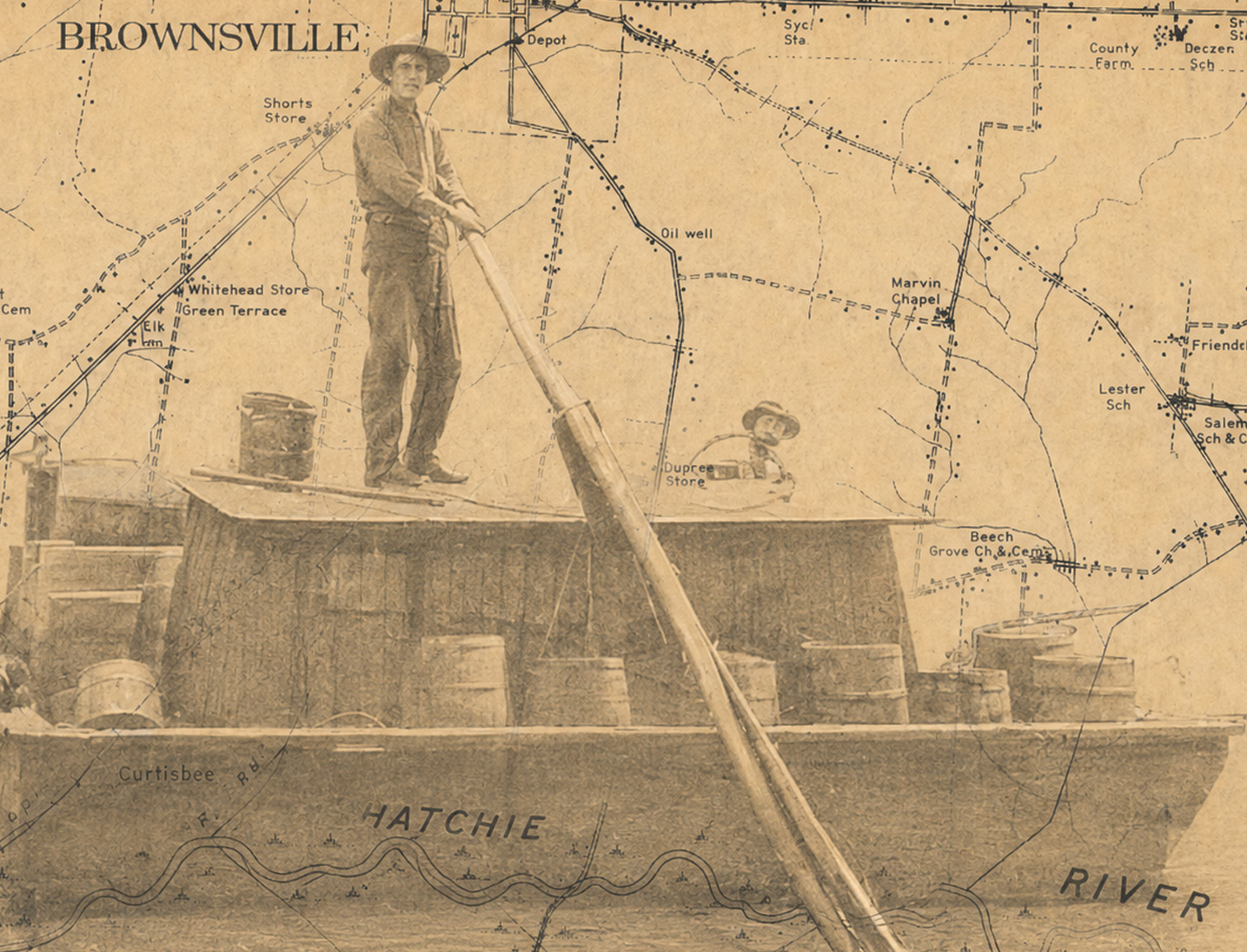
Although Brownsville never sat directly on the Hatchie River, during the first half of the 19th century, it functioned very much like a river town.
The Hatchie flowed south and west of Brownsville before emptying into the Mississippi River about 35 miles north of Memphis. The Forked Deer River drained the northern portion of early Haywood County and eventually joined the larger Mississippi River system. Together, these waterways connected inland West Tennessee communities with Memphis, Natchez, New Orleans and markets throughout the Mississippi Valley.
Farmers and merchants like my ancestors used roads connecting the various communities with nearby landings and ferries.

My friends at the West Tennessee Delta Heritage Center have been teaching visitors to the area about the Hatchie for years. Their Hatchie River Museum, located at the center, includes three fresh water aquariums filled with creatures who make the river their home.
An 1872 description of Haywood County identified the Hatchie and Forked Deer as its principal streams and noted that small steamboats and flatboats traveled them before the arrival of the railroad. Brownsville Landing stood on the Hatchie about six miles from the county seat, making it the town’s principal connection to the Mississippi River transportation system.1
Haywood County’s River Landings
Brownsville Landing was not the only point of river commerce. Landings and ferries were scattered along the Hatchie every few miles, usually wherever a road met the river or a merchant, planter or mill operator had enough business to justify one.
Hiram Bradford (1797-1862), one of Brownsville’s earliest merchants, established Bradford’s Landing about 10 miles downriver from Brownsville Landing. He also operated a store, built Haywood County’s first cotton gin and erected a hand-powered sawmill at the landing. His operation connected several parts of the local economy. Farmers could gin their cotton, lumber could be processed and crops and merchandise could be transferred between wagons and boats.

Location of the landing on the Hatchie belonging to Richard Nixon
Richard Nixon (1769-1831), who settled east of Brownsville on Nixon Creek — near the eventual site of my maternal grandparent’s house — also operated a store and landing on the Hatchie. Other landings and ferries served communities throughout the county. As early as 1825, the Haywood County Court established ferry rates for horses, wagons, livestock and passengers.2
Of course, river travel depended heavily on water levels. The smaller, low-draft steamboats used on Tennessee rivers could operate in relatively shallow water, but the best shipping season came during periods of high water. Snags, submerged logs, narrow bends and shifting channels could delay or disable even an experienced crew.3
The landing was therefore part warehouse, part transportation depot, part trading post and part waiting room. It was also one of the few places where people from scattered farms and communities regularly encountered one another.

The Jolly Flatboatmen by George Caleb Bingham, 1846, is probably the most recognized and widely used image of a flatboat today. Photo credit: National Gallery of Art
Passing the Time at Brownsville Landing
Samuel Edmund Taylor (1828-1905) left one of the best descriptions of what that experience was like.
Taylor belonged to one of Haywood County’s earliest families and kept a diary that recorded the ordinary details of life in the county. Portions were later published in “The Taylors of Tabernacle,” a family history that includes journals and biographical sketches from the Tabernacle community east of Brownsville.
In January 1850, Taylor traveled to Brownsville Landing on business. He heard a steamboat coming downriver, walked upriver to another landing and boarded the boat for the brief ride back to Brownsville Landing.
A few weeks later, he returned with cotton he intended to ship to Memphis. The first boat would not take it, so Taylor remained at the landing waiting for the Pitser Miller, which was expected within a few days.
The wait stretched from Sunday into Thursday.
Taylor wrote that he “knocked about the landing” and did little of importance. When several other young men arrived, however, they “passed off the time very agreeably.”
On Thursday morning, the group obtained gunpowder, an anvil and matches. They created such a loud explosion that people across the surrounding countryside believed a steamboat was arriving and rushed toward the river. The actual boat did not appear until after dark and remained at the landing overnight.
The next morning, Taylor and his cotton finally “rolled off for Memphis.”
The voyage took several days. A fire briefly broke out aboard the boat. Rain kept passengers from spending much time on deck. A log became lodged in the paddle wheel and broke it. Snow and darkness eventually made the river too dangerous for the pilot to continue.
Taylor reached Memphis by breakfast on Feb. 10. He sold part of the cotton for 11½ cents per pound and the remainder for 12 cents. While in the city, he attended church, visited acquaintances, ate at the Gayoso Hotel, went to the theater and watched a performance involving trained canaries.
His return journey was equally slow. The boat reached Brownsville Landing around midnight on Feb. 14. Taylor left early the following morning and rode home.
His diary reveals that shipping cotton was not simply a matter of loading a wagon and catching the next boat. A farmer might wait several days before a vessel appeared. The boat might refuse his cargo. Weather, mechanical failures and river obstructions could add days to the trip.
The diary also shows why landings became social centers. Waiting was part of river travel, and people found ways to entertain themselves while they waited.4 Their choice of entertainment did not always impress everyone.
Local tradition holds that the Rev. Obadiah Dodson (1792-1854), one of West Tennessee’s best-known pioneer Baptist preachers, once disrupted gambling aboard a steamboat traveling from Estonallie toward Memphis. According to the story shared with me by my friend local historian Billy King, Dodson began singing and preaching until the gamblers stopped their card games, threw their cards overboard and asked to be baptized when the boat reached Brownsville Landing.
The First Steamboat on the Hatchie
The arrival of the first steamboat on the Hatchie became one of Haywood County’s most frequently repeated pioneer stories.
Joseph S. Williams (1814-1878) included his version in “Old Times in West Tennessee,” published in 1873. Williams grew up in what he called the “Big Hatchie Country” and recorded stories and memories from the region’s earliest years.
According to Williams, news spread across the county several days before the Red Rover was expected at Brownsville Landing. On the appointed day, men, women and children came on horseback, in carts and on foot. Brownsville residents reportedly organized a procession and carried banners to welcome the boat.
Most of the people gathered there had not yet seen a steamboat in person. Their knowledge of steam power came largely from newspaper stories about boiler explosions and other disasters.
The Red Rover approached the landing with flags flying as the crowd cheered. Then the engineer released steam from the valves.
The tremendous blast produced immediate panic.
People screamed and ran. Horses bolted. Carts overturned. According to Williams, the scene looked as though “the devil had broke out of his harness.” Some people reportedly continued running until they were too exhausted to go any farther.5
Meeting the Rover From the River
Susan E.D. Smith (1817-after 1867), later known for her Civil War work in Southern hospitals, recorded another version of the Rover story in her 1867 autobiography, The Soldier’s Friend.
Smith’s account is especially valuable because she did not witness the steamboat’s arrival from the riverbank. She saw it while her own family was attempting to navigate the Hatchie.
In February 1828, Smith, her sister and two brothers left Wilson County, Tennessee, aboard a flatboat fitted out for their move west. They floated down the Cumberland River into the Ohio, entered the Mississippi and eventually reached the mouth of the Hatchie.
Traveling upstream proved much more difficult. The family used hooks and poles to work the flatboat through the Hatchie’s narrow, crooked channel.
At one point, the boat became lodged on a submerged log. While the family struggled to free it, a small steamboat named the Rover suddenly appeared around a bend.
Smith remembered the family’s excitement at seeing what she believed was the first steamboat to navigate the Hatchie. When the boat reached Brownsville, residents prepared a banquet for the captain and the women traveling aboard and held a community reception.
Local histories generally date the Red Rover’s appearance to the fall of 1827, while Smith’s firsthand chronology places the encounter in February 1828. It’s possible that the ship made more than one early trip and that later writers combined separate arrivals into a single story.6
Cotton, Timber and the Road to Memphis
Cotton soon became the most important cargo moving through Haywood County’s landings, but it was not the only one.
The rich bottomlands also produced enormous quantities of hardwood timber. White oak, hickory, cypress and ash could be made into barrel staves, wagon parts, shingles and other products. Corn, livestock and locally produced goods also traveled by water.
Boats carried much of that freight to Memphis. Once there, cotton could be sold to commission merchants or transferred to larger vessels bound for New Orleans and national or international markets. Merchandise moving in the opposite direction could be unloaded at a Hatchie landing and carried inland by wagon.
The river was not always dependable, but it gave local farmers and merchants an alternative to expensive overland transportation. That competition remained important even after railroads reached West Tennessee.
When the Railroad Replaced the Landing
The first railroad reached Brownsville in 1846. It offered something the Hatchie could not: scheduled transportation that did not depend as heavily on seasonal water levels, river obstructions or the arrival of a particular boat.
By 1872, the railroad had largely replaced commercial river traffic at Brownsville Landing. A county description published that year said the landing was no longer used for freight or passenger travel to the Mississippi. Instead, it had become primarily a destination for hunters and fishermen.
That transition was gradual, however. Boats and railroads sometimes worked together. A recollection preserved in 1939 described boats towing barrel staves from Estanaula on the Hatchie to a railroad connection near Covington. The staves were then loaded aboard trains and carried to Louisville.
The river carried the freight through the bottomlands. The railroad carried it the rest of the way.7
As roads improved and railroad service expanded, small rural landings lost their purpose. Stores closed, ferry routes disappeared and roads that once led directly to the water were abandoned or redirected.
In 2007, the Tennessee Wildlife Resources Foundation established the Hatchie River Wetland Mitigation Bank and 685 acres of land along the Big Muddy Creek was targeted for restoration. More than two miles of levees were removed, seven miles of ditches were filled and 224,000 native bottomland hardwood seedlings were planted. Today, the project is considered a big success.
A River System Transformed
The waterways surrounding Brownsville also changed.
The fertile soil that attracted settlers had been created in part by centuries of flooding. Once farms, roads, railroads and communities occupied those floodplains, residents increasingly viewed the same water as an obstacle.
Unfortuatley, bottomland forests were cleared. Wetlands were drained. Ditches were cut and tributaries were straightened to move water away from agricultural land more quickly. Farm land equaled money. The Tennessee Wildlife Resources Agency reports that much of the Forked Deer basin was drained and most of its tributaries were channelized, significantly altering water quality and wildlife habitat.
The Hatchie survived in a more natural condition. The Tennessee portion remains the only unchannelized river in West Tennessee, although many of the smaller streams feeding it have been altered.8
That difference helps explain why it can be difficult to imagine the landscape that early Haywood Countians knew. Many of the waterways, like Nixon Creek, no longer resemble the winding bodies of water that carried flatboats, supplied ferries and periodically flooded the surrounding forests.
The old landings have largely disappeared, but diaries, memoirs, newspaper articles and county histories allow us to reconstruct the network of transportation they created for my ancestors.
For more of my genealogy research, visit rscottwilliams.info.
- J.G.H. Buck, “Historical Sketch of Haywood County, Tennessee,” in West Tennessee Combination Directory Containing the Histories and Directories of Jackson, Brownsville and Trenton (Louisville, KY: Circulating Directory Co., 1872), reproduced by Haywood County TNGenWeb; and Thomason and Associates, Historic Resources of Brownsville, Tennessee, 1823-1964 (National Register of Historic Places Multiple Property Documentation Form, 2014), sec. E, 3-4. ↩︎
- Thomason and Associates, Historic Resources of Brownsville, sec. E, 3-4; “Haywood County History,” in Goodspeed’s History of Tennessee (Nashville: Goodspeed Publishing Co., 1887), ↩︎
- Michael Allen, “Steamboating,” Tennessee Encyclopedia, last modified March 1, 2018. ↩︎
- Taylor Kinsfolk Association at Tabernacle Church, The Taylors of Tabernacle: The History of a Family, Including the Genealogy of Its Descendants with Biographical Sketches and Family Journals with Daily Accounts of Life in Haywood County, Tennessee, for Over a Century (Brownsville, TN: Taylor Kinsfolk Association, 1957), 96-97. ↩︎
- Joseph S. Williams, Old Times in West Tennessee: Reminiscences, Semi-Historic, of Pioneer Life and the Early Emigrant Settlers in the Big Hatchie Country (Memphis: W.G. Cheeney, 1873), 256-258. ↩︎
- Susan E.D. Smith, The Soldier’s Friend: Being a Thrilling Narrative of Grandma Smith’s Four Years’ Experience and Observations, as Matron, in the Hospitals of the South, During the Late Disastrous Conflict in America (Memphis: Bulletin Publishing Co., 1867). ↩︎
- Buck, “Historical Sketch of Haywood County”; “My Father Was a Steam-Boat Man,” June 3, 1939, quoted in Billy King, Big Black Creek, vol. 2, and reproduced by the Hatchie River Conservancy in “The Mysterious Origins of the Hatchie River Boat Wreck.” ↩︎
- U.S. Fish and Wildlife Service, Hatchie National Wildlife Refuge Comprehensive Conservation Plan (Atlanta: U.S. Fish and Wildlife Service, 2011), 22, 29; Tennessee Wildlife Resources Agency, South Fork of the Forked Deer River Conservation Opportunity Area (Nashville: Tennessee Wildlife Resources Agency, 2015), 1. ↩︎


Leave a Reply