
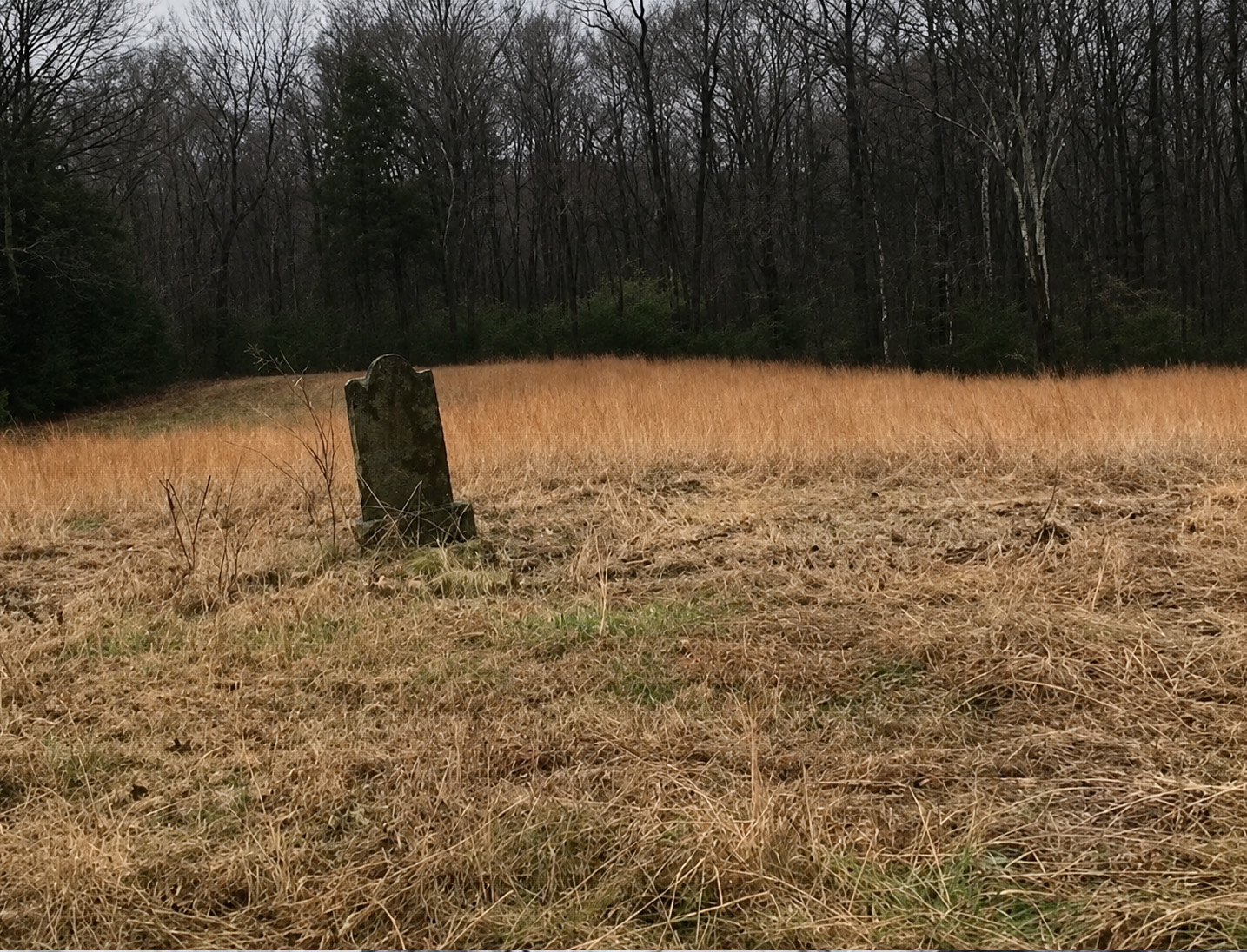
After blogging first about my search for the location of Richard Nixon’s cabin and then about finally identifying the property, being home for the holidays gave me the opportunity to see the site for myself.
Thanks to Billy Wright for providing directions and to Durwood Dixon, the current owner, for giving me permission to explore the property. Because I visited during deer season, I wore bright red and tried very hard not to look like a deer.
Richard Nixon (1769-1831) is traditionally identified as the first permanent white settler in what became Haywood County, Tennessee. A North Carolina native, Nixon came to the Western District of Tennessee in 1821 and claimed a 3,600-acre tract originally granted in recognition of his father’s Revolutionary War service. He settled about four miles east of present-day Brownsville along the stream that became known as Nixon Creek.1
Nixon reportedly built a cabin near what was eventually named Nixon Creek and soon became an important figure in the new settlement. He also established a store and a landing on the Hatchie River, where he could take advantage of the traffic created by settlers, merchants and agricultural shipments moving through the region.
His home soon became more than a private residence. It served as Haywood County’s first seat of government.
Visiting the Site
The likely location of Nixon’s cabin appears behind and to the right of the surviving headstone.
Durwood also shared a family story passed down that bricks were once made by enslaved laborers at another location on the property and used to build Nixon’s home on the property.
Nixon died July 25, 1831, at age 62. Later county histories say he was “buried in the Nixon family cemetery about three miles east of Brownsville.” Because the cemetery was apparently located on or near his extensive property, it is logical to suspect that this isolated burial ground could be connected to his family. I have not, however, found a surviving marker or cemetery record proving that Nixon himself was buried at this particular spot.
The single visible headstone certainly indicated that a burial ground once existed there. When I first saw it, I expected the inscription to identify a member of the Nixon family.
It did not.

The Grave of Laurinda Jordon
The weathered inscription was difficult to read, so I shared photographs of the marker in a genealogy group on Facebook. With help from members of the group, I arrived at the following transcription:
IN
MEMORY
OF
LAURINDA JORDON
WIFE OF
JOHN P. JORDON
WHO DEPARTED
THIS LIFE 24 FEBRUARY
1831
AGED 22 YEARS
The date appears to be Feb. 24, 1831, although weathering makes parts of the inscription difficult to interpret. Based on the age given on the stone, Laurinda Jordon (c. 1808-1831) was born about 1808 or 1809.
Her death occurred only five months before Nixon’s.
As so often happens in genealogy research, solving one mystery opened the door to another: Who was Laurinda Jordon, and why was she buried near the probable site of Richard Nixon’s home?
Searching for Laurinda
I have not found Laurinda in the known Nixon family tree, nor have I identified a marriage, estate, deed or court record connecting a Jordon family directly with Richard Nixon.
The spelling also complicates the search. In early records, “Jordan” and “Jordon” were often used interchangeably, sometimes for the same person. A researcher looking only for the spelling carved on the stone could easily miss a record entered under the more common Jordan spelling.
The 1830 federal census lists a Samuel Jordan as a head of household in Haywood County, but the household enumeration does not appear to include a woman matching Laurinda’s age. Because the census named only heads of households, however, its usefulness is limited. Laurinda and her husband could have been living in another household, newly arrived in the county or temporarily absent when the census taker visited.
The 1840 census includes a John Jordon in Haywood County, but there is no evidence proving that he was Laurinda’s widower. The man in that household was recorded as being between 20 and 30 years old, meaning he was born between about 1810 and 1820. He could have been as young as 10 or 11 when Laurinda died in 1831. Even at the oldest possible end of that age range, he would have been only about 20 or 21.
The absence of John and Laurinda from a conventional family tree does not necessarily mean they were unrelated to the Nixons. Laurinda could have been a daughter, sister, niece or other relative of one of Nixon’s neighbors, tenants, business associates or employees. She and John may also have stopped in the community only briefly during the heavy westward migration of the 1820s and 1830s.
Her burial near Nixon’s home may indicate a family relationship, but it could also reflect something much simpler. Nixon may have allowed neighbors and travelers to use a portion of his land as a community burial ground before established church cemeteries became readily available.
Could Laurinda Have Been Enslaved?
The 1830 census recorded 43 enslaved people in Richard Nixon’s household, in addition to eight free white residents. Five of the enslaved people were females between the ages of 10 and 23, the category that would have included a 21- or 22-year-old woman.
That raises the question of whether Laurinda could have been one of the people Nixon enslaved. It is possible in the broadest sense, but the headstone itself makes that explanation less likely.
The inscription identifies her by a surname and calls her the “wife of John P. Jordon.” Tennessee law did not recognize marriages between enslaved people as legal civil marriages. Enslaved couples certainly formed families and considered themselves married, and churches sometimes recognized those unions, but a formal stone describing Laurinda as a named man’s wife more closely resembles the burial customs used for a free woman.
The size and workmanship of the marker are also significant. A carved stone would have represented a substantial expense in frontier Haywood County in 1831, particularly when many graves — including those of free settlers — were marked only with fieldstones or perishable wooden markers.
What the Headstone Tells Us
Although Laurinda’s identity remains uncertain, her marker tells us several things.
She was young, married and important enough to someone for a professionally carved memorial to be placed over her grave. She died during Haywood County’s first decade, when Brownsville was still a small frontier community and the surrounding countryside was filling rapidly with settlers.
Her burial also demonstrates that this property was used for more than Nixon’s cabin and farm. Whether it was a private family cemetery or a small neighborhood burial ground, the site became sacred ground for at least one early Haywood County family.
The marker may also be the only surviving physical evidence of a cemetery that once contained several graves. Unmarked burials could remain nearby, particularly if markers were made of wood, inexpensive fieldstone or other materials that disappeared over time. A careful ground-penetrating radar survey might determine whether additional graves or structural remains are present without disturbing the site.
For now, Laurinda Jordon remains one of those people who briefly emerges from the historical record through a single surviving object. Her headstone gives us her name, her husband’s name, her approximate birth year and the date of her death. Everything else has been lost — or is still waiting in an overlooked deed, court minute, family Bible or church record.
I went looking for the home of Richard Nixon and found the grave of a young woman whose connection to him remains unknown.
Perhaps someone reading this will recognize the names Laurinda Jordon or John P. Jordon and provide the clue that finally restores more of her story.
Notes:
- Joe E. Bone, ed., Haywood County, Tennessee (Brownsville, TN: Haywood County Historical Society, 1989), 1-2; and University of Tennessee at Martin, Paul Meek Library, Special Collections, Haywood County, Tennessee Revised, 1. The latter describes Nixon as the first known settler in present-day Haywood County and says he came from North Carolina in 1821 to claim 3,600 acres. ↩︎


Leave a Reply