
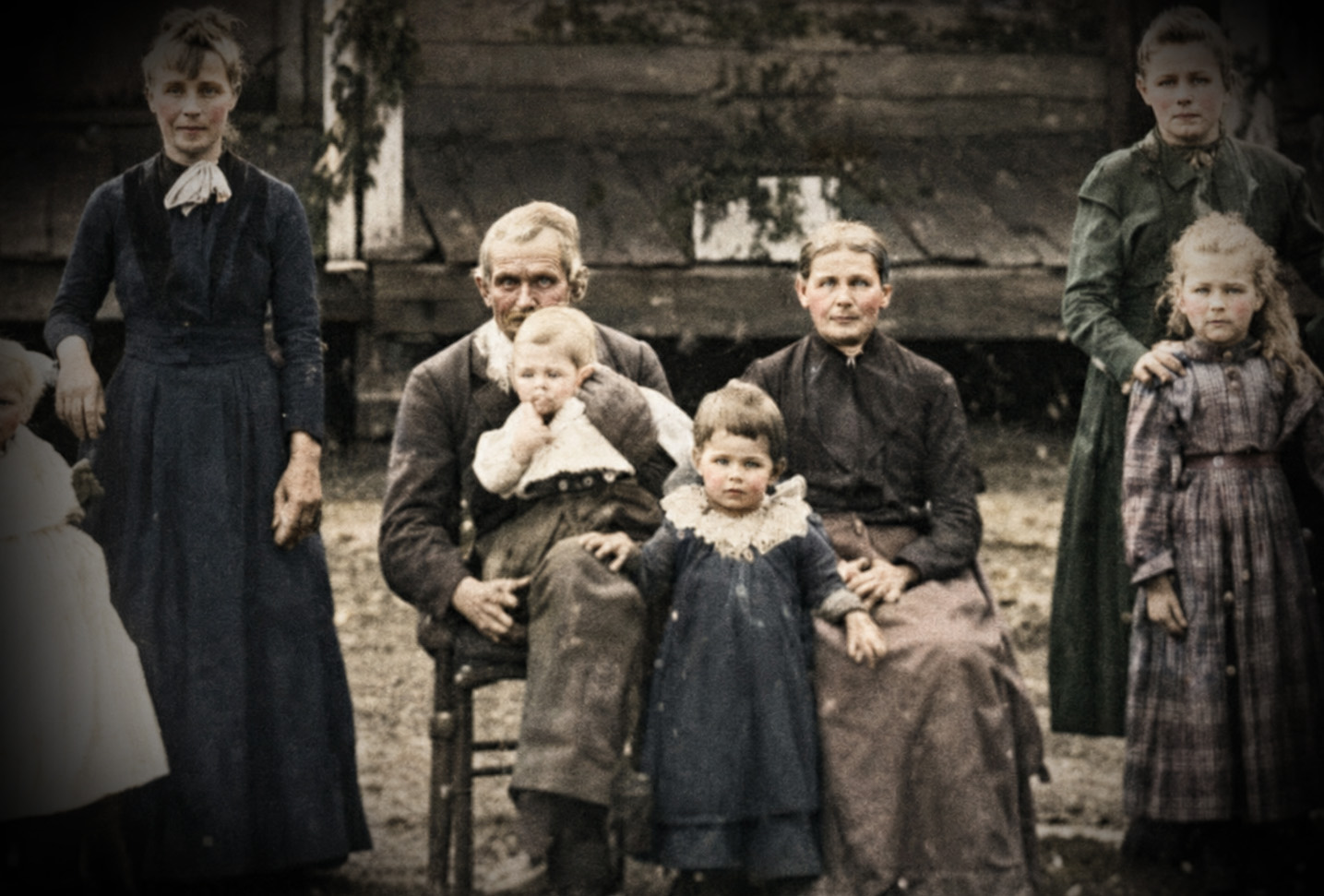
While updating the Joyner family page on my website, I discovered that my third-great-grandmother, Nancy Ross Joyner (1825-1906), had a much more interesting family history than I realized.
Nancy was born April 22, 1825 (according to her headstone) and died June 25, 1906, in Madison County, Tennessee. Apparently, her family remained confused about her actual year of birth. Her reported ages in the census records of 1860, 1870 and 1880 suggest she may have been born closer to 1828 or 1829.

Top from left: Will William’s first wife, Janie Williamson, Jessie E. Williams, Mae E. Williamson, Nannie M. Williamson. Front row from left: Jo Stella Williamson and Will Williams. Will’s wife, the girls mother, Mary Elizabeth Joyner Williamson, had died in 1898.
Nancy married Alfred Bunn Joyner (1810-1899), a widowed farmer whose family was among the early settlers of the Haywood and Madison counties. Nancy and Alfred were the parents of my second great-grandmother, Mary Elizabeth Joyner Williamson (1862-1898). Mary Elizabeth was the mother of Janie Elizabeth Williamson Williams (1887-1914) (pictured back row left above), who was the mother of my paternal grandfather, Jesse Lloyd “Bo” Williams (1910-2008).
Looking backward, Nancy was a daughter of Hezekiah H. Ross (1801-1854), a North Carolina native who settled in Madison County. Hezekiah was a son of Donald Ross (c. 1765-1823), who was a son of Scottish immigrant Hugh Ross (c. 1750-1798).
My sixth great-grandparents Hugh and Margaret McDonald Ross
Much of what is known about the earliest generations of this family comes from “The Ross Family,” a privately printed family history compiled in 1934 by Sam White Ross (1859-1966). Ross acknowledged that his book was intended as an outline for family members rather than a fully documented genealogy. For that reason, its stories are valuable clues but not necessarily evidence.1
According to the book, Hugh Ross was orphaned in Scotland when he was about five or six. Before his father died, he reportedly placed Hugh in the care of a nobleman. When that man later became ill, he arranged for Hugh to be apprenticed to a tailor.

The historic county of Sutherland in the northern Highlands of Scotland. It stretches from the North Sea coast westward across a mountainous interior to the Atlantic.
The family history says Hugh completed his apprenticeship and became known for his craftsmanship in Edinburgh and in what the book calls “Southenland Shire,” a reference to Sutherlandshire. While living there, Hugh met and married Margaret McDonald.
Hugh and Margaret reportedly immigrated to America in 1771 and settled in Anson County, North Carolina. I have not found a passenger list or immigration record confirming the date, but the 1790 federal census does establish that a Hugh Ross was living in Anson County by that year. The census also recorded one enslaved person in his household.2
The couple had at least six children: Donald Ross, Hugh Ross Jr., Margaret Ross Campbell, Mary Ross, Jean/Jane Ross and Katherine Ross. Hugh’s will, written in Anson County on Nov. 18, 1793, names Margaret as his wife and identifies all six children. Three of their children married into the Lacy family of Anson County. Because siblings from one family married siblings from another, their children were double first cousins, sharing both sets of grandparents.
Family records place Hugh Ross’ death on March 3, 1798, in Anson County, North Carolina. According to his will, He left his wife, Margaret McDonald Ross, and at least six children: Donald, Hugh, Margaret, Mary, Jean and Katherine. Their exact ages have not been established, although the language of his will indicates that at least one of the three younger daughters had not yet turned 18 when he wrote it on Nov. 18, 1793.
The will, prepared more than four years before his death, portrays a careful and comparatively prosperous planter who sought to provide for his widow and daughters while keeping his land and assets within the Ross family through his sons. He left a plantation and other land, horses, cattle, sheep, hogs, household furnishings, feather beds, farming equipment and debts owed to him through bonds, notes and accounts. The document also records that Hugh enslaved a man named George. Margaret received the use of George during her lifetime, after which he was to become the property of Hugh’s sons, Donald and Hugh. The will provides no surname, age or family information for George, but the preservation of his first name offers a rare genealogical clue to a man whose life otherwise may have gone unrecorded.3

One side note about the Ross family: While researching, I ran across the July 1958 edition of a newsletter titled The Genealogical Society Bulletin, published by the Fort Worth Genealogical Society in Texas. It included the paragraph above about the Ross family. Here I am, nearly 60 years later, researching the same family. Perhaps 60 years from now, someone will run across this blog post and think the same thing.
My fifth great-grandparents Donald and Nancy Hough Ross
Hugh and Margaret’s oldest son, Donald Ross, married Nancy Hough (1775-1842) on Aug. 28, 1800, according to compiled Anson County family records. Some online trees identify Nancy as the widow of a man named DeFarnette, but I have not found a marriage, probate or court record to prove that.
Donald and Nancy had four children: Hezekiah, Hugh, William and Nancy.
Sam Ross wrote that Donald was elected to the North Carolina Legislature seven times and became known as a talented speaker. Legislative rosters appear to confirm that, to some degree. They list a Daniel Ross as an Anson County representative in the House of Commons in 1795 and from 1797 through 1800. An Anson County deed index explicitly notes that one transaction naming Donald Ross was titled under “Daniel,” strongly suggesting that the legislator and Donald Ross were the same man. The surviving rosters document five sessions rather than seven.
Nancy Hough was a daughter of Hezekiah Hough (1734-1817). North Carolina records identify a man of that name among the officials serving Northampton County during the Revolutionary era. By 1790, Hezekiah was living in Anson County, where the census recorded a household of 10 free white residents and six enslaved people.4
Donald died in 1823 at about age 58. Nancy lived until 1842. Cemetery records place them in the Ross-Allen-Flake Cemetery near Wadesboro in Anson County.
My fourth great-grandparents Hezekiah and Ede Henry Ross
Donald and Nancy’s oldest son, Hezekiah H. Ross, married Edith Rogers “Ede” Henry (1803-1861). The couple moved west from North Carolina and settled in Madison County, Tennessee.
Family history traditionally places their move around 1826. However, if Nancy Ross Joyner was born in Madison County on April 22, 1825, as family and cemetery records indicate, her parents must have arrived at least a little earlier. Hezekiah’s household appeared in the 1830 Madison County census. That census also recorded two enslaved people in the household.
| Goodspeed Publishing Co., Biographical and Historical Memoir, 1889 William P. Ross, a farmer and gi’nner of Totten Township, was born in 1833, in the state of Tennessee, and was a son of Hezekiah H. and Edith (Henry) Ross, of North Carolina. The parents of Hezekiah were natives of Scotland and immigrated to this country before the Revolutionary War, in which his father took an active part, and settled in Anderson County, N.C., where he engaged in teaching. He died in 1820, at the age of about ninety years. His wife lived to be over one hundred years of age, dying in 1840. They were the parents of four children, of whom Hezekiah was the eldest. He grew up in North Carolina and was married there. In 1826, he moved to Tennessee, where he farmed until his death, which occurred in 1854. He belonged to the Whig Party. His wife afterward came to Arkansas with her family, which consisted of nine children, six of whom are still living. Three of the sons lived to serve the Confederacy in the late war. Mrs. Ross died in 1861, at the age of sixty-five years.4 |
The 1889 Goodspeed biographical sketch of Hezekiah’s son William P. Ross stated that Hezekiah moved to Tennessee in 1826, farmed there until his death in 1854 and belonged to the Whig Party. The sketch is useful for information about William and his immediate family, but its account of the earlier Ross generations contains obvious errors. It appears to confuse Hezekiah’s parents with his Scottish-born grandparents and gives ages and death dates that conflict with surviving family and cemetery records. A later Goodspeed county history described Hezekiah as an active Whig.
The Whig Party became a major political force in Tennessee during the 1830s, drawing together opponents of President Andrew Jackson (1767-1845) and his increasingly powerful Democratic Party. Whigs generally supported Henry Clay’s (1777-1852) “American System,” which promoted banks, government-supported transportation improvements, public education and a more commercially connected national economy.
The party was especially strong in East and West Tennessee, although its support varied considerably from county to county. Between 1839 and 1853, Whigs and Democrats each won four Tennessee governor’s races, while Whig presidential candidates carried the state in 1840, 1844, 1848 and 1852.
Hezekiah H. Ross’ identification as an active Whig therefore placed him within one of the most important political movements in antebellum West Tennessee, rather than on the margins of local politics.5
Hezekiah died March 8, 1854, at age 52. After his death, Ede moved to Arkansas with some of their children, while Nancy remained in Tennessee. Ede died Feb. 17, 1861, at age 57. One thing about researching genealogy is it opens your eyes to how fortunate many today are to live beyond their 60s and 70s. So many of my ancestors died in their 50s.
Nancy was buried in New Hope Cemetery in present-day Lonoke County, Arkansas. Her gravestone identifies her as the “wife of Col. H. H. Ross.” I have not located a record explaining the family’s use of the title “colonel.”
My third great-grandparents Alfred Bunn and Nancy Ross Joyner
By the time her mother moved to Arkansas, Nancy had established her own life in West Tennessee.
About 1857, Nancy married Alfred Bunn Joyner, a farmer nearly 15 years her senior. Alfred had previously been married to Mary Frances Stanfield (1813-1855). Alfred and Mary Frances had two children, Littleton T. Joyner (1839-1862) and Sarah P. Joyner Chambers (1840-1912).
The 1850 census recorded Alfred, Mary Frances and their children on a Haywood County farm valued at $1,200. The accompanying slave schedule listed six enslaved people: five females ranging in age from infancy to 23 and an 11-year-old boy. Their names were not recorded, a common practice in the federal slave schedules.
Mary Frances died in 1855. Alfred married Nancy about two years later.
The 1860 census recorded Alfred as 50, Nancy as 31, Littleton as 21, Sarah as 19 and Robert as 2. Alfred reported $3,000 in real estate and $9,700 in personal property. A portion of that personal-property would have represented the enslaved people that were considered property. That never ceases to shock me when researching census records.
Alfred and Nancy had four children together:
- Robert Franklin “Bob” Joyner (1858-1954)
- My great-grandmother Mary Elizabeth Joyner Williamson (1862-1898)
- Alfred Ross Joyner (1863-1941)
- Jesse Henry Joyner (1867-1940)
By 1870, Alfred and Nancy were living with Robert, Mary, Alfred and Jesse. Alfred reported real estate worth $2,400 and personal property worth $1,000. The sharp decline in the value of their personal-property between 1860 and 1870 reflects, in large part, the end of slavery and the destruction that took place during the Civil War.
The 1880 census recorded Alfred as 70 and Nancy as 52. Their four children were still living with them. The census also listed four Black residents with the Joyner surname as servants. They could have been former enslaved people.

Littleton Joyner died during the Civil War and has a marker at Providence Cemetery.
Littleton T. Joyner and the Civil War
Littleton T. Joyner died June 28, 1862, at age 23 in Holly Springs, Mississippi, while serving the Confederacy. His marker at Providence Methodist Church Cemetery states that he “sickened & died at Holly Springs Miss. while in the Confederate Servise.” An 1899 obituary for his father, Alfred Bunn Joyner, adds that Littleton left his medical studies “to give his life to the Confederacy.” Holly Springs was not the site of a major battle at the time. It served as a Confederate hospital and supply center, and military records document sick Confederate soldiers being treated at Holly Springs Hospital by April 1862.
His death was only one of the losses Alfred experienced during his long life. His first wife died young, his son died during the war and his daughter Mary Elizabeth died in January 1898, about 18 months before Alfred.
Joyner’s Hill Farm
Alfred established Joyner’s Hill Farm in northeastern Haywood County in 1838, beginning with about 160 acres. According to the Tennessee Century Farms account, he raised cotton, corn, hay and small grains.
MTSU’s Center for Historic Preservation has published a new limited-edition book, “Plowshares and Swords: Tennessee Farm Families Tell Civil War Stories,” to share more statewide history during this 150th anniversary of the conflict that split a nation.
The Tennessee Century Farms Program, administered by Middle Tennessee State University’s Center for Historic Preservation, recognizes farms that have remained in the same family for at least 100 years. More than 2,300 Tennessee farms have received the designation. Joyner’s Hill Farm is included among the state’s historic Century Farms.¹²
After Alfred’s death, his son Bob acquired the farm. Bob expanded it to more than 400 acres and diversified its production to include corn, cotton, soybeans, sorghum, wheat, strawberries and livestock. The Century Farms account described him as a progressive farmer interested in new methods.
The farm’s history stretches from the antebellum cotton economy and slavery through the Civil War, emancipation, agricultural diversification and the modernization of Tennessee farming. Its survival provides a physical connection to the Joyner family’s nearly two centuries in Haywood County.

Alfred died July 19, 1899 and was buried at Providence Methodist Church Cemetery in Madison County. Nancy died June 25, 1906 and was buried beside him.
Remembering Alfred and “Aunt Nan”
Alfred died July 19, 1899, at age 89. An obituary published the following day described the Joyners and Stanfields as two of the pioneering families of the Wellwood community.

Alfred’s obituary appeared in Brownsville’s newspaper The Graphic.
The obituary described Nancy as “a most practical, level-headed, considerate Christian lady.” It said she was known throughout the community as “Aunt Nan.”
The writer also remembered Alfred as a devoted member of the Methodist Episcopal Church, South, and a strong advocate for temperance. According to the obituary, when his physician offered him a toddy during his final illness, Alfred replied, “I want pure water to drink.”
Even in his 90th year, Alfred reportedly remained capable of walking and riding horseback. He enjoyed company, newspapers and books, and his mind remained clear until near the end of his life.
You can read the complete obit here.
Alfred was buried at Providence Methodist Church Cemetery in Madison County. Nancy survived him by nearly seven years. She died June 25, 1906, at age 81 and was buried beside him.
[Photo caption: The headstones of Alfred Bunn and Nancy Ross Joyner at Providence Methodist Church Cemetery.]
Many of Alfred and Nancy’s children, grandchildren and later descendants are also buried at Providence. The cemetery became the final resting place not only of the Joyners but also of members of the Williamson and Williams families who descended from them.
Nancy’s story connects several important parts of my family history: Scottish immigration, settlement in the Carolinas, westward migration into Tennessee, slavery, the Civil War and the growth of family farms in Haywood and Madison counties.
For more of my genealogy research, visit rscottwilliams.info.
- Sam W. Ross, The Ross Family (privately printed, 1934), unpaginated; reprinted by Caroline Anne Ross, 2003. ↩︎
- Heads of Families at the First Census of the United States Taken in the Year 1790: North Carolina (Washington, D.C.: Government Printing Office, 1908), Anson County, entries for Hugh Ross and Hezekiah Hough ↩︎
- Hugh Ross, last will and testament, November 18, 1793, Anson County, North Carolina, Will Book 1, 37-39. ↩︎
- “Ordinances of Convention, 1776,” in Colonial and State Records of North Carolina, Documenting the American South, University of North Carolina at Chapel Hill; 1790 U.S. census, Anson County, North Carolina, household of Hezekiah Hough. ↩︎
- Jonathan M. Atkins, “Jacksonians,” Tennessee Encyclopedia of History and Culture, last modified March 1, 2018; “Patterns in Presidential Elections in Tennessee,” Tennessee Encyclopedia of History and Culture. ↩︎


Leave a Reply