
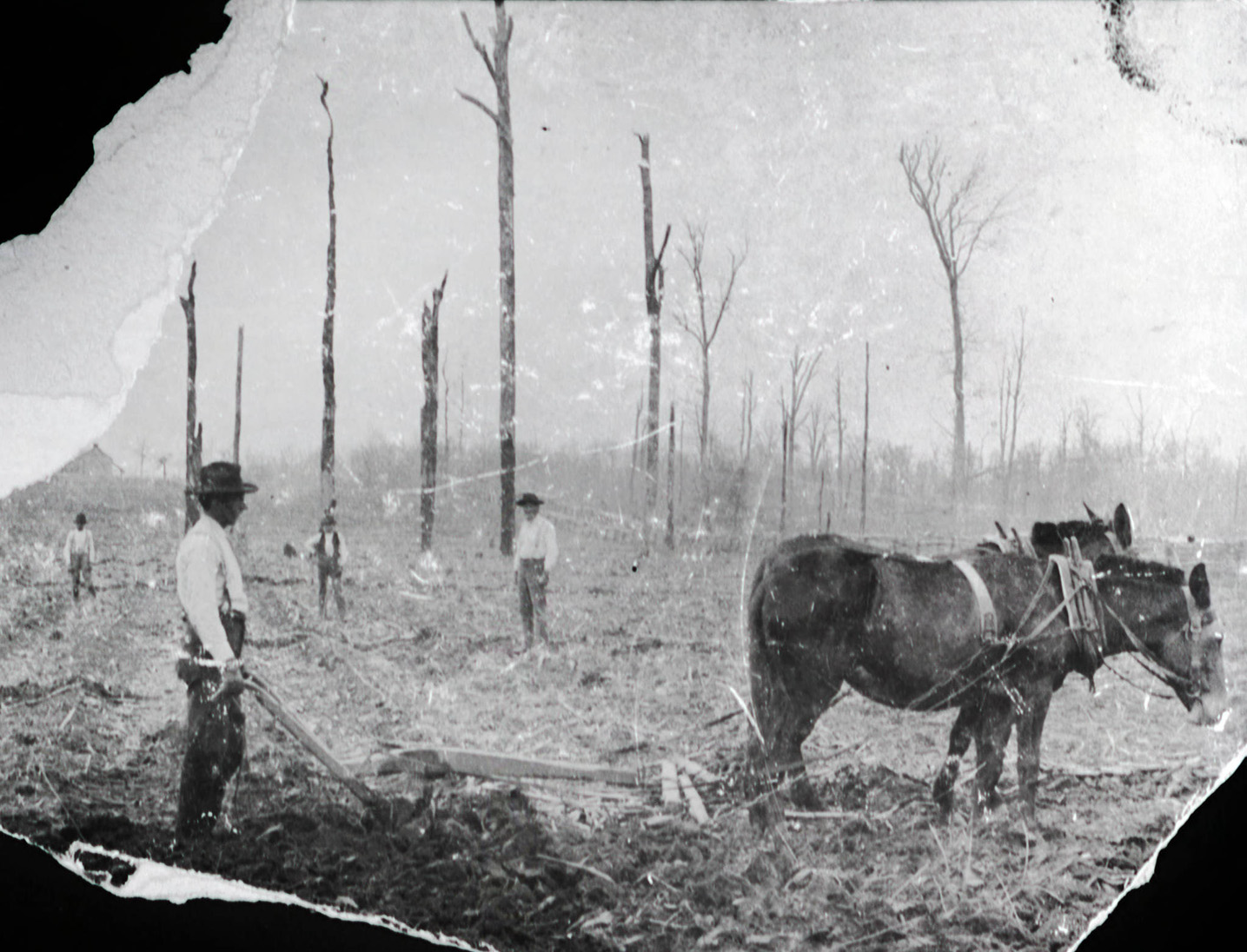
Photo: Peyton Overall clearing the land on his farm at the Hatchie River Bottom around 1800; photo credit: Tennessee State Library & Archives
While I was home for Christmas, my dad, my family’s dog Romeo and I spent a day exploring Haywood County, Tennessee. Along with finding some good Tennessee barbecue, we included a visit to the Hatchie National Wildlife Refuge.

Although I had passed the refuge hundreds of times, I had never given the Hatchie River much thought until I began researching its history for an earlier blog post. I soon discovered that the river was once an important transportation route for the region’s early settlers. Flatboats and, by 1828, steamboats traveled the river, connecting landings in West Tennessee with the Mississippi River and larger markets beyond. The boats carried passengers, supplies, agricultural products and, especially, cotton.
The federal government established the Hatchie National Wildlife Refuge in 1964 to provide protected habitat for migratory birds. Today, it covers 11,556 acres along 23 miles of the middle reaches of the Hatchie River. Its landscape includes nearly 9,800 acres of bottomland hardwood forest, along with swamps, sloughs, streams, open water, agricultural fields, grasslands and upland forest.

As with many projects of this size, the refuge did not receive universal support when it was proposed. Newspaper coverage documented opposition from some local landowners who did not want to sell property included within the refuge boundaries. Their concerns were understandable. The creation of the refuge protected an important natural area, but it also required some families to give up land that may have been in their possession for generations.1
More than 97% of the refuge was acquired through the Migratory Bird Conservation Fund, which receives most of its revenue from the sale of Federal Migratory Bird Hunting and Conservation Stamps, commonly called Duck Stamps. Today, 98% of the purchase price of each Duck Stamp goes directly toward acquiring and protecting wetland habitat and conservation easements.
When we arrived, I was surprised by how much there was to explore.
Oneal Lake is a good place to begin. Observation areas provide views across the water, and the roads and trails surrounding the lake offer opportunities to watch birds and other wildlife. Signs near the entrance help visitors identify the paved and gravel roads, walking trails and sections of the refuge included in the auto tour.
The refuge was much larger than I had imagined. From the area around Oneal Lake, roads wind through portions of the bottomland forest and provide access to the Hatchie River itself. The refuge is also a great place for hiking, fishing, boating, birding, wildlife observation and photography.
The Hatchie River is particularly important because it remains largely undammed and unchannelized. The Nature Conservancy describes it as the longest naturally meandering river remaining in the Lower Mississippi Valley and the longest free-flowing tributary of the lower Mississippi River. Its floodplain is the largest remaining forested floodplain in Tennessee.
Those natural flood cycles support an unusually diverse ecosystem. More than 100 species of fish, 35 species of freshwater mussels and about 250 species of birds use the Hatchie River and its surrounding forests. River otters, beavers, white-tailed deer, turtles and other wildlife also make their homes there.⁷
The refuge has been recognized as an Important Bird Area because of its value to migrating and nesting birds. Mississippi kites, cerulean warblers and Swainson’s warblers are among the notable species found there. Prothonotary warblers, American redstarts and Acadian flycatchers also commonly nest within the refuge.

During our visit, Romeo was just as interested in the river as we were.
The Hatchie National Wildlife Refuge is one of those places I had driven past many times without fully appreciating what was there. It preserves part of Haywood County’s history while protecting one of West Tennessee’s most important natural landscapes.
Anyone planning a visit should check the U.S. Fish and Wildlife Service website for current maps, regulations and information about seasonal closures. The refuge office is at 6772 Highway 76 South in Stanton.
For more of my genealogy research, visit rscottwilliams.info.
Notes:
- “U.S. Is Pushing Refuge,” Jackson Sun (Jackson, TN), August 2, 1964, 13.,” Aug. 2, 1964, 13. ↩︎


Leave a Reply