
Whenever I live through a period that I know people will someday study as “history,” I find myself thinking about my ancestors and wondering how they experienced the upheavals of their own time.
That was especially true on April 4, 2020, during the opening weeks of the COVID-19 pandemic. While doing a little genealogy research to take my mind off the news, I realized that April 4, 1920 — exactly 100 years earlier — had been Easter Sunday.
I began imagining what it would be like to spend that Easter traveling Poplar Corner Road and visiting the members of my family who were living there at that time. I hoped the exercise might offer a temporary escape from the pandemic. Instead, I discovered that many of those families were living in the shadow of another one.
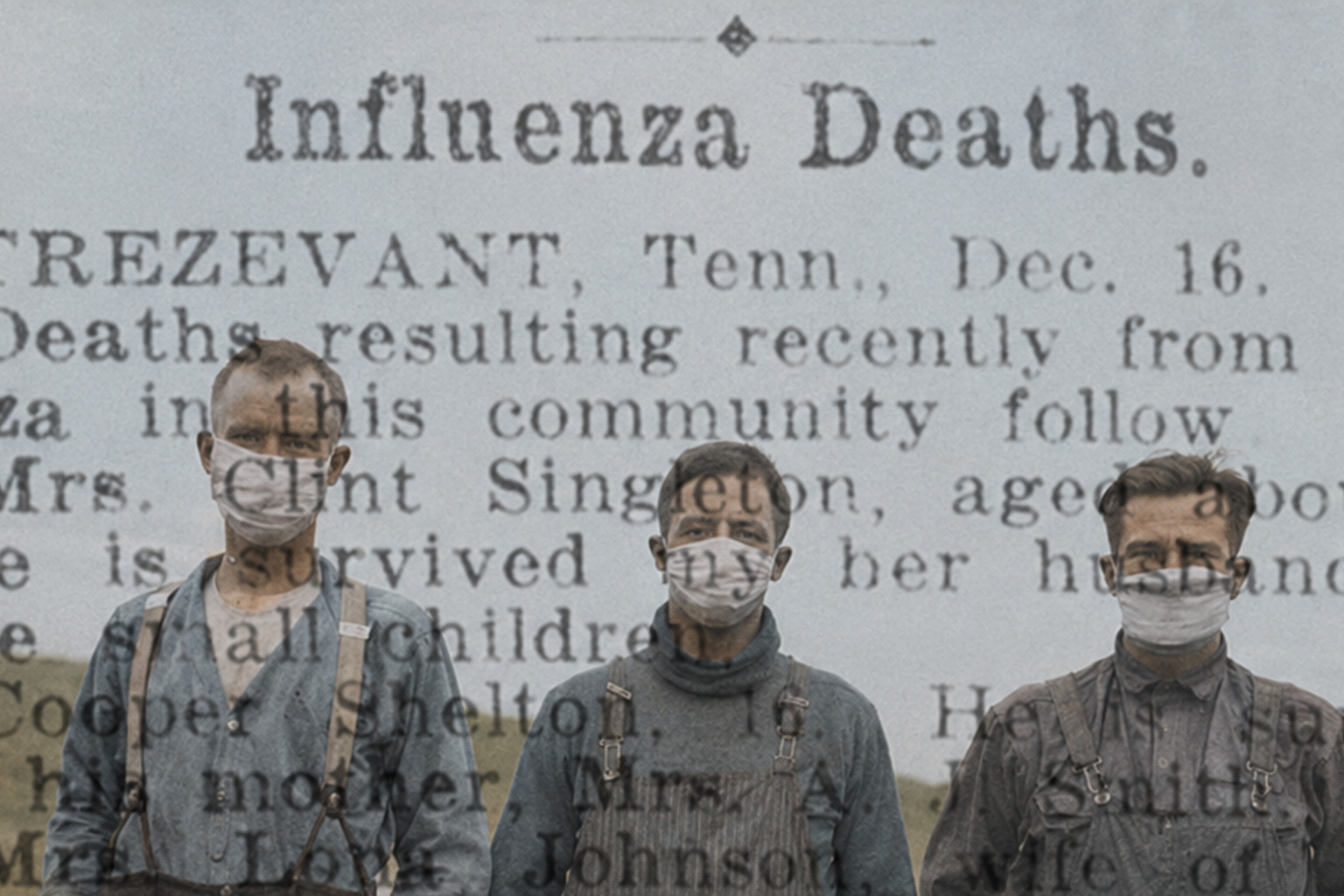
The influenza pandemic commonly called the Spanish flu had swept around the world in devastating waves beginning in 1918. An estimated 500 million people — about one-third of the world’s population — became infected, and at least 50 million died. The United States lost about 675,000 individuals to the disease. Although the worst waves had passed by Easter 1920, the disease and its consequences must have remained painfully fresh in the memories of families throughout Haywood County.1

Easter morning at Holly Grove
I would begin my visit at Holly Grove Baptist Church on Poplar Corner Road. On Easter Sunday morning, a church filled with Castellaws, Watridges, Williamses and members of other interconnected families would be the ideal place to begin finding my ancestors.
The congregation had been organized on the second Sunday in October 1885, when 38 former members of Zion Baptist Church met in the Holly Grove School. The one-room school stood on an acre donated by my third-great-grandmother Nancy Miranda Johnson Castellaw (1844-1921). Her daughter Mary Jennie Castellaw Jacocks (1866-1946) became its first teacher.
Nancy donated the school property, but the land on which the church building stood came from Dorsey H. Watridge (1840-1890) and his wife, Mary E. Watridge (1844-1899). Their deed was filed in July 1886. The congregation continued meeting in the school until it completed its first church building several years later.

Holly Grove Baptist Church in the late 1940s with Bob and Zula’s house in the background; Photo credit: Sandra Smith
Nancy grew up in the Johnson Grove community northeast of Brownsville, near Alamo in what became Crockett County. She was a daughter of Charles Randall Johnson (1802-1864) and Margaret Louisa Wood Johnson (1808-1862). Her maternal grandfather, Francis M. Wood (1777-1843), was among the early white settlers of that part of West Tennessee.

My father, Bob Williams, and I once explored the Johnson Grove community to see what evidence of our family remained. We found generations of Johnsons and Castellaws buried in the cemetery there.
Charles Johnson was a prosperous farmer and landowner who donated property for Johnson Grove Church. He also enslaved a substantial number of people. When his estate was divided after his death on April 14, 1864, his heirs received land, possessions and human beings who were assigned monetary values. Nancy’s share included two women identified only as Manda and Cherry, whose birth and death dates remain unknown. The estate appraised them together at $675.
If I could sit beside Nancy that Easter morning, I would ask what she remembered about her enslaved people. Where did they live? Did either have a family? What happened to them after emancipation? Did they remain in West Tennessee or leave the Johnson property when freedom became possible?
I also would ask Nancy how she understood the enormous changes she had witnessed. She had grown up in a slaveholding household, lost both parents during the Civil War and watched a community built upon slavery collapse. Fifty-five years had passed since the war ended, but the consequences remained visible in way people farmed, churches and the loss of family fortunes all around her.
Nancy and the Castellaws
Shortly after the Civil War, Nancy married Thomas Jefferson “Tom” Castellaw Jr. (1841-1879), a son of Thomas Jefferson Castellaw Sr. (1808-1878). Tom had served in the Confederate 7th Tennessee Cavalry, a regiment associated with Brownsville’s Col. William L. Duckworth. Elements of the regiment surrendered and were paroled at Gainesville, Alabama, in May 1865. Tom returned to Haywood County and married Nancy on Aug. 16.
Tom and Nancy had nine children, although several died at birth or during infancy. Tom died in March 1879 at only 37, leaving Nancy with young children and considerable responsibility for the family’s property.
In 1888, she married Tom’s half-brother John Edward Castellaw (1833-1896). John had suffered extraordinary loss nearly two decades earlier. His first wife — Nancy’s sister, Margaret Wood Johnson Castellaw (1836-1870) — died April 18, 1870. Three of their children followed within weeks: Mary L. Castellaw (1856-1870) on April 21, Dicy A. Castellaw (1862-1870) on April 30 and William R. Castellaw (1859-1870) on May 14.
Family tradition has sometimes attributed those deaths to yellow fever. The best-documented West Tennessee yellow fever epidemics occurred in 1873, 1878 and 1879, not during the spring of 1870. The close timing of the four deaths strongly suggests an infectious disease of some sort.
John Edward died in 1896, and Nancy did not marry again. The 1920 census recorded her as a 75-year-old widow and head of her household. Living with her was a 56-year-old housekeeper identified as Mrs. Dan Mathias.
Nancy remained surrounded by her children, grandchildren and members of the Castellaw, Williams, Watridge, Brantley and Lovelace families. On Easter Sunday 1920, she had only about nine months left to live. She died Jan. 8, 1921, and was buried beside Tom in the small Castellaw family cemetery off Poplar Corner Road.
It seems I would be reaching her with little time to spare.
Bob and Zula Castellaw
Nearby I would find Nancy’s son, Robert Edward “Bob” Castellaw (1868-1954), then 51, and his wife, Zula Zera Watridge Castellaw (1875-1940) was 45. Bob farmed and operated a small country store near the intersection of Poplar Corner and Dr. Hess roads.

Robert Edward “Bob” Castellaw (1868-1954), Zula Zera Watridge Castellaw (1875-1940) and their children, around 1908. Back row, l to r: Bob, Isaac and Daniel, front row, l to r: Brant, Rob, Zula and Irene. Ruby and Elizabeth had not yet been born.
Their youngest daughter, my grandmother Elizabeth Castellaw Williams (1915-1998), was 5. She later joked that her father spoiled her because she was the baby of the family. I would enjoy watching the family together before illness and tragedy altered their lives.

Bob and Zula Castellaw
Bob’s later history requires careful wording this many years later. Facts are few but according to family accounts past down through the years, he developed serious behavioral or psychiatric problems. In February 1940, Zula told my grandmother that she had been injured during a struggle with him. She died March 8 after what her obituary described publicly as a 12-day illness. Bob was subsequently committed to Western State Hospital in Bolivar, where he remained until his death in 1954.
The Williams family next door
The 1920 census placed my paternal great-grandfather William Lafayette “Will” Williams (1888-1962) and his second wife, Eva Iris Overton Williams (1896-1970), near Nancy Castellaw.

Will Williams with Eva, their daughters Ladonia and Mary and Will’s son, Bo, about 1917.
Will’s son from his first marriage, Jesse Lloyd “Bo” Williams (1910-2008), was 9. Living only a short distance away was 5-year-old Elizabeth Castellaw, the girl Bo eventually would marry.
Bo’s mother, Janie Elizabeth Williamson Williams (1887-1914), had died in August 1914, when he was not quite 4. More than 90 years later, my wife, Michelle, asked him about his childhood. He proudly told her that he had never forgotten his mother.
I would like to hear him describe Janie while his memories were still recent. Perhaps he could recall her voice, the clothes she wore or a story she shared about her own childhood. Such ordinary details rarely appear in census records, marriage licenses or death certificates, but they are the things that make a person come alive in genealogy research.
Down Poplar Corner Road
From Holly Grove, I would travel toward Zion Baptist Church to find my maternal great-grandparents William Day “Willie” Brantley (1897-1969) and Allie Ern Marbury Brantley (1898-1995). They had married Dec. 21, 1916, when he was 19 and she was 18.

Willie and Allie Brantley, probably about 1935.
According to notations associated with the 1920 census, they lived “on a byroad north of Hardy Cobbs’.” Their farm was along what is now called Brantley Road.

Allie and Willie Brantley with (front row from left) Virgina and Cordelia. Willie is holding Betty.
Their oldest daughter, my grandmother Virginia Brantley Lovelace (1917-2007), was 2. Their second daughter, Dorothy Cordelia Brantley Jacocks (1919-2005), was 6 months old. Their youngest daughter, Betty Jean Brantley Sullivan (1926-1996), would not be born for another six years.
Willie and Allie lived near Archie Erbert Brantley (1880-1953), Archie’s wife, Mary Castellaw Brantley (1878-1962), and the family matriarch, Margaret Rebecca Steele Brantley (1850-1930). All of them worked small farms clustered along the road.
Willie and Allie Brantley with their daughters Virginia, Betty and Cordelia.
Betty later wrote about the food and work that defined her childhood:
My folks raised most of our food stuff. They killed and cured our pork and canned or dried the fruit from the orchard. Vegetables from the garden and truck patches were also canned. We raised chickens and the cows were milked twice a day to provide fresh milk and butter. There was not a lot bought from the store; only flour, meal, etc. … My playmate Sunshine Cobb used to say, “I’d rather have Aunt Allie’s biscuits than cake.”
Her memories were recorded years later, but the habits she described had already been established by 1920. Their farm supplied pork, milk, butter, eggs, fruit and vegetables. What little cash purchases they made were limited largely to things the family could not produce itself and could not live without.
I would make certain I arrived in time for Easter lunch. Allie’s biscuits, country ham, homemade butter and preserves sound like an excellent reason to linger.
Margaret Steele Brantley
I also would hope to find Willie’s grandmother Margaret Rebecca Steele Brantley at the table. She was 69 and had been widowed for less than two years.

Henry Day Brantley and Margaret Rebecca Steele Brantley.
Margaret and her husband, Henry Day Brantley (1845-1918), had 10 children and at least 24 grandchildren. Henry suffered for several years from an illness that family tradition later suggested might have been Parkinson’s disease. He died Nov. 5, 1918.
Three of their sons married three Castellaw sisters. Walter Brantley (1876-1933) married Emily Castellaw Brantley (1880-1926). Archie Brantley married Mary Castellaw. Vivian “Viv” Brantley (1882-1964) married Joseph Lyda Castellaw Brantley (1882-1923), a couple whose names often causes confusion in family records: Viv was married to Joseph but Joseph was the wife and Viv was the husband.
By Easter 1920, Margaret was living with Archie and Mary. A surviving photograph from around that period shows them with Archie’s English shepherd, Jeff.

Archie Brantley and Mary Castellaw Brantley with Margaret Steele Brantley and Archie’s English Shepard, Jeff, about 1920; Photo credit: Joe H. Cobb
At that time, Margaret was mourning her son Reginald A. Brantley (1885-1919), who died Feb. 16, 1919. His Zion Baptist Church obituary praised him as a husband, father and citizen but did not identify his illness. Family research has associated his death with pneumonia following influenza.
Henry, Reginald and other relatives were buried in the Brantley family cemetery. The small burial ground eventually became an island of trees surrounded by cotton fields. Margaret joined them there after her death in 1930.
When I first visited the cemetery in 2012, I found an old conch shell resting on Henry and Margaret’s headstone.
I once wondered whether Henry or Margaret’s family brought it from North Carolina. If I could visit Margaret in 1920, I would ask whether the shell belonged to her and whether it held some family significance.
Centerville School
Somewhere farther along Poplar Corner Road stood Centerville School, built about 1910. I would stop for a moment to look around inside at the school that many of my ancestors attended when they were small. Local historian Martha Jones, described it in her self-published book, “A Journey Into Yesteryears,” as a three-room school with a stage in the large center room.

Children at Centerville School in the early 1900s; Photo credit: Joan
1. Leslie Fowler
2. Robert Brantley, a son of Vivian Brantley and his wife Joseph Castellaw
3. Blanch Lovelace, the sister of my grandfather, Guy Lovelace
4. Camillia Watridge, daughter of Champ Watridge
5. Joe Watridge, son of Champ Watridge
6. Ovid Lovelace, brother of my grandfather, Guy Lovelace
7. Clara Brantley, sister of my great-grandfather, Willie Brantley
8. Guy Brantley, brother of my great- grandfather, Willie Brantley
9. Mabel Marbury, sister of my great-grandmother, Allie Marbury Brantley
10. Gladys Brantley, sister of my great grandfather, “Willie” Brantley
This photograph from the early 1900s includes children from several of my family lines.
My great-aunt Marie Lovelace Carlton (1921-2022) later remembered a peach tree growing outside one of the school’s windows. She said teacher Irene Booth sometimes threatened misbehaving children with a little “peach tree tea” — a whipping administered with a switch cut from the tree.
The Marburys and Sim Cobb
Living on a road the census taker described as “Cobb Switch to Centerville School” was my great-grandmother Allie’s family.
Her father, Hardy Joyner Marbury (1872-1932), was 47. Her mother, Sarah Evelena “Lena” Booth Marbury (1868-1949), was 51. Allie’s sister Mabel Clara Marbury (1901-1942) was 19. An unidentified 43-year-old member of the Patterson family also lived in the household.
Next door lived Simeon Amherst “Sim” Cobb (1840-1927) and his third wife, Caroline Fletcher “Callie” Betts Cobb (1871-1935). Sim was 79; Callie was 48.

Simeon Amherst “Sim” Cobb
Sim kept a detailed diary during part of 1875, recording farm work, visits, illnesses, deaths and other community events. Those entries are particularly valuable because the people he mentioned were not historical celebrities. They were relatives and neighbors whose daily activities seldom appeared in newspapers or official documents.
Joe H. Cobb, whose dates remain unconfirmed, preserved much of the diary in Nicholas Cobb: Descendants, Neighbors, and Relatives, 1613-1983. Without that transcription, another firsthand record of rural Haywood County might have disappeared.
The Cobb family cemetery
Before reaching Zion Baptist Church, I would stop at the Cobb family cemetery. The property had been set aside by my third-great-grandfather John Hardy Cobb (1798-1880).
John Hardy and his wife, Harriet Warren Castellaw Cobb (1804-1869), recorded in their family Bible that they left Bertie County, North Carolina, on March 6, 1834, and arrived in Haywood County on April 22. Their journey took about seven weeks.
Harriet’s father, John Dawson Castellaw (c. 1780-1859), helped lead groups of related families from Bertie County to West Tennessee. He eventually settled in Haywood County himself. The Cobb cemetery became the burial place of members of the Cobb, Castellaw, Watridge, Williams and Brantley families.
Many gravestones have since disappeared. Family records, Bible entries, cemetery surveys and books have preserved at least some knowledge of the people buried there.
One of the newest graves on Easter Sunday 1920 would belong to Thomas Adelbert “Dell” Cobb (1877-1920), who died Feb. 2 and left a widow, Elizabeth Frances “Lizzie” Gordon Cobb (1879-1938), and two young sons.
Another recent grave in the Cobb Cemetery would be that of Virginia Estelle “Essie” Cobb Williams (1861-1919), who died Dec. 18, 1919. Essie was a daughter of John Charles Warren Cobb (1830-1914) and Penelope Trottman White Cobb.
Essie’s death certificate reportedly attributed her death to pulmonary abscesses that developed after influenza, another victim of the pandemic.
In 1900, Essie had become the third wife of my second-great-grandfather George Dempsey Williams (1846-1919). Their daughter, Mary Lorene Williams Brantley (c. 1901-1936), married Henry Earl Brantley, Lorene died from acute appendicitis in 1936 at only about 34.
On Easter afternoon 1920, I might find Lorene or other family members placing flowers on Essie’s new grave.
Preston and Mary Etta Brantley
Across the road stood the home of my second-great-grandparents Henry Preston Brantley (1872-1956) and Mary Etta Cobb Brantley (1871-1935), Willie Brantley’s parents. The house had been built by Mary Etta’s father, William Thomas “Tom” Cobb (1833-1898).
Several of Preston and Mary Etta’s children remained at home in 1920. Gladys Brantley (1895-1984) was 24, Clara Brantley (1902-1994) was 17, Preston Guy Brantley (1904-1994) was 15 and Mary Elizabeth Brantley Marbury (1909-2003) was 10 or 11.

Photo: Henry Preston and Mary Etta Cobb Brantley with their children. In the back row, from left, are Clara and Gladys. Standing between them is my great-grandfather, William “Willie” Brantley. Mary is seated in Mary Etta’s lap, and Guy is seated in Preston’s lap. Photo credit: Elsie Watkins Haynes
Gladys and Guy never married. Guy remained in the house until his death in 1994 at 90. I regret that I did not become serious about genealogy while he was still alive. Family members remember him as intelligent and widely read. He had known people born before the Civil War and could have shared stories that no document will ever replace.

At the far right are my second great-grandparents Henry Preston and Mary Etta Cobb Brantley with their children. Gladys Brantley is the tallest. My great-grandfather William Day “Willie” Brantley stands in front of her. He was the father of my maternal grandmother Virginia Brantley Lovelace. Clara Brantley Watkins is to Willie’s left. Mary Elizabeth Brantley Marbury is being held by her mother, and Preston Guy Brantley stands in front of his father. Bet is in the rocking chair next to the portrait of her husband, Tom.
Mary Etta was a daughter of Tom Cobb and Elizabeth Temperance “Bet” Outlaw Cobb. She was a granddaughter of John Hardy Cobb, who made the 1834 journey from Bertie County.
Her maternal grandfather, George W. Outlaw (c. 1803-1861), had traveled west with his first wife, Ludie Perry Outlaw (unknown-1842), and his widowed father, Jacob Outlaw. Jacob died in Knoxville before completing the trip.
In 1860, the widowed George, then about 57, married 20-year-old Rowena Linley Outlaw. Family accounts say his adult children opposed the marriage. George and Rowena moved to the vicinity of Earle, Arkansas, where he died the following year.
Zion Baptist Church
Many of the Bertie County migrants who moved to Haywood County had Baptist connections in North Carolina. Soon after reaching Haywood County, a group established Zion Baptist Church.
On the Saturday before the third Sunday in November 1836, the congregation met in its building and elected the Rev. George S. Williams (1797-1852), my fourth-great-grandfather, as pastor. Church minutes record that a member was instructed to write Williams and inform him of the call.
George had previously served at Holly Grove Baptist Church in Bertie County. His movement to Tennessee strengthened the connection between the old community and the new one. Zion became far more than a place for Sunday worship. Its minutes recorded marriages, deaths, disciplinary proceedings, membership transfers, disputes and the creation of other congregations such as Holly Grove.
By the time I reach Zion on Easter Sunday 1920, the church will already be more than 80 years old. Several generations of my family had worshipped there, served as deacons and committee members and been buried across the road.
Jim and Ruby Lovelace
Around the corner from Zion I would find the family of my great-grandparents James Luther “Jim” Lovelace (1885-1968) and Ruby Fowler Lovelace (1887-1952). Their son, my grandfather Guy Clinton Lovelace (1916-1997), would be 3.

Centerville School in the late 1920s. Guy Lovelace is in the top row left. Hiis brother Homer Lovelace is in the bottom row left standing alone.
The family had recently completed a new house. Their children at home would include Ovid Monroe Lovelace (1906-1983), 13; Earl Jack Lovelace (1907-date unknown), 12; Blanche Lovelace (1910-1994), 9; James Homer Lovelace (1914-1976), 5; Guy, 3; and Otha C. Lovelace (1919-1961), about 6 months old. Marie Lovelace Carlton would be born the following year.
Ruby’s father, Lewis M. Fowler (1852-1938), also lived with them, as did Jim’s young nephews Jesse Thomas Fowler and William Leslie Fowler.
Lewis’ wife, Sarah E. Patterson Fowler (c. 1851-1920), had died Jan. 25, only a little more than two months before Easter. Family research identifies pneumonia following influenza as the cause, making her another victim of the pandemic.
Her absence would have been unmistakable. The family was still adjusting to a household in which Lewis had lost his wife and Ruby had lost her mother. Easter dinner, church services and family visits would have carried the weight of recent grief.
Charlie and Nancy Lovelace
Just across a field, in a house built around the Civil War era, lived Jim’s parents, Charles Buchanan “Charlie” Lovelace (1858-1938) and Nancy Jane Yelverton Lovelace (1861-1936).
Several of their children remained at home at Easter 1920. The family’s Yelverton and Blount ancestry reaches deep into colonial North Carolina, although some of the earliest connections in online family trees still require stronger documentary proof. I would ask Nancy what she had been told and whether any oral history survived in 1920.

Charles Buchanan Lovelace and Nancy Jane Yelverton Lovelace
Zion’s minutes provide one particularly intriguing glimpse of Charlie’s community life. In 1890, the church appointed a committee to speak with Charles Lovelace about “allowing dancing in his home.” The report found the accusation true, and the church “disciplined” him.
The minute does not say Charlie played music at the dances, but it is tempting to connect the episode with a fiddle that descended through the family and eventually came to live at my house. If it was his instrument, I would love to hear him play it in 1920 — knowing that a century later it would hang on our wall.
Easter evening at Zion
I would finish my journey at Zion Baptist Church before the evening service or what Baptist call Training Union began.

Zion is where my mother was baptized and where my parents were married. Today, the cemetery across the road contains many of the people I would have visited that day in 1920. Michelle and I also have plots there, so it will probably become my final resting place someday as well.
Standing outside the church in 1920, listening to them sing hymns, I would hear the voices of family members I first encountered on census pages and death certificates. They would not yet know which children would marry, which farms would remain in the family or which photographs and stories would survive.
They also would not yet know how history would remember their time. To them, the influenza pandemic was not a paragraph in a history book. It was an empty chair, a recent grave, a widowed parent or a child left without a mother.
That may be the most valuable lesson I could bring home from my imaginary Easter in 1920. The people we call ancestors did not experience history as a series of dates. They experienced it one illness, one meal, one funeral, one church service and one ordinary day at a time.
After the evening service, I would leave Zion and return to April 2020 with more answers, but probably even more questions. I also would return with a deeper appreciation for the people who endured their own uncertain times and continued building families and communities from which we still benefit.
- Centers for Disease Control and Prevention, “History of the 1918 Flu Pandemic,” archived CDC website, accessed August 4, 2026; Jeffery K. Taubenberger and David M. Morens, “1918 Influenza: The Mother of All Pandemics,” Emerging Infectious Diseases 12, no. 1 (January 2006): 15-22. ↩︎


Leave a Reply