
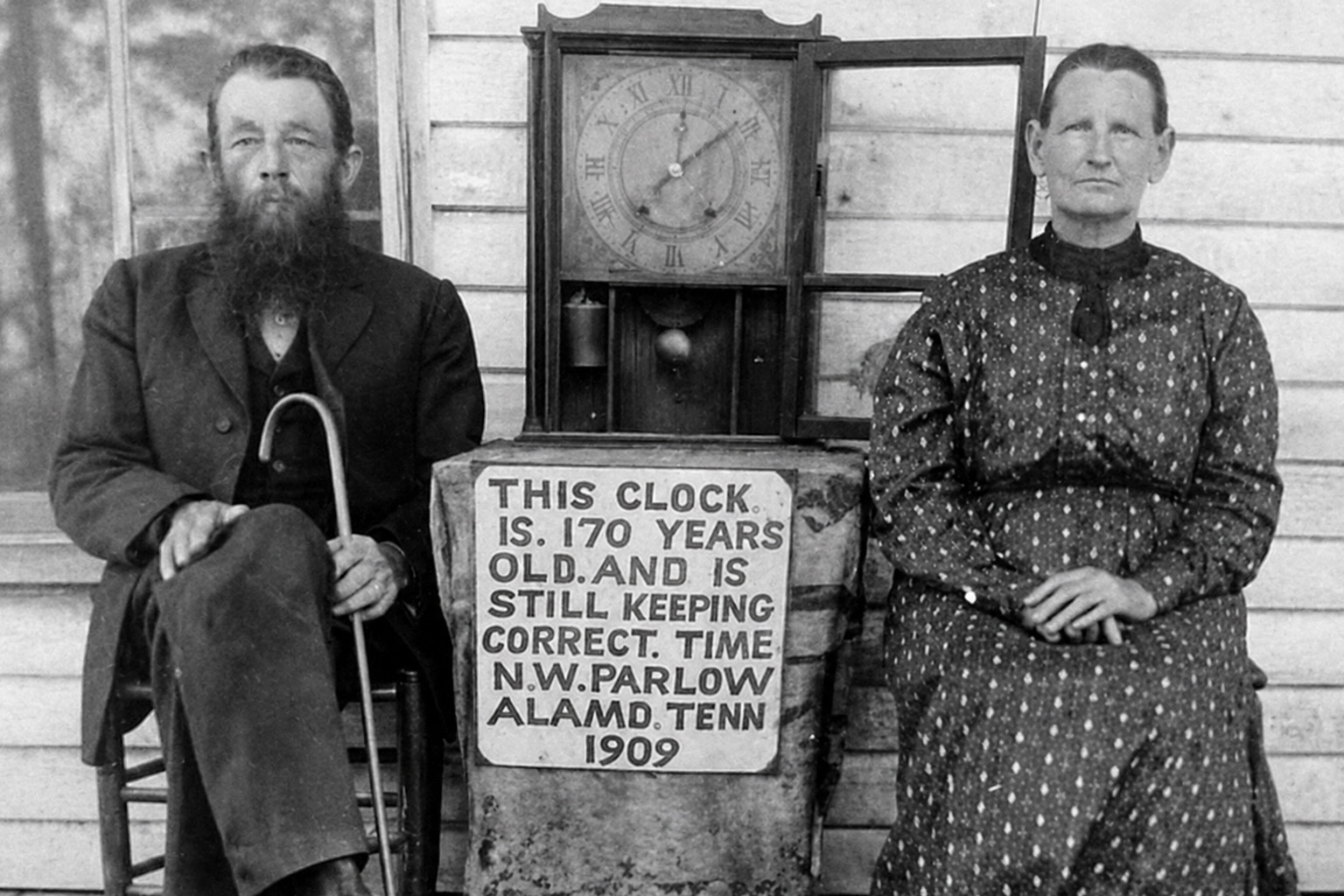
Photo: In 1909, Nathan Washington Parlow (1849–1919) and his second wife, Martha B. Womack Parlow (1852–1928), posed at their home in Alamo, Tenn., beside a clock that Nathan said was 170 years old and “still keeping correct time.” /
Although this West Tennessee couple is not in my direct family line, I recently came across their photograph on Facebook and immediately wanted to know more about them. I especially love that Nathan was apparently so proud of his old clock that he prepared a hand-lettered sign and positioned the timepiece between himself and Martha as though it were another member of the family.
The sign reads:
THIS CLOCK
IS 170 YEARS
OLD AND IS
STILL KEEPING
CORRECT TIME
N.W. PARLOW
ALAMO TENN
1909
If Nathan’s claim was accurate, the clock would have been made during the colonial period, 37 years before the Declaration of Independence. Clocks remained uncommon and very expensive possessions in early 18th-century America.
I took the “time” to so a little research, and Nathan’s clock appears to be an early American pillar-and-scroll shelf clock, probably made in Connecticut during the 1820s or early 1830s. Its mahogany-veneered case, scroll-shaped crest, painted Roman-numeral dial, central pendulum and cylindrical weights closely resemble clocks produced by Eli Terry and other Connecticut makers, including Seth Thomas, Samuel Terry, Ephraim Downes and Silas Hoadley.
It likely had a 30-hour, weight-driven wooden movement and originally may have included brass finials and a decorative reverse-painted lower glass panel, both of which appear to be missing. Similar examples like the one below have sold at auction for several hundred dollars to more than $1,000, depending on the maker, condition and amount of original material remaining.

Regardless of the actual age of Nathan’s clock, their family name sounded familiar to me. As I researched, I realized there was a stronger family connection than I initially realized.
The Parlow family in Madison County
Nathan was born May 19, 1849, in Madison County, Tenn., to Charles Henry “Seth” Parlow (1803–1889) and Nancy Wright Parlow (1816–1890). Nathan was the youngest of their large family.
One theory is that the clock came to Nathan through his father. A 1915 Tennessee death certificate for Nathan’s brother, Isaac Parlow (1836–1915), identifies their father as “Chas. Parlov” and gives his birthplace as Boston, Mass.
Charles eventually settled near Denmark and Uptonville in Madison County, where he became a farmer and landowner. Records examined by Madison County historian Thomas L. Aud show that Charles reported losing 4,080 pounds of cotton valued at $1,020 when it was burned during the Civil War. That was a considerable agricultural loss, although the record does not establish if the family remained prosperous after the war.1
Charles died March 24, 1889, and was buried in Uptonville Cemetery. Although Nathan was the youngest son, Charles’ will shows that birth order did not prevent Nathan from receiving an inheritance. Charles directed that, after Nancy’s death, Nathan was to receive “40 acres from the northeast corner of the home tract.” Another son received the remaining land, while several other sons received only $5 each. Charles left the household and kitchen furniture to two daughters.
No mention of passing down a clock.
Nathan’s first marriage
Nathan married Arlesia “Alssia” Yarbrough Parlow (1849–1879) in 1870. Her given name appears in several forms. Their marriage record identifies her as “Miss Alssia Yarbrough.” It also shows that the marriage license was issued Aug. 25, 1870. A later obituary for their daughter Sarah identifies her mother as “Arlesia Yarbrough Parlow.”

This enhanced photo was likely taken around 1900. Back row from left: Martha Agnes Parlow Castellaw (1873-1961), Alice Lugenia Parlow (1872-1906), George Washington Parlow (1877-1957), Elizabeth “Lizzie” Parlow (1886-1978) and Sarah Jane Parlow (1874-1966); Front row from left: Ousmond Benjamin “Ause” Parlow (1886-1967), Nathan Washington Parlow (1849-1919), Martha Braking Warmack Parlow (1851-1928) and Edwin Oscar Parlow (1888-1912). Lizzie and Ause were twins. Nathan had a unique look and some strong genes. His children all clearly “took after” their father. Photo credit: Sarah Jackson Conley
Agnes is the great-grandmother of Sarah Jackson Conley of Alamo, Tennessee who shared the photo at a Castallaw family reunion.
Nathan and Arlesia had four known children: Alice, Martha, Sarah Jane and George.
Arlesia died Dec. 29, 1879, at about age 30 and was buried in Uptonville Cemetery. Her death left Nathan with four young children.
The 1880 census records Nathan and the children in the household of his parents, Charles and Nancy, in Madison County’s 4th Civil District. The arrangement would have given the widowed father help caring for his children while the family continued farming.
The connection to the Castellaw family
On Dec. 5, 1895, Nathan’s daughter Martha Agnes married John Frank Castellaw (1872–1941), a brother of my great-grandfather Robert Edward “Bob” Castellaw (1868-1954). Frank and Agnes had seven children and lived in a large white house across from a cotton gin on Poplar Corner Road near Holly Grove Baptist Church. By all appearances, it was an unhappy marriage, and the couple ultimately divorced in 1918.
When I was a boy, I spent considerable time with my grandmother. She loved telling me the more dramatic stories about her father’s Castellaw family. Whenever she discussed Frank and Agnes’ troubled marriage, she almost always added, “Agnes came from money.”
Agnes’ grandfather Charles owned land and that he had once possessed a substantial quantity of cotton. Nathan also inherited land from his father. Those records suggest that the Parlows had property, but they do not mean that Agnes was wealthy by the time she married Frank.

John Frank Castellaw and Martha Agness Parlow Castellaw after 1905 with children (likely) Thomas Jefferson Castellaw (1897-1956), Nancy Arlesia Castellaw (1900-1995), and Leola Gertrude Castellaw (1905-1993).
John Frank and Martha Agness had seven children together. Their son, John Frank Castellaw Jr., named after his father, was born in 1903 and lived only a short time.
In addition to the three children pictured above, they were the parents of James Francis Castellaw (1908-1989), Malcolm R. Castellaw (1911-1976) and Aaron Samuel “Sammy Castellaw (1914-1944). Sammy died in World War II and was buried at Holly Grove Cemetery.
Before the January 1918 term of the Haywood County Circuit Court, Agnes filed for divorce from Frank and sought custody of their five children. According to legal documents about the case, Frank was served but failed to answer the complaint, allowing the court to enter an order pro confesso against him. After hearing testimony, Judge Thomas E. Harwood granted Agnes the care, custody and control of the children. When Frank later attempted to challenge that arrangement, Agnes responded that nothing had changed since the original decree to justify removing the children from her care. On April 25, 1922, the court permitted her to amend her answer and rely upon the earlier custody decree as a legal barrier to Frank’s claim.2
After a very long custody battle, John Frank and Martha Agness were divorced by March 1, 1918 when John Frank married Beulah Louise Duncan (1899-1931).
A telling family story about the estangement of Frank and Agnes appeared in the 1984 genealogy Nicholas Cobb: Descendants, Neighbors, and Relatives, 1613–1983. According to the account, the estranged Agnes arrived at the family home with a mule-drawn wagon to retrieve Sammy, their youngest child. Frank discovered what she was doing and gave chase as Agnes drove the wagon up the road through Holly Grove.
| “The story was told that Frank and Agnes were having marital problems and were estranged for a time. Frank had Sammy, the youngest child, and Agnes desired to get him. She drove a team of mules and wagon to the homeplace when she thought Frank was gone and proceeded to load Sammy into the wagon. Frank was not as far off as Agnes had thought, and he saw what she was doing. Agnes saw him coming and hit the mules on their rears with the lines. The race was on up the road through Holly Grove. It was like the stagecoach racing a band of marauding Indians.” 3 |
Agnes seemed to move on and have a very full and fulfilling life after her divorce.

“Mrs. Castellaw Rites Are Today,” The Jackson Sun, July 17, 1961, 10.
Nathan’s second marriage
On Oct. 20, 1881, Nathan married Martha Braking Womack (1851-1928) in Madison County.
Nathan and Martha later made their home in the Alamo area. They had three children together:
Ousmond “Ause,” Elizabeth “Lizzie” and Edwin.
Ause and Lizzie were twins. The record for Ause says he was born in McNairy County, suggesting Nathan and Martha had not yet settled permanently in Alamo at the time of the twins’ birth.
Oscar, the youngest child, died in 1912 while still in his early 20s. A memorial written by his sister-in-law states that he died Sunday afternoon, June 23, following an illness of about a month. An uncomfirmed report stated that he died of tuberculosis.
| In Memory of Oscar Parlow That death selects a shining mark, was verified last Sunday afternoon, June 23rd, 1912, when the Angel of Death entered the home of N. W. Parlow and called his son, Oscar, to his reward in heaven. He was the youngest child of Mr. and Mrs. Parlow, and was just budding into manhood when the summons came. Oscar possessed many virtues of the highest type, and was truly a man of courage, meeting every obligation of life bravely, and when the death summons came, he said, “I am asleep.” He was a loving, tender and devoted son, brother and friend. O, how hard to give up one so young and precious as was Oscar to us all. We see his grief-stricken parents traveling along this rugged path of life without the strong arms of affection of Oscar. He was always cheerful, had a kind word for everyone, especially father and mother. During his month of illness, not one word of complaint was he heard to murmur. How we miss the smiling face. There is a vacant chair that no one can ever fill and broken hearts that only God can mend. We no longer can hear his voice on earth. He was always ready to speak, a comforting word to the lonely ones. We would say, weep not as those who have no hopes, but live to honor God’s word that you may be worthily accounted of the crown that Oscar is wearing now. Only time can make us understand that he is now enjoying his rich reward for a life of service for the Master. A peaceful life with work well done is his. May the Lord bless the bereaved ones and save us all in heaven. Signed: His Sister-in-law.3 |
Nathan’s death
Nathan Parlow died June 25, 1919, at age 70. A newspaper notice reports that Nathan “died suddenly at his home near Quincy, this county.” It also reported that he had been “a member of the Baptist Church for fifty years.”4 He was buried in the Cairo Cemetery in Alamo where his young son Oscar had been buried 7 years earlier.
Martha died in September 1928 and was also buried there. Sarah Jane Parlow Cates, Nathan’s daughter from his first marriage, was also buried there after her death in 1966.
Now if we can just find out what happened to that clock.

Ause Parlow, Martha Agnes Parlow Castellaw, Sarah Jane Parlow Cates and Lizzie Parlow Conley in 1960. Photo credit: J. Cates
Notes:
- Thomas L. Aud, “Cotton and the Madison County Archives,” Family Findings (January 2015): 4. ↩︎
- Agnes Castellaw et al. v. Frank Castellaw, amendment to answer, April 25, 1922, Haywood County Circuit Court, Haywood County, Tennessee. ↩︎
- “Edwin Oscar Parlow Obituary,” Crockett County TNGenWeb, contributed by Joe Max Cates, 2007. ↩︎
- “N. W. Parlow,” The Tennessean (Nashville), June 25, 1919, 1. ↩︎


Leave a Reply