
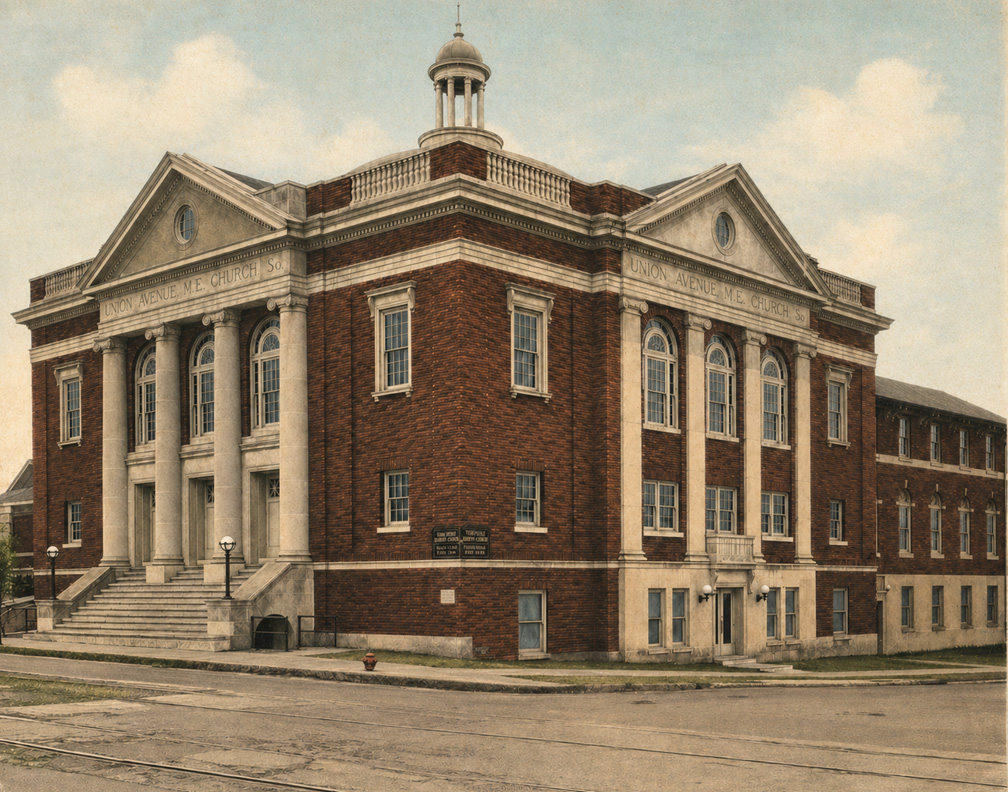
What Memphis Lost at Union and Cooper
In 1924, the congregation at Union Avenue Methodist Episcopal Church, South, installed an M.P. Möller pipe organ inside its new sanctuary at 2117 Union Ave. The instrument had 1,457 pipes, enough to fill that corner of Union and Cooper with the sound of hymns, weddings, funerals and Sunday mornings for generations.

The Commercial Appeal, Feb. 7, 1924, p. 17
Now that sanctuary is a pile of rubble.
It had been listed in the National Register of Historic Places in 1987 for good reason. Its education building dated to the World War I era, and its sanctuary followed in the 1920s. Memphis Heritage pointed out that John Gaisford and Hubert Thomas McGhee were architects connected with the complex, two names that place made the church an important part of Memphis’s architectural history.
However, membership declined and the Union Avenue church building became difficult to maintain. The remaining members of Union Avenue United Methodist Church merged with St. Luke’s United Methodist Church around Easter 2010. According to the Rev. Mark Matheny, pastor of St. Luke’s, the congregation had received no “written and solid offers” for the property other than a CVS proposal, and the former Union Avenue members wanted to use the merger to make “a significant contribution to God’s work in the world.”
Matheny wrote that portions of the church building and furnishings went to other churches and institutions, including a stained-glass window to First United Methodist Church downtown, the pipe organ to Memphis Theological Seminary and pews to local congregations and Methodist University Hospital. He also wrote that “significant financial gifts” from the sale proceeds would support world and local missions, including First Works, a ministry that had operated from Union Avenue. 1
CVS bought the property for $2.25 million for the church property and also bought adjoining land for $650,000. The company wanted the corner for a new drugstore, so the church had to go.
Who deserves the blame? CVS does not deserve all of it, although I will be a Walgreens customer from now on. The remaining church members agreed to sell their historic building for redevelopment, a decision I still have trouble understanding. Then, after Midtowners, preservationists and neighborhood advocates protested, the Memphis City Council approved the plan even though the Land Use Control Board had rejected it. In the end, plenty of people had a hand in what happened.
Those trying to save the church deserved better. Memphis Heritage, led by June West, argued that the building mattered to the whole neighborhood, not just to the congregation that owned it. Midtown Action Coalition, Idlewild and Central Gardens neighborhood leaders and other activists rallied at the site. Members of the family that originally sold the land for church use tried to stop the sale through the courts, citing a deed restriction that called for the property to remain a “place of divine worship.”
They lost because National Register status alone does not protect a privately owned building from demolition. They lost because the city approved the project. They lost because the legal fight did not stop the wrecking ball in time.
By March 17, demolition began. By March 29, a wrecking ball knocked down a wall of the sanctuary. Today, what is left of the church is a pile of rubble being hauled to the dump. It is a great loss for Midtown, for Memphis and for anyone who believes the city’s historic buildings help tell the story of who came before and the lives they lived.
More:
Crème de Memph, Lost Memphis 5: Union Methodist
- Mark Matheny, “Union Avenue United Methodist Church,” Memphis Flyer, March 24, 2011. ↩︎


Leave a Reply