
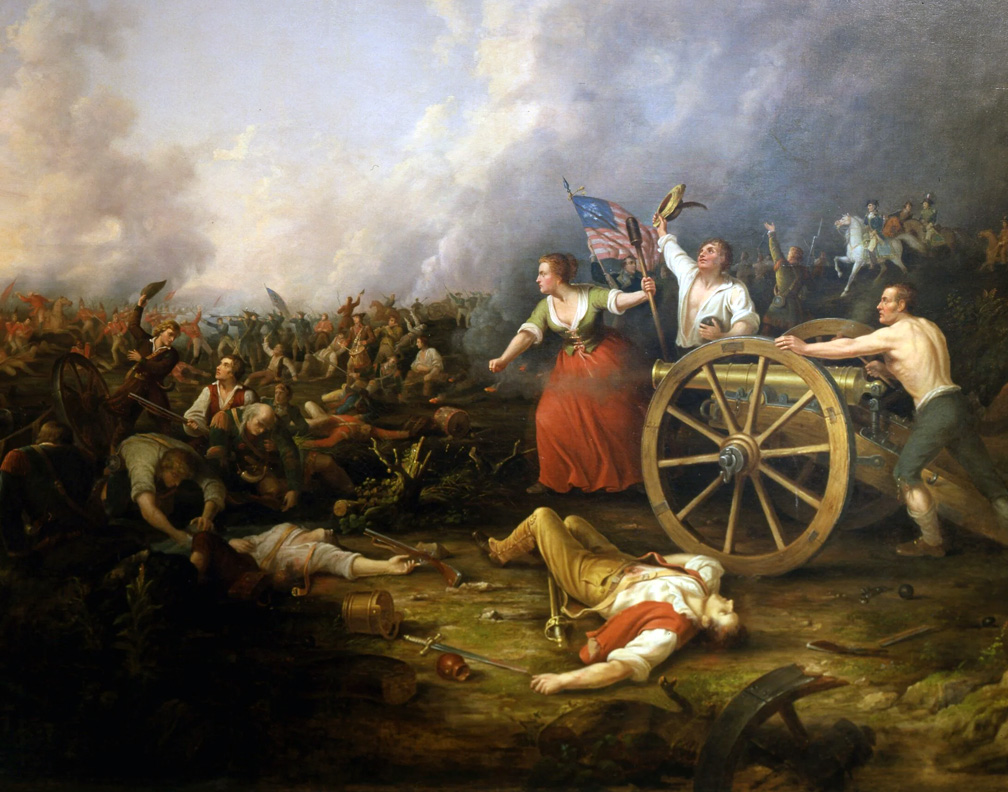
Photo: Molly Pitcher at the Battle of Monmouth by Dennis Malone Carter (1827-1881), 1854, Oil on Canvas
With the loss of the Union Avenue Methodist Church building to CVS fresh in my mind, I have been researching another historic site that people tried to save but lost: Bell’s Mill in Randolph County, North Carolina. Bell’s Mill stood near Muddy Creek and Deep River, and the American Revolution gave it a place in North Carolina history. The Randleman Lake project has now covered the site with water. 1
The story matters to Revolutionary War history, but it also interests me because it connects to my fifth great-grandparents, Thomas Hill Dougan and Mary Kerr Dougan. They lived in the same Deep River community that produced Martha McFarland McGee Bell, one of North Carolina’s best-known women of the American Revolution. 2

Photo: Michael K. Brantley / Martha McFarlane McGee-Bell historic marker in Guilford County, North Carolina. More
Local history connects Mary Dougan and Martha Bell in a particularly striking way. A North Randolph Historical Society account says that after British forces took Col. Thomas Dougan prisoner and sent him to a prison ship at Wilmington, “his mother Mary Dougan and Matty Bell wife of William Bell went to the prison ship from Randolph” to try to see him. 3 That detail suggests more than a casual acquaintance. It places the two women together during one of the most dangerous moments in the family’s Revolutionary War story.
William Bell owned Bell’s Mill. In 1779, he became the first sheriff of newly created Randolph County. That same year, he married Martha McFarland McGee, a wealthy widow whose wartime reputation later grew into legend. Tradition remembers Martha Bell as a woman who confronted British troops, protected her property and carried intelligence for the Patriot cause while her husband served in the war. Some of those stories deserve caution, but Martha Bell clearly held an important place in Randolph County’s Revolutionary memory. A marker at Guilford Courthouse National Military Park honors her as a “Loyal Whig, Enthusiastic Patriot, Revolutionary Heroine.” 4
Bell’s Mill itself also mattered. During the Guilford Courthouse campaign in 1781, Cornwallis and British troops moved through the area. The mill, buildings, open bottomland and grazing land made the site useful to an army on the move. After the Battle of Guilford Courthouse, Cornwallis returned to the area around Bell’s Mill before continuing toward Ramsey’s Mill. 5
That alone should have made Bell’s Mill worth protecting.
For years, however, the site stood in the path of the Randleman Lake project, a regional water-supply reservoir for North Carolina’s Piedmont Triad. The project had roots that reached back decades. Greensboro described the project as a way to provide a safe and dependable water supply for the region for 30 to 50 years. The lake would hold 18 billion gallons and eventually produce up to 48 million gallons of water a day for participating communities. 6
That public need made the preservation fight difficult from the beginning.
Local history advocates, including Gary Strader, called attention to the site after construction activity exposed portions of the old mill walls. Others wrote about the discovery and urged officials to recognize what they had found before the lake covered it. A 2005 proposal even called for a Randolph County historical park that would have included Bell’s Mill. 7
But progress won.
The people who wanted to save Bell’s Mill faced a familiar problem. They could prove that the site mattered, but they could not make that significance outweigh a major public-works project already moving forward. Water supply, engineering plans, government approvals and regional growth carried more force than memory, archaeology and Revolutionary War history.
Randleman Lake now provides water for cities and towns that need it. But the lake also covers the remains of a place where William Bell ran his mill, Martha Bell built her legend, Cornwallis moved his army and my Dougan ancestors lived near some of the most consequential events of the Revolution in North Carolina.
A historic marker at Guilford Courthouse National Military Park still honors Martha Bell. The Bell-Welborn Cemetery still holds graves connected to the story. Researchers, descendants and local historians still keep the memory alive.
But Bell’s Mill itself has disappeared beneath the water.
Footnotes
- “Martha McFarlane McGee Bell,” NCpedia, accessed April 17, 2011, https://www.ncpedia.org/biography/bell-martha. ↩︎
- Randolph County Historical Society, Randolph County, 1779–1979 (Asheboro, NC: Randolph County Historical Society, 1979), 34–35. ↩︎
- “Martha McFarlane McGee Bell,” NCpedia. ↩︎
- Randolph County Historical Society, Randolph County, 1779–1979, 34–35. ↩︎
- Ibid., 35. ↩︎
- City of Greensboro, “City to Receive Randleman Lake Water Beginning October 4,” October 1, 2010, accessed April 17, 2011, https://www.greensboro-nc.gov/Home/Components/News/News/926/. ↩︎
- Stewart Pittman, “Bell’s Mill,” Duck Duck Goose, January 20, 2006, accessed April 17, 2011. ↩︎


Leave a Reply