
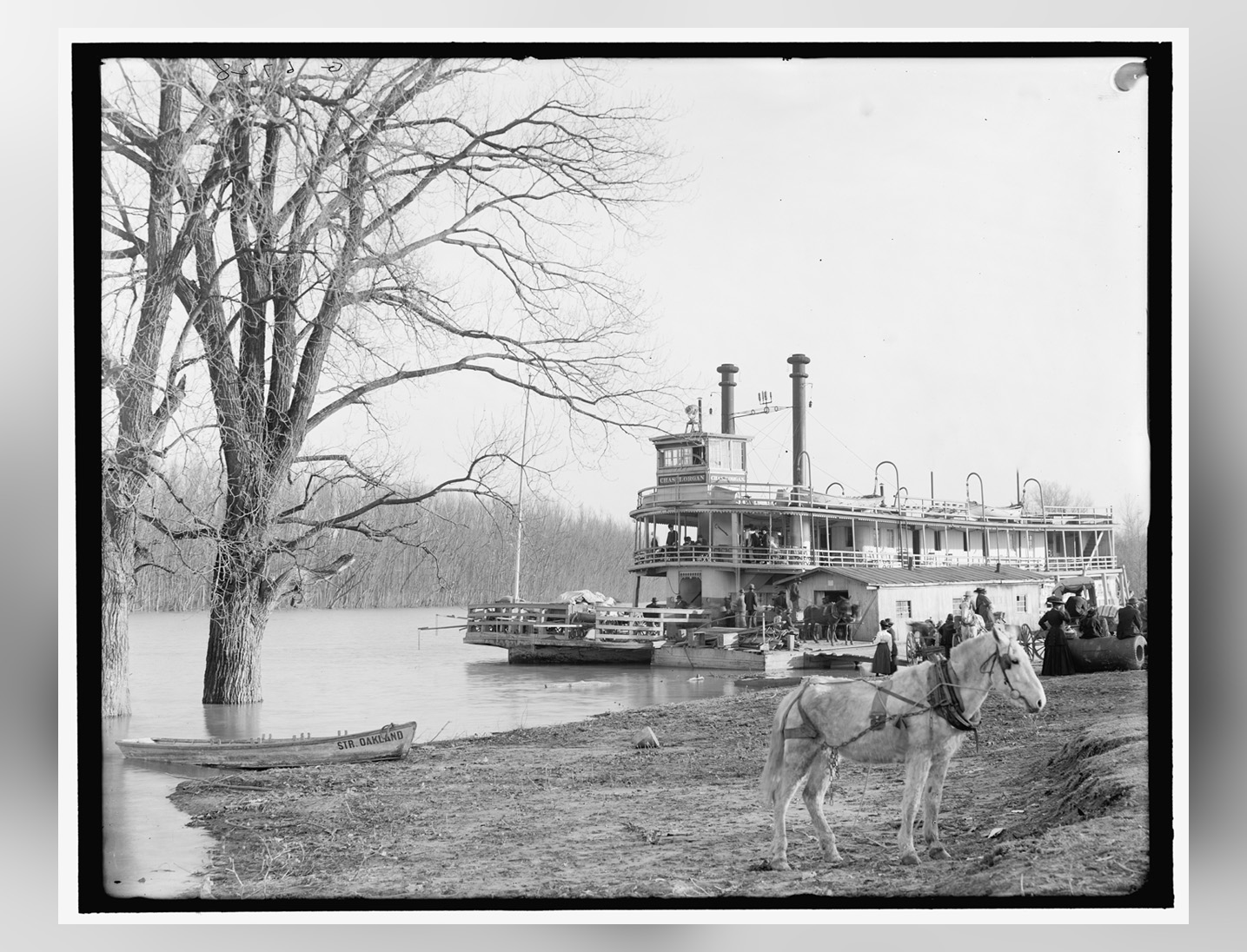
River packet Chas. H. Organ landing at Mound City, Arkansas, near Memphis, between 1900 and 1915. Detroit Publishing Co. photograph collection, Library of Congress Prints and Photographs Division. Download a high resolution copy
Download a high-resolution version
I was recently exploring the Library of Congress’ Detroit Publishing Company Collection and came across a great photo of the river packet Charles H. Organ landing at Mound City, Arkansas, on the Arkansas side of the Mississippi River near Memphis. The Library of Congress dates the image between 1900 and 1910.¹
Mound City was once an important trading town and ferry landing directly across the river from Memphis.² River packets and ferries like the Charles H. Organ moved people, freight and agricultural products at a time when the Mississippi River functioned as one of the region’s major highways.
The Charles H. Organ was built in Dubuque, Iowa, in 1897 as a ferry for the Memphis and Hopefield Point route. It later became part of the West Memphis Packet Co.’s service between Memphis and Arkansas points along the Mississippi River.³
A 1905 U.S. Supreme Court case, Foppiano v. Speed, includes a few details about this particular boat. James Foppiano (1843-1942) leased the bar on the Chas. H. Organ during the years 1901, 1902 and 1903. Shelby County officials said he owed a license tax for selling beer and liquor. Foppiano argued that because the ferry operated between Tennessee and Arkansas, his business was “engaged in interstate commerce” and not subject to the state tax.⁴
The court record says the West Memphis Packet Co. used the Charles H. Organ as its regular ferryboat between Memphis and points along the Arkansas shore, including Hopefield Point in Crittenden County.⁵
Judge John Preston Young (1847-1934) also mentioned this ferry in his 1912 book, “Standard History of Memphis, Tennessee.” Young wrote that the West Memphis Packet Co., operating from the foot of Court Avenue, ran the steamer Charles H. Organ several times daily to Hopefield, Mound City, President’s Island and Wyanoke. He added that the boat was “much patronized by excursionists and pleasure seekers.”⁶
The photo was published by the Detroit Publishing Co., a major photographic publisher founded in the late 19th century by William Allan Livingstone Jr. (1867-1924) and Edwin H. Husher (1863-1919). The company became known for mass-producing photographs, postcards, albums and color photochrom prints. Its holdings grew even larger after photographer William Henry Jackson (1843-1942) joined the firm and brought thousands of negatives with him.⁷

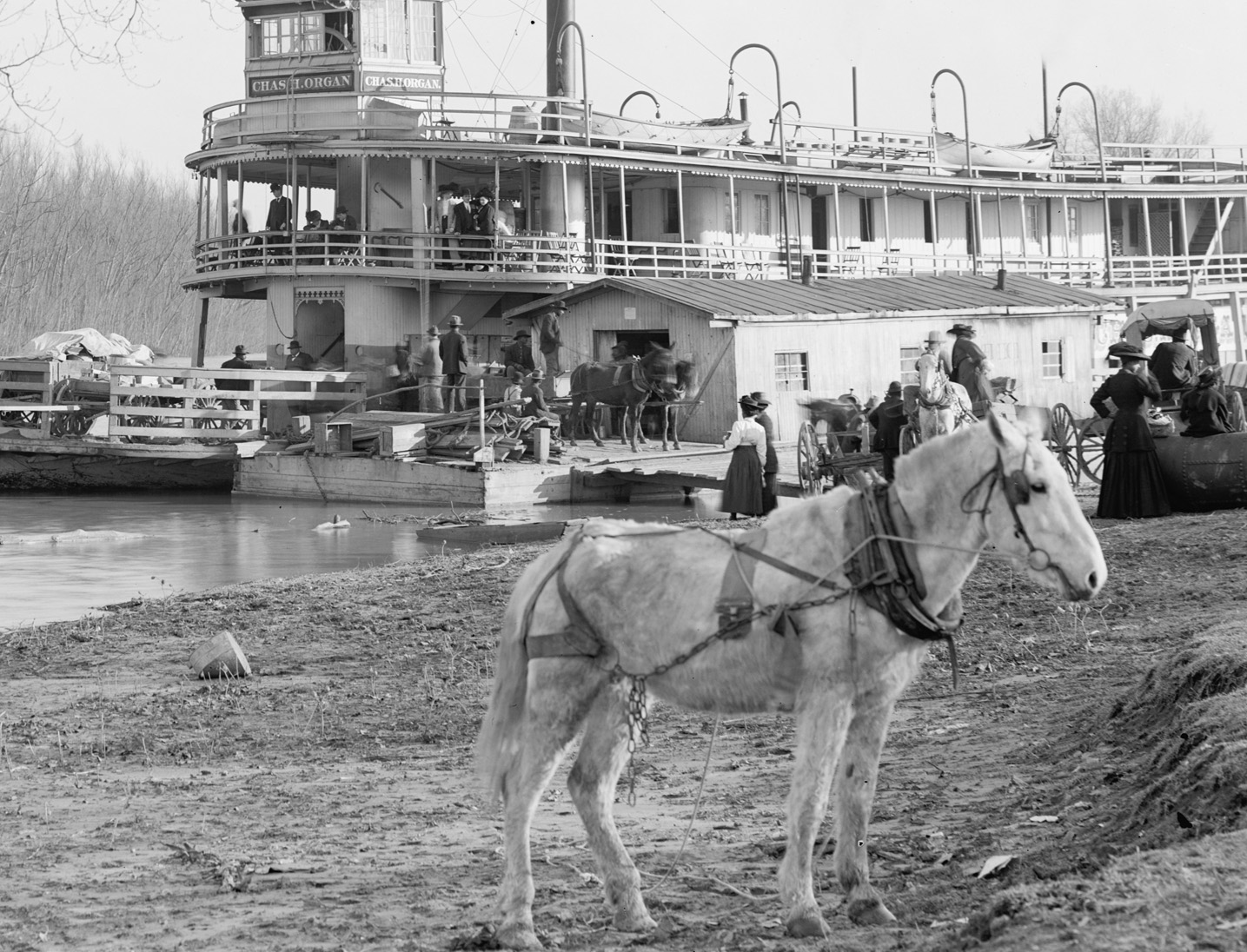
What makes this photo so interesting is the high-resolution clarity of the activity taking place in the background while the Charles H. Organ sat at the dock.
When you first see the digital image, made from an 8-by-10-inch dry plate negative, all you notice is a white horse standing in front of a boat. But when you zoom in, much of the action comes into view in surprising detail.

From the better-dressed passengers above, whose attention seems focused on the nervous mule creating a ruckus on the dock below, to the African American workers moving through the scene less than 50 years after slavery ended, the activity captured in the photo is mesmerizing to me.

These three passengers appear to be casually checking out the action taking place behind the dock. They seem bored by it all and have the same look people today have when riding a city bus.

Slavery had ended less than 50 years before this photo was taken, so some of these men could have been born into slavery.

This well-dressed lady seems to be waiting for someone.
Many of those waiting on the dock appear to be dressed for a pleasure trip rather than for work, and several are holding baskets that may have carried food.
In 1918, the Charles H. Organ was sold to the Patton-Tully Transportation Co. of Memphis, converted into a towboat and renamed the Dan Quinn. The boat mainly towed logs, timber and barges and did contract work along the Mississippi River. It was retired and dismantled in 1933.⁸
The Detroit Publishing Co. went into receivership in 1924 and liquidated its assets in 1932. Fortunately, much of the company’s surviving collection is now housed by the Library of Congress, giving us a small but remarkably detailed glimpse into the past.
Endnotes:
- Library of Congress, Prints and Photographs Division, “River packet Chas. H. Organ landing at Mound City, Memphis, Tenn.,” Detroit Publishing Co. Collection, Detroit Publishing Co. no. 039519, glass negative, ca. 1900-1910. See also Library of Congress, “About This Collection: Detroit Publishing Company.”
- “History,” Mound City, accessed July 7, 2026.
- University of Wisconsin Digital Collections, “Dan Quinn (Towboat, 1918-1933),” UW-La Crosse Historic Steamboat Photographs; “Dubuque Boat & Boiler,” Shipbuilding History.
- Foppiano v. Speed, 199 U.S. 501 (1905).
- Foppiano v. Speed, 199 U.S. 501 (1905).
- John Preston Young, Standard History of Memphis, Tennessee: From a Study of the Original Sources (Knoxville, Tennessee: H.W. Crew & Co., 1912), 394.
- Library of Congress, “About This Collection: Detroit Publishing Company”; Henry Ford Museum, “Finding Aid for the Detroit Publishing Company Collection”; University of Arizona Press, On a Trail of Southwest Discovery.
- University of Wisconsin Digital Collections, “Dan Quinn (Towboat, 1918-1933)”; Keith Norrington, “The Charles H. Organ,” The Waterways Journal, Oct. 3, 2021.


Leave a Reply