
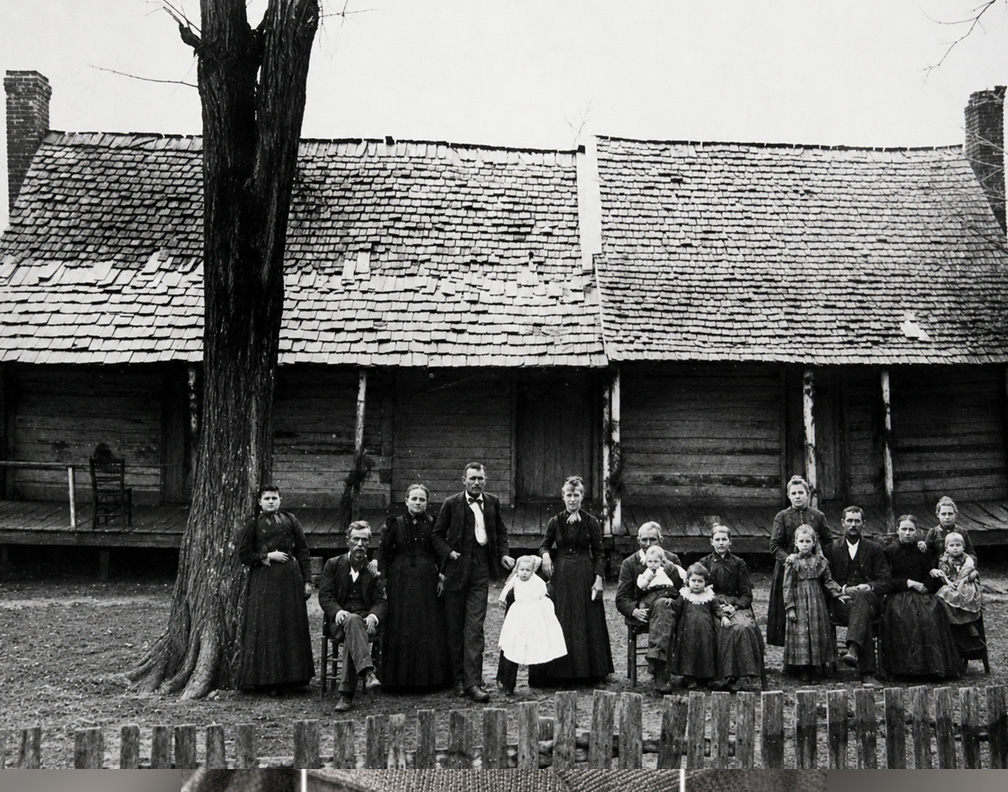
Photo: Alfred Bunn Joyner and Family, Haywood County, Tennessee, mid-1890s
I love finding a photo of a whole group of my ancestors in front of their house. My aunt, Joline Joyner Williams, originally shared this one with me. Of course, I enjoy seeing what they looked like, but a photo like this one also provides clues about their lives.
This photo was taken in the mid-1890s. Alfred Bunn Joyner (1810-1899), the patriarch of this family who is sitting in the middle of the photo, is my third-great-grandfather. Alfred was born April 29, 1810 in Lebanon, Wilson County, Tennessee. He married Mary Francis Stanfield (1813-1855) in Haywood County in 1838. After her death in 1855, he married Nancy Ross (1825-1906). Alfred had two children with Mary Francis and four with Nancy, including my second great-grandmother, Mary Elizabeth Joyner (1862-1898).

L to R: Elvira Lyson, who was raised by Joe and Sarah Joyner Chambers; Joe Chambers and Sarah Joyner Chambers; Jesse and Sally Joyner with son, Herman.
Their clothing, the size of their house and the fact that they could afford a photograph all suggest that they had achieved a measure of success in Haywood County. Before the Civil War, this family enslaved a number of individuals and grew cotton.
In the 1870 census, six years after the Civil War, Alfred Joyner’s land value had grown to $2,400, but his personal property value had fallen from $9,700 to $1,000. The loss of enslaved labor and the destruction caused by the war likely explain much of that decline.

Far left are Alfred Bunn Joyner, holding Howell, and Nancy Ross Joyner. The child standing beside them died young. The family to the right includes my second-great-grandparents, Joe and Mary Elizabeth Joyner Williamson. Standing in the back row, center, is Nancy “Nannie” Williamson. Standing in the back row, right, is Jessie E. Williamson. The baby at the far right is Mai Edith Williamson Shelton. My great-grandmother, Janie Williamson Williams, is standing in the front row in the middle of the photo. The youngest daughter in the family, Jo Williamson Reid, had not yet been born.
Alfred also lost a son in the war. When it began, Littleton Joyner, who had studied medicine, left school to join the Confederate Army. He died Saturday, June 28, 1862. According to his headstone, he “Sickened & died in Holly Springs, MS while in the Confederate Service.”
Alfred Joyner farmed property named Joyner’s Hill Farm.
| “The agricultural development of Joyner’s Hill Farm mirrors that of many other West Tennessee Century Farms. In the nineteenth century, the founders produced one perhaps two staple crops for market with all other commodities geared to home consumption. In the early twentieth century, however, the region’s farmers have attempted to produce a diverse range of commercial farm commodities. Purchasing 160 acres located in the northeastern corner of Haywood County, Alfred B. Joyner established Joyner’s Hill Farm in 1838. The founder cultivated fields of cotton, corn, hay and small grains. The father of six children, Alfred married twice and his son Bob Joyner inherited the entire farm in 1904. A charter member of the Farm Bureau, Bob “was a progressive, substantial farmer interested in new ideas and methods.” He expanded his property to 423 acres and raised diversified products such as corn, cotton, soybeans, sorghum, wheat, strawberries and livestock. His wife Ada Thweatt was the mother of six children.1 |
Alfred Joyner died soon after the family photo.
The Brownsville States-Graphic published this article about the Joyners on July 20, 1899:
| The departure of the pioneers of the county deserves more than passing notice. The citizens of Haywood County will read with interest a brief sketch of the last, but one of a noted and noble family-father, mother brother and sisters. You will, I believe, cheerfully lend space in The Graphic for this section of history. Littleton Joyner, with his family, came to Haywood and settled near Wellwood in 1827. Here he operated a farm and was afterwards for a series of years County Court Clerk, the duties of which office he discharged with marked ability and fidelity. This family distinguished themselves in a notable degree for the tiniest qualities of head and heart; for intelligence, morality, sobriety, hospitality and piety. The direct subject of this sketch was about 18 years old when he came with his father from Wilson County, this state, to Haywood. Another family from Bedford County, Middle Tennessee preceded the Joyners, coming in the winter of 1824-25. This was the Stanfield family. Ephraim A. Stanfield, Esq. and his wife Sarah, who brought a large family of children, all of whom, except for Dr. C.A. Stanfield of Toledo, Ark. have with the Joyners, passed over the river to rest under the shadow of the trees. This family settled north of Wellwood and were noted in many respects. Ten sons and three daughters; the boys grew to manhood, remarkable for their unusual physical and mental development, above medium size, erect, strong, active, healthy and intelligent, all except one lived to raise families, many of whose descendants are filling positions of trust and honor in Arkansas, Texas, Kentucky, etc. these two families were among the first settlers of this section. They with Rev. F. S. Brandon and others who soon came to their help, whose names ought not to be forgotten such as Uncle Thomas Bay Green; Freeman George and Jesse Cus (paper torn here unable to read) …the land and building houses in which to live; but not only those. Before the deer the catamount and the bear had been driven out of the land these brave people had erected a house of worship and in which their children were to be taught the rudiments of an education; not satisfied with this however, an academy was soon built near by and Prof. Johnson put in charge to teach higher mathematics, Latin, Greek, etc. This was one of the best high schools of the early times. One of the boys mastered seven languages and preached in four. The Joyners and the Stanfields were at the front of every enterprise; at their homes, in the schoolroom and the church – noted for filial and fraternal attachments – there were no broils or feuds. It is said that no son of these old people was even seen intoxicated or heard to swear or fail to pay a debt. It is not strange that these families became friends. The second daughter, Miss Francis Stanfield, became Mrs. Alfred Bunn Joyner and lived most happily in the sacred relation of wife till she was called hence, leaving that brilliant and noble boy, Littleton T. Joyner who left his medical studies to give his life to the Confederacy; and Miss Sallie P. Joyner, now Mrs. Josias Chambers, to mourn with their devoted father the loss of one of the most affectionate of pious christian mothers. Mr. Joyner, after some years, married Miss Nancy Ross, of Madison County a most practical, level-headed, considerate Christian lady; dear aunt Nan, as she was familiarly called, who, with three sons, survive their noble father. Mr. Joyner was from his youth a consistent member of the M.E. church, South, of unswerving faith to his God and Savior; his faith in himself sometimes weak. His strong temperance sentiments were conspicuous in life, and in the hour of death, when his physician gave him, toddy, he said, “I want pure water to drink.” Uncle Alfred Joyner was blessed with an active, vigorous old age; though in his nintieth, year could walk or ride horseback; his mind was clear, and he was happy in society, or with his paper or his books. The whole community sorrow with Aunt Nan and the children and grand-children of this good old man., who went peacefully to reap his reward – the reward of the faithful, on August – His remains were interred at Providence cemetery; funeral by Rev. B.F. Poebles Commenting the bereaved to the God of ——— in love and sympathy. |

The little girl in the photo is my great-grandmother, Janie Williamson Williams who died Aug. 19, 1914, in Haywood County when she was just 27. Her son, my grandfather Lloyd “Bo” Williams, was just 4 at the time.
- Carroll Van West, Tennessee Agriculture: A Century Farms Perspective, 292. ↩︎


Leave a Reply