
I was searching for the parents of my third great-grandfather, Charles Randall Johnson (1802-1864). I still have not found them.
But genealogy has a way of rewarding one search with an entirely different discovery.
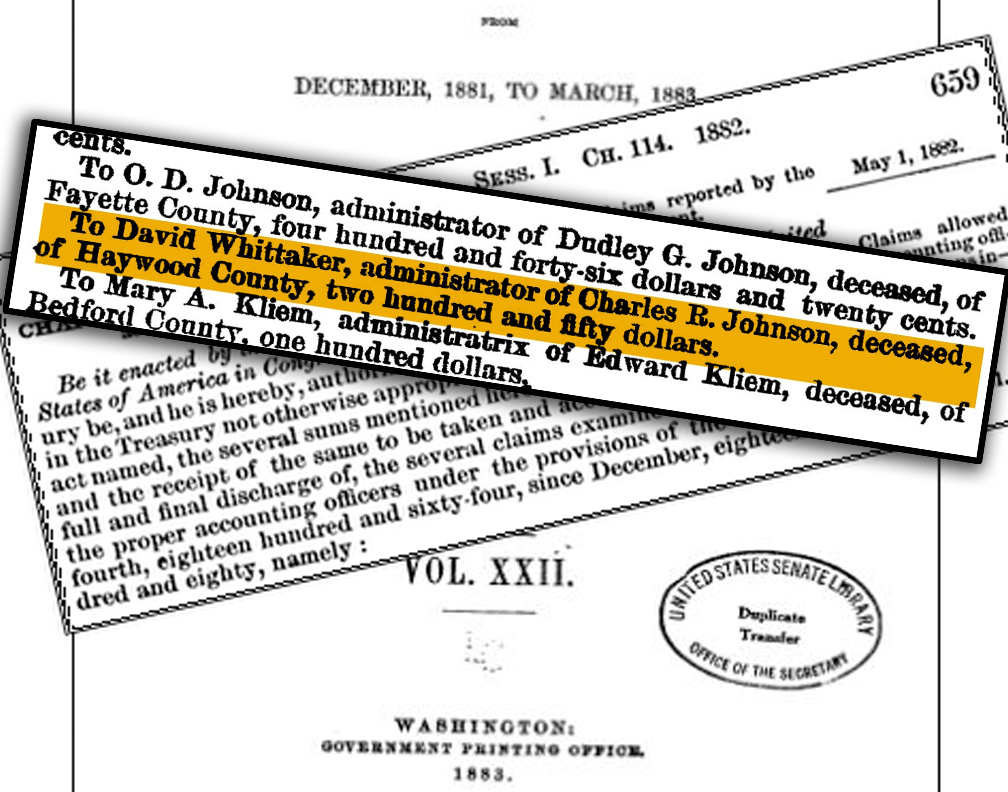
In the “United States Statutes at Large,” I found an 1882 act authorizing a $250 payment to David Whittaker (1827-1889), administrator of Charles R. Johnson’s estate. The entry says simply: “To David Whittaker, administrator of Charles R. Johnson, deceased, of Haywood County, two hundred and fifty dollars.”
That one sentence may not look like much, but it opens a door.
The payment appeared in a federal law covering claims that Treasury accounting officers had examined and allowed under the Act of July 4, 1864. That law dealt with claims involving property furnished to or taken by the U.S. Army during the Civil War.
In other words, I have found the final payment record. What I have not yet found is the claim file explaining why the government paid it.
Charles Randall Johnson was my third great-grandfather. His daughter, Nancy Marianna Johnson Castellaw (1844-1921), married Thomas Jefferson “Tom” Castellaw (1841-1879). Their son was Robert Edward “Bob” Castellaw (1868-1954), who was the father of my grandmother, Elizabeth Castellaw Williams (1915-1998). She was the mother of my father, Bob Williams (1940-present).
Charles was born Nov. 27, 1802, in North Carolina, likely in Orange County. By the 1830 U.S. Census, he had moved to Haywood County, Tennessee, in an area that later became part of Crockett County. He married Margaret Louisa Wood Johnson (1808-1862), the young widow of William R. Wortham (dates unknown).

Johnson Grove Baptist Church in Crockett County, Tennessee today
A deed shows that Charles donated land for Johnson Grove Church near Alamo. His will and estate records also help identify his children, property and family connections.
Headstone of Charles Randall Johnson and Louisa Wood Johnson in the Castellaw Family Cemetery in Crockett County, Tennessee.
Louisa died March 28, 1862. Charles died April 14, 1864.
He died at a tense time in West Tennessee. Two days earlier, Confederate forces under Nathan Bedford Forrest (1821-1877) had captured Fort Pillow on the Mississippi River, an event that quickly became one of the most controversial episodes of the Civil War. Tennessee State Parks notes that a congressional report soon labeled the event a massacre, and that the attack killed a disproportionate number of United States Colored Troops stationed there.
I do not yet know whether wartime events had anything to do with Charles’ death. But the date places him in West Tennessee during one of the most volatile periods of the war, when raids, divided loyalties, military searches and fear shaped civilian life. Forrest’s spring 1864 raid into West Tennessee aimed to disrupt U.S. Army activity, recruit soldiers and gather supplies.
| Looking for the Castellaw Family Cemetery? From the intersection of TN-54 S/TN-88 W & US-412 S, west of Alamo, travel west on TN-54 S/TN-88 W for 0.8 mi.; turning south (left) continuing on TN-54, going 2.6 mi.; turning west (right) onto Johnsons Grove Rd., going 0.3 mi.; turning south (left) onto Castellaw Rd., going 0.5 mi.; turning west (right) onto a gravel road, going about 150 yards to this ‘deeded’ cemetery, as notated on USGS topo maps. |
Both Charles and Louisa are buried in the Castellaw Family Cemetery, located south of Johnson Grove on the west side of Castellaw Road in Crockett County. Crockett County did not exist when Charles lived there; Tennessee created it in 1871 from parts of Haywood, Madison, Dyer and Gibson counties.

Photo thought to be Charles and Louisa’s daughter, Nancy Johnson Castellaw, my second great-grandmother.
Charles’ estate named the following children:
- William R. Johnson (1834-1887)
- Charles R. Johnson Jr. (1840-unknown)
- Ann Elizabeth Johnson Whitaker (1830-1883)
- Margaret “Peggy” Wood Johnson Castellaw (1836-1870)
- Sarah “Sallie” Johnson Sanders (1838-unknown)
- Adeline Johnson Midyett (1843-unknown)
- Nancy Marianna Johnson Castellaw (1844-1921), my direct ancestor
- Zachariah T. Johnson (1842-unknown)
- Louisa Johnson (1851-unknown)
The estate records also show that Charles owned enslaved people.
- Lot #1–C. R. Johnson, Jr. received negro woman Martha and boy Jerry valued at $925. 00.
- Lot #2–Nancy Johnson received negro woman Manda & Cherry valued at $675. 00. Lot #3–Sarah Sanders received negro woman Margaret and child Georgianna valued at $75. 00.
- Lot #4–Louisa Johnson received negro woman Mary and her child Willie, also a boy John valued at $975. 00.
- Lot #5–Z. T. Johnson received negro woman Priscilla & boy Silvester valued at $950. 00.
- Lot #6–W. R. Johnson received negro man Nelson valued at $700. 00.
- Lot #7–M. B. Midyett received negro man Peter valued at $700. 00.
- Lot #8–John E. Castellaw received negro girl Amanda & negro man Matthew valued at $807. 00. Lot #9–L. D. Whittaker received negro girl _ and boy Joe valued at $825. 00.
Nearly two decades after Charles died, someone, apparently his son-in-law and estate administrator David Whittaker, convinced the federal government that Charles’ estate deserved $250.
The document does not say what property formed the basis of the claim. It may have involved livestock, crops, food, forage, wagons or other supplies. It only gives the final payment.
That is what makes it so interesting.
I have found the government’s answer, but not the question that led to it.
The act refers to claims handled under the Act of July 4, 1864. That law covered claims for property furnished to or taken by the U.S. Army. It required proof that the property had actually gone to army use and that the claimant met the loyalty requirement. A later congressional report summarized the rule plainly: both the use of the property and the loyalty of the claimant had to be affirmatively established before a claim could be allowed.
That does not prove Charles was an outspoken Unionist. It also does not prove that he personally filed anything, since he died in 1864. But it does show that his estate became part of a federal Civil War claims process that required evidence.
That evidence is what I want to find.
The Southern Claims Commission, created in 1871, handled claims from Southern Unionists who said they had remained loyal to the United States and had property taken by or furnished to the U.S. Army. Its files can include petitions, witness depositions, reports from special agents, Treasury Department reviews, final recommendations and receipts of payment.
I do not yet know whether Charles’ claim file sits in the standard Southern Claims Commission records, in a Treasury accounting file or in another related set of Civil War claims records. Because the 1882 act names David Whittaker as the administrator, the file may not appear under Charles R. Johnson’s name at all.
That is genealogy at its best. One record does not end the search. It changes the search and sends you down a compleltey different path.
For more of my genealogy research, visit rscottwilliams.info.


Leave a Reply