
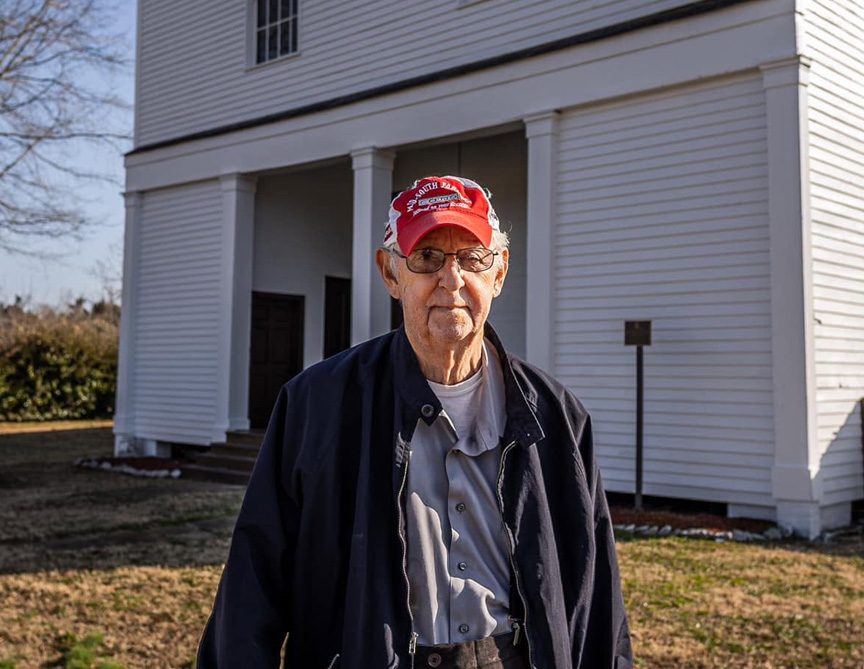
Billy King, Photo credit: Cypress Magazine /
While I was back in Tennessee recently, my father, youngest daughter and I stopped by the Forrest Cemetery for the first time. In researching the Forrest family, I had seen numerous references to this cemetery and was looking forward to seeing it in person. Author and historian Billy King shared both the location and some background on the cemetery with me.
This cemetery was not as hard to find as the Jacocks Cemetery since it is well cared for by a group of Forrest descenants. It even has a sign at the entrance. As you can see from the video, a branch had recently fallen from a tree, which was very unfortunate for the bees who had made it their home. I stayed away, but I did think it would be nice to have some Forrest Cemetery honey.

Entrance off Rice Road near the Haywood-Madison county line in Tennessee.

For the Google map directions, click here.

Although the graves of my fourth great-grandparents, Samuel William Forrest (1794-1860) and Zilpha Sherrod Forrest (1797-1870), are not actually in the cemetery, their headstones are.
Some concerned individuals, including Billy King, relocated Samuel and Zilpha’s headstones to this cemetery, along with a few others, after loggers destroyed the nearby cemetery where they were actually buried. By the way, if you have an interest in this part of the country, King has written two books about the Big Black Creek area: Big Black Creek, Volume One and Big Black Creek, Volume Two. I highly recommend adding both to your genealogy library.

Zilpha, wife of Samuel Forrest
The broader family migration from Wayne and Pitt Counties in North Carolina, to West Tennessee began in 1826. Family members included Samuel’s brother, Thomas Joiner Forrest (1792-1847); Thomas’ wife, Charlotte Brown Forrest (1793-1862); Charlotte’s mother, Elizabeth Brown; and Charlotte’s brother, Samuel Brown Jr., who King says led the wagon train.
Elizabeth was blind, which makes that journey even harder to imagine. Can you imagine leaving your home for a trip like that and not being able to see?

Thomas Joiner Forrest and Charlotte Brown Forrest
A one-mile-square tract of land, or 640 acres, had been given to Elizabeth Brown’s husband, Samuel Brown Sr., for his service in the Revolutionary War. Samuel died in Greene County, North Carolina, and willed the land to his wife and daughter.

Elizabeth Brown, mother of Charlotte Brown Forrest
According to the Brown Family Bible, they “left North Carolina on Thursday March 16, 1826. Their journey ended “in the Forkodeer Hinterland 11 May which was 8 weeks on the road.” The family traveled with a number of families in covered wagons to their new home in the adjoining Tennessee counties of Madison and Haywood. Included in the group were the Dickinsons, Forrests and Musgraves.”
Like other members of his family, Samuel was an enslaver, farmer and brickmaker and was likely active in his church.
Billy King includes a passage about their local church in volume one of his Big Black Creek books:
| The Samuel Brown family donated the land where Obediah Dodson had established the Browns Creek Baptist Church. The church had slave members and even slaves who were deacons. The church split over missions. Obediah wanted it to send missionaries to the Louisiana Purchase. On a Sunday morning, the anti-missionary preacher pushed Obediah out of the pulpit. Obediah told the congregation, ‘all of you who want to hear me come out under the trees.’ Most of the church went and they formed the Brown’s Creek Missionary Baptist Church. The slaves went with this group. They built a new church building on Brown’s Creek Road, just beside the creek. After the Civil War, this property was given to the black members. In 1870, the white congregation changed their name to Woodland Baptist Church and built a new church. Both the Brown’s Creek and Woodland Baptist churches are very active today. 1 |

Woodland Baptist Church
Woodland Baptist Church is located around the corner from the Forrest Cemetery.

The cemetery, which was established in 1847, is cared for through a trust fund. According to King, the headstones that look handmade are not the original headstones. They were placed there several years ago and then replaced again with newer headstones about five years ago. Also according to Bill, the last grave in the cemetery is of Jack Forrest, twin brother of Gene Forrest.

Samuel Forrest
Samuel Forrest died Dec. 30, 1860. Zilpha died a decade later, on June 24, 1870, at age 73 and was buried next to her husband.
More posts about the Forrest family:
Forrest, Yelverton and Sherrod Connection
For more of my genealogy research, visit rscottwilliams.info.
Update:
Billy King passed away on December 12, 2021 in Humboldt at age 84. I was fortunate to have gotten to know him in the years prior to his death. His funeral was held at Denmark Presbyterian Church with burial in Woodland Cemetery.
Billy King was a founding member of the Big Black Creek Historical Association, a historian, pianist and organist and more. He is missed by many, but especially those of us who have a passion for West Tennessee history.
You can hear Billy share more about his work on episode 71 of the podcast Our Jackson Home.
His books are available from time to time on Amazon and online where used books are sold.
Big Black Creek Vol I
Big Black Creek, Vol. II – A Community at War
- Billy King, Big Black Creek, Vol. I (Place of publication: Publisher, Year), 59.
↩︎


Leave a Reply