
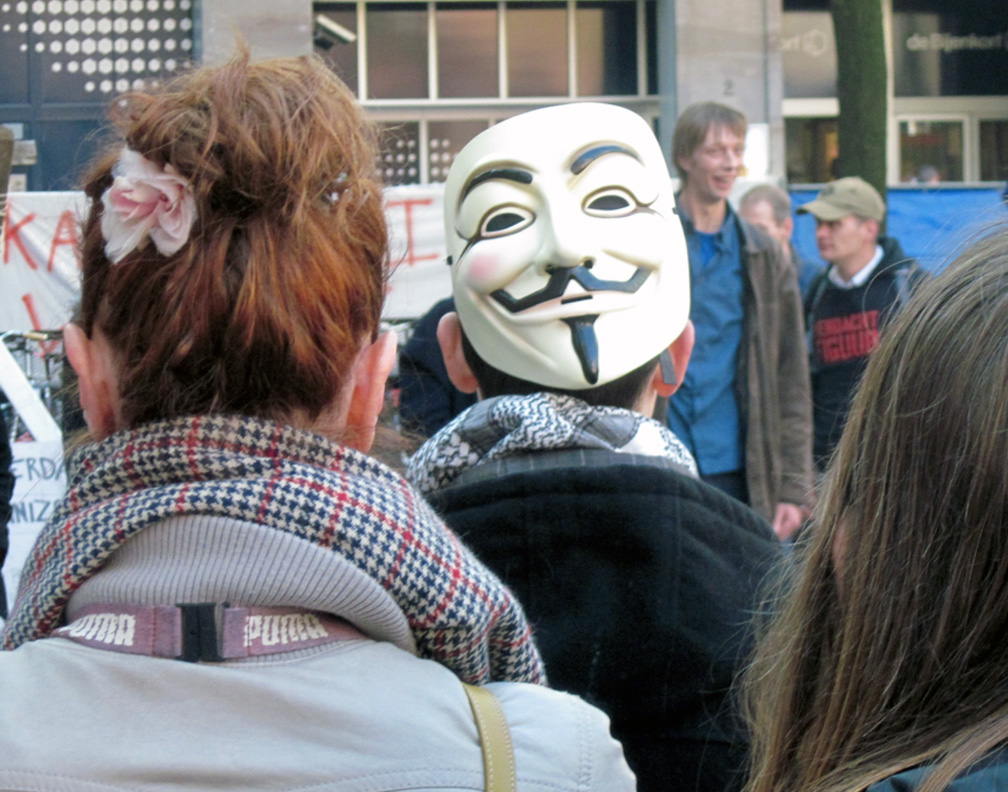
I was in Amsterdam last week and stumbled upon the “Occupy” protest in front of the Euronext stock exchange building. Regardless of a person’s political or social opinions, there is something exciting about being present at an event you know will someday be part of history.
There was an intense energy in the crowd, but it was honestly hard to tell who was protesting and who, like me, was just watching the protest. There were about 60 tents, several hundred people and more flyers, signs and handmade banners than I could count.
I cannot remember protesting much in my own life, other than my long-standing refusal to shop in a CVS drugstore. But watching all the protest in Amsterdam brought to mind one of my ancestors, Bridgeman Joyner (1655-1719), my ninth great-grandfather.
In October 1677, Bridgeman Joyner and his brother, Thomas Joyner Jr. (about 1658-1708), were among 88 people from Isle of Wight County, Virginia, who signed a petition asking officials to pardon William West (about 1642-1708/09).
I am not sure if Bridgeman and Thomas pitched tents, carried signs or blocked any colonial traffic, but they did sign their names to a document connected to one of the most dramatic chapters in early American history.

Illustration inspired by an engraving from an 1895 history textbook artistically presenting Governor William Berkeley baring his chest and daring Nathaniel Bacon to kill him. The caption in the book reads, A Fair Mark – Shoot!
West had been active in Bacon’s Rebellion, the 1676 uprising in the Virginia Colony led by Nathaniel Bacon (1647-1676) against the government of Gov. Sir William Berkeley (1605-1677). The rebellion grew out of frontier violence involving Native Americans, colonists’ anger over Berkeley’s policies and a much larger struggle over land, power and class in colonial Virginia.
The West family had a personal reason to be angry. According to the petition, William West’s father had been “most barbarously murdered” by Native Americans. West then joined the rebellion and led a rebel force that attacked a fort held by Berkeley loyalists.
Officials captured West on Jan. 16, 1677, and sentenced him to death. Before they could carry out the sentence, he escaped from prison. Later that year, his supporters in Isle of Wight County circulated a petition asking that his life be spared and that his estate be restored to his wife and children.
Bridgeman and Thomas Joyner signed it.
Apparently, their protest worked. William West lived for more than 30 more years. In April 1708, he witnessed the will of Thomas Joyner Jr., the same man who had helped petition for his pardon decades earlier.
Bridgeman Joyner (1655-1719) was the father of John Joyner (1696-1748), who was the father of Absalom Joyner (1720-1790), who was the father of Thomas Littleton Joyner (1762-1824), who raised Littleton Bunn Joyner (1782-1852). Littleton Bunn Joyner was the father of Alfred Bunn Joyner (1810-1899), who was the father of Mary Elizabeth Joyner Williamson (1862-1898), who was the mother of Janie Elizabeth Williamson Williams (1888-1914), who was the mother of Jesse Lloyd “Bo” Williams (1910-2008), who was the father of Robert Lafayette “Bob” Williams, who was my father.


Leave a Reply