
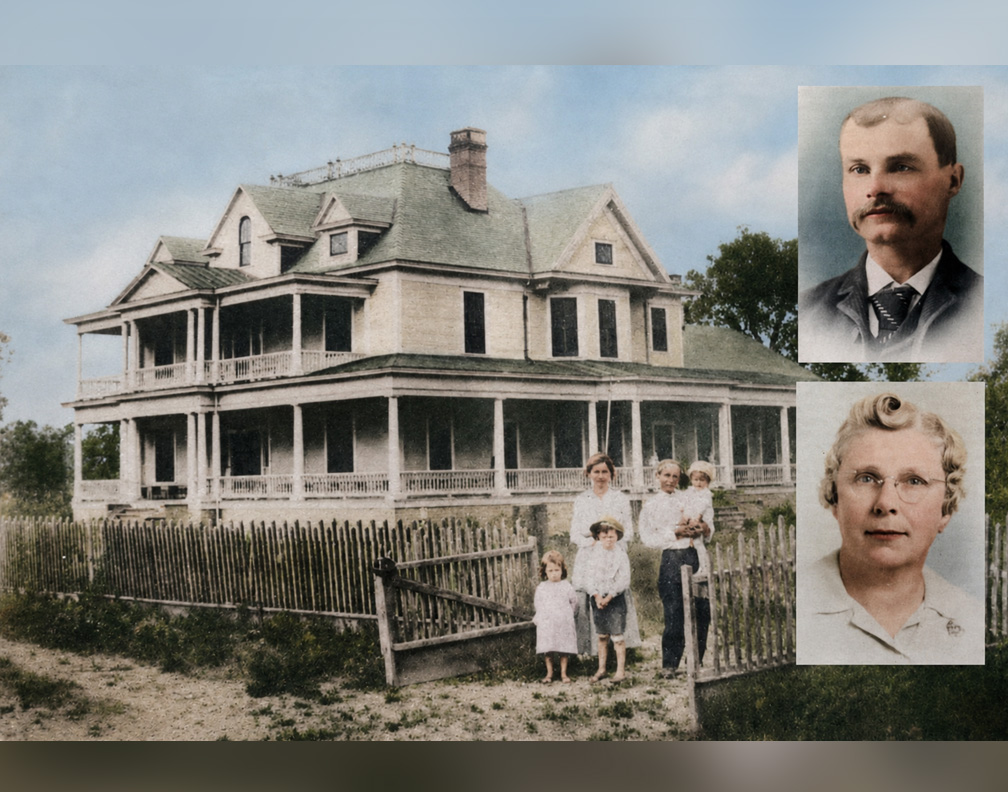
Photo: Dred and Ellen Yelverton and their home in Wayne County, NC
I am finally taking a break from researching my Yelverton line.
That took longer than expected because the Yelvertons turned out to be such an interesting family that I kept getting sidetracked. One of the things I enjoyed most was learning about the places they lived. One generation takes me to colonial North Carolina, where rebellion simmered in their communities. Another takes me to a turn-of-the-century farmhouse in Wayne County, North Carolina, that eventually made the National Register of Historic Places. Another takes me to a house in a cotton field in Haywood County, Tennessee, where family tradition says children once found themselves chained to a tree in the front yard.
So, yes, nearly every generation had something to offer in the way of interesting homes.
John Yelverton Sr. and Edenton, North Carolina
John Yelverton Sr. (1685-1750), my seventh great-grandfather, gives me a connection to colonial North Carolina and the Edenton area.
I want to be careful with this early part of the line. My own documentation is strongest from my mother back to Hardy Yelverton (about 1755-1829). From there, outside sources help support the earlier connections. A National Register nomination for the Dred and Ellen Yelverton House states that John Yelverton Jr. (about 1720-1795) moved into Wayne County, North Carolina, in 1756 and identifies Hardy as his son and Etheldred Yelverton (1784-1851) as Hardy’s son. 1 That fits the line I am using: Shirley Lovelace Williams (1939-present), Guy Lovelace (1916-1997), James Luther Lovelace (1885-1968), Nancy Jane Yelverton Lovelace (1861-1936), Samuel W. Yelverton (1828-1876), Etheldred, Hardy, John Jr. and John Sr.
John Sr. was born around 1685, probably in England, and had reached North Carolina by the early 1700s. He married Elizabeth Blount Yelverton (about 1685-1724), daughter of James Blount (died 1717) and granddaughter of Capt. James Blount (about 1620-1686), a colonial official and leader in Culpeper’s Rebellion. 2

Standing at the head of the Courthouse Green since 1767, the Chowan County Courthouse is one of the most important surviving buildings from the colonial period in North Carolina. The Courthouse was the most important building for public and community activities in Chowan County and Edenton from the late 18th century into the 21st century.
The Yelverton and Blount names show up frequently in records connected to the Chowan and Edenton area. One land abstract from 1711-12 places John Yelverton on Tindal’s Swamp, Mattacomack Creek Swamp and the wetland of the Chowan River. That matters because Mattacomack Creek was part of the early geography of the place that became Edenton, one of the most important towns in colonial North Carolina. 3
Before he died, John deeded land described as “a tract of 100 acres of land which contained houses, orchards, gardens, fencing timbers & trees, woods, water & waters courses.”
That is the detail I like best. It does not tell us exactly what his house looked like. It does tell us something better. John Yelverton’s world was not just a name on a map. It had houses, gardens, orchards, fences, timber, woods and water.
That sounds like a nice place to live.
The Dred and Ellen Yelverton House in Wayne County, North Carolina
My third great-grandfather, Samuel W. Yelverton, had a brother named Thomas Whitney Yelverton (1812-1890), and Thomas had a son who left behind a house you can still see today.
Thomas and his wife, Nancy Cumi Farmer Yelverton (1819-1896), lived in Wayne County, North Carolina. The National Register nomination for the Dred and Ellen Yelverton House says Thomas owned more than 1,000 acres between Fremont and Eureka. The Yelvertons in that area were large landowners and slaveholders before the Civil War.

Print ad for George Franklin Barber and Thomas Kluttz Home Architects, Knoxville, 1907
At the end of the 19th century, Thomas and Nancy’s farmhouse burned. Their son, Etheldred “Dred” Yelverton (1855-1931), decided to build something much grander in its place. According to the National Register nomination and the North Carolina Architects & Builders project, Dred hired Fremont contractor Claude Dickerson around 1900 to build a new house using plans from the Knoxville architectural firm of Barber and Kluttz. George F. Barber, the firm’s founder, was nationally known for mail-order house plans. 4
Then things went wrong.
Dred had a dispute with the contractor, filed a lawsuit and lost. The house stood unfinished for years. In 1910, Dred and his twin sister, Nannie Yelverton, were living together in another house across the road from the homeplace. Then Dred married Cherry Ellen Davis Yelverton (1891-1978) in 1912, and that apparently gave him the motivation needed to finish the house. The family moved in around 1913.

The Dred and Ellen Yelverton House in Wayne County, North Carolina
The house has changed remarkably little since then. In 2009, it was listed in the National Register of Historic Places for its distinctive design and exceptional condition. The nomination calls it one of the most intact examples in North Carolina of the work of George F. Barber. 5
Polly Was No Gadabout
Another house, not on the National Register but certainly important to its owner, belonged to Polly Whitney Yelverton Curlin (1850-1927).
Polly was born in November 1850 to Samuel W. Yelverton and Ann M. Sherrod Yelverton (1834-1880). My second great-grand aunt spent most of her life around Denmark, Tennessee, and she apparently preferred it that way.

Obituary of Polly Curlin from unidentified newspaper clipping
When Polly died, a newspaper article celebrated the fact that she had spent most of her time at home. According to the article, she had never ridden in a car or a train and had never even been to the county seat.
Apparently, she once told someone, “I never cared about being a gadabout.”
Even her funeral was held at her house. She did finally leave home when she was buried in the Ebenezer Cumberland Presbyterian Church Cemetery in Madison County, Tennessee next to her husband.
The Yelverton House Near Woodland
Lastly, there is a Yelverton house I have not seen in person but found in a photo in the genealogy room of the Elma Ross Public Library in Brownsville, Tennessee.

The house was off Highway 138 in the Woodland area of Haywood County and supposedly belonged to Etheldred H. “Dred” Yelverton (1857-1936), the brother of Polly, Maggie Yelverton Marbury (1853-1884) and Nancy Jane Yelverton Lovelace (1861-1936).
Dred apparently had the unfortunate combination of a bad temper and a large number of children. He and his first wife, Sallie Wilkins (1859-1901), had several children. After Sallie died, Dred married Eudie Betty Parker (1880-1962), and they had several more. All told, the research points to 13 children.
A Yelverton descendant once told me her grandmother remembered Etheldred as a mean man who was known for things like chaining his son to a tree in the front yard. She also remembered a family story that he once scared a man so badly the man died of fright.
I cannot document those stories, so I will leave them where they belong, in the category of family tradition. But I will say this: if even half of that is true, he lived up to his nickname, Dred.

The Jackson Sun, January 27, 1936, 7.
I am also pretty sure his children did not share Aunt Polly’s problem of being too attached to home. I suspect some of them got on the first horse or into the nearest car, wagon, train or anything else they could find with wheels the moment they could and got out of Dred’s house.
- M. Ruth Little, “Dred and Ellen Yelverton House,” National Register of Historic Places Registration Form, Wayne County, North Carolina, 2009, section 8, 5. The nomination cites Stephen T. Yelverton, “The Yelverton Family,” in The Heritage of Wayne County, entry 972, for the older Yelverton line. ↩︎
- J. Bryan Grimes, ed., Abstract of North Carolina Wills (Raleigh: E. M. Uzzell & Co., 1910), abstract of James Blount will, Chowan County, Feb. 12, 1716, proved Mar. 27, 1717; Mattie E. E. Parker, “Blount (Blunt), James,” Dictionary of North Carolina Biography, via NCpedia; Mattie E. E. Parker, “Blount (Blunt), Thomas,” Dictionary of North Carolina Biography, via NCpedia. ↩︎
- J. R. B. Hathaway, ed., The North Carolina Historical and Genealogical Register, vol. 1 (Edenton, N.C.: Hathaway, 1900), abstract of land grants, Book I, page 192, John Yelverton, March 4, 1711-12; “Edenton,” NCpedia. ↩︎
- Little, “Dred and Ellen Yelverton House,” section 8, 6; “Dred and Ellen Yelverton House,” North Carolina Architects & Builders, North Carolina State University Libraries. ↩︎
- Little, “Dred and Ellen Yelverton House,” section 8, 5. ↩︎


Leave a Reply