
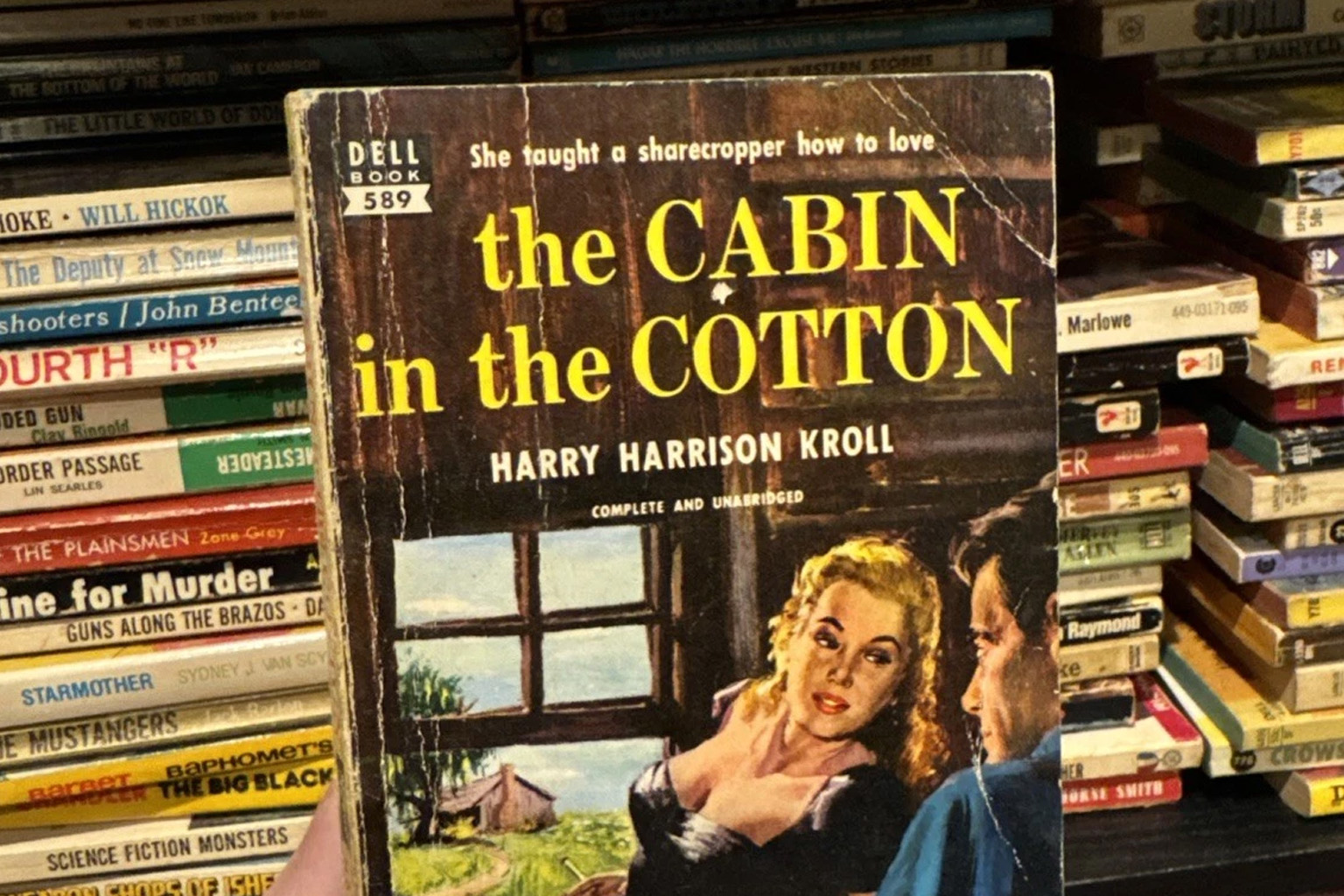
Every summer, I select a lesser-known Tennessee author from the past and add some of his or her work to my reading list. This summer, I chose novelist, short-story writer, illustrator and professor Harry Harrison Kroll (1888-1967). His subjects, characters and descriptions provide a fascinating bridge to the lives of rural West Tennesseans several generations ago.
For me, reading writers such as Kroll adds depth and texture to geneaology research into Southern history and ancestry that otherwise consist primarily of census records, wills and, when lucky, old family photographs from relatives.
The University of Tennessee at Martin, where a large collection of Kroll’s papers is archived, describes his writing as notable for its “gritty realism” and focus on rural Southern life. “Southern Writers: A New Biographical Dictionary” calls him a realistic chronicler of rural and mountain life who wrote with a “proletarian sensibility.”1 In other words, Kroll wrote primarily about working people, poverty, agricultural labor and the persistent struggle to improve one’s circumstances.
“The Cabin in the Cotton”
Bette Davis discusses her role in “The Cabin in the Cotton”
Kroll’s second major published book, “The Cabin in the Cotton,” appeared in 1931. First National Pictures, then operating as a Warner Bros. company, adapted it into the 1932 film starring Richard Barthelmess (1895-1963), Dorothy Jordan (1906-1988) and Bette Davis (1908-1989).

Davis delivered the film’s most memorable line: “I’d like to kiss you, but I just washed my hair.” It became one of her signature lines and one she continued to quote years later.
Barthelmess played Marvin Blake, a tenant farmer’s son who becomes caught between the interests of impoverished sharecroppers and a wealthy plantation owner. His predicament becomes more complicated when he is torn between two women: Betty Wright, played by Jordan, and Madge Norwood, the plantation owner’s seductive daughter, played by Davis.
Jordan was born in Clarksville, Tennessee, and enjoyed a relatively brief but successful Hollywood career. In addition to “The Cabin in the Cotton,” she appeared in such films as “Min and Bill,” “The Searchers” and “The Wings of Eagles.”
Kroll wrote popular rather than highbrow literary fiction, but he was remarkably productive. Saunders lists 25 major published books, including one issued after Kroll’s death, while archival summaries credit him with more than 900 published stories and articles.2 That gives me plenty of material for my summer reading list.
“I Was a Share-Cropper”
I recently completed “I Was a Share-Cropper,” Kroll’s autobiographical account published by the Bobbs-Merrill Co. in 1937. A New York Times reviewer called it “an interesting, indeed an amazing book about a share-cropper’s family, tied to the earth by toil.” The review also noted the family’s repeated moves through the West Tennessee lowlands in search of better landowners for whom to work.3
The book attracted attention beyond the Times. Writing in The Atlantic in February 1938, David L. Cohn (1894-1960) called it “a moving and beautiful book” and praised it as an unusually measured account of the sharecropping system by someone whose family had endured its poverty and hardships.4
Kroll opening paragraph includes that line: “We were going deeper into the bottoms now. It was spring of the year, and sometime in an afternoon.” He continues by describing a wagon passing beneath a canopy of intertwined branches, with shifting patterns of sunlight crawling across its canvas covering. Inside, a little girl sleeps on a musty quilt as the wagon rolls deeper into the lowlands. In only a few sentences, Kroll establishes the dampness, isolation and uncertainty surrounding a family on the move.
His descriptions help readers today imagine the world inhabited by my West Tennessee rural families whose lives rarely appear in books or movies.
“Never Been Rich”
I have also been reading “Never Been Rich: The Life and Work of a Southern Ruralist Writer, Harry Harrison Kroll,” a very thorough biography published in 2011 by Richard L. Saunders. At the time, Saunders was a special collections librarian and archivist at UT Martin. He later served as dean of library services at Southern Utah University, where he is now listed as a professor of library and information science.5
Kroll was born near Hartford City, Indiana, on Feb. 18, 1888. His family later moved south, and much of his childhood was spent in Tennessee and Alabama. He received little formal schooling during his early years and worked in sawmills and as a photographer. Recognizing education as a path away from poverty and transient labor, he studied on his own and qualified for a teaching certificate.
Kroll married teacher Annette “Nettie” Heard Kroll (1888-1961), and the couple taught in rural Alabama schools beginning in 1911. He later enrolled at George Peabody College for Teachers in Nashville, earning a Bachelor of Science degree in 1923 and a Master of Science degree in 1925.
After teaching at Lincoln Memorial University in Tennessee and Iowa Wesleyan College, Kroll turned increasingly to freelance writing. He joined the faculty of the institution now known as UT Martin in 1935 and taught English composition and literature until his retirement in 1958. Former students remembered his blunt, unconventional personality, but they also remembered him as one of the most popular professors on campus.6

Advertisement for “The Cabin in the Cotton”
Warner Bros. used Kroll’s rise from rural poverty as part of its publicity campaign for “The Cabin in the Cotton.” As was common in Hollywood publicity, the studio embellished his life to create a more dramatic story. The resulting newspaper columns are entertaining, but far from fact.

A Warner Bros. publicity column that appeared in The Missoulian of Missoula, Montana, on April 11, 1932.
Kroll never achieved the enduring literary reputation of some of his Southern contemporaries. His work was written primarily for the commercial market, and he preferred productivity and accessibility to literary experimentation. His greatest and most lasting influence may have come through his teaching and the generations of students who remembered his writing classes.
Kroll died June 11, 1967, at age 79. He was buried beside Nettie at Edgewood Cemetery in Knoxville.

Obituary, Daily News-Journal, Murfreesboro, Tennessee, June 13, 1967.
Kroll’s Legacy
Kroll’s surviving manuscripts, correspondence and other papers are now divided among archival collections at the University of Memphis and UT Martin. The UT Martin collection includes manuscripts, typescripts, photographs, illustrations and material related to “I Was a Share-Cropper” and several of his novels.
Today, Kroll has largely disappeared from the popular literary landscape. His books are rarely read outside academic circles and among people interested in Southern, Appalachian and agricultural history. That is unfortunate because his work preserves something official documents cannot: the voices, surroundings, frustrations and ambitions of people living close to the land.
Saunders concludes his biography with an appropriate agricultural metaphor, writing that Kroll “did not mind toiling in the hardscrabble field of literature, where there is always work for new field hands.”7
Selected works by Harry Harrison Kroll
“Mountainy Singer” (1928); “The Cabin in the Cotton” (1931); “Three Brothers and Seven Daddies” (1932); “Return Not Again” (1936); “The Ghosts of Slave-Driver’s Bend” (1937); “I Was a Share-Cropper” (1937); “Keepers of the House” (1939); “The Usurper” (1942); “Perilous Journey” (1943); “Fury in the Earth” (1945); “Their Ancient Grudge” (1946); “Lost Homecoming” (1950); “Riders in the Night” (1965); “Bluegrass, Belles, and Bourbon” (1967); and “Mounds in the Mist” (1969), published posthumously.
For more of my genealogy research, visit rscottwilliams.info.
Notes:
- University of Tennessee at Martin, “The Harry Harrison Kroll Collection,” Paul Meek Library, accessed August 2, 2026; Patrick D. Hundley, “Harry Harrison Kroll,” in Southern Writers: A New Biographical Dictionary, ed. Joseph M. Flora and Amber Vogel (Baton Rouge: Louisiana State University Press, 2006), 260-65. ↩︎
- Richard L. Saunders, Never Been Rich: The Life and Work of a Southern Ruralist Writer, Harry Harrison Kroll (Knoxville: University of Tennessee Press, 2011). ↩︎
- Review of I Was a Share-Cropper, by Harry Harrison Kroll, New York Times, October 31, 1937. ↩︎
- David L. Cohn, “The New South,” The Atlantic, February 1938. ↩︎
- Saunders, Never Been Rich, copyright page; Kaden McBride, “Faculty Friday: Meet Dr. Richard Saunders, Library,” Southern Utah University, December 19, 2017; Southern Utah University, “Library Faculty and Staff,” accessed August 2, 2026. ↩︎
- “UTM Professor Publishes Kroll Bio,” NWTN Today, November 30, 2011. ↩︎
- Saunders, Never Been Rich, 216. ↩︎


Leave a Reply