
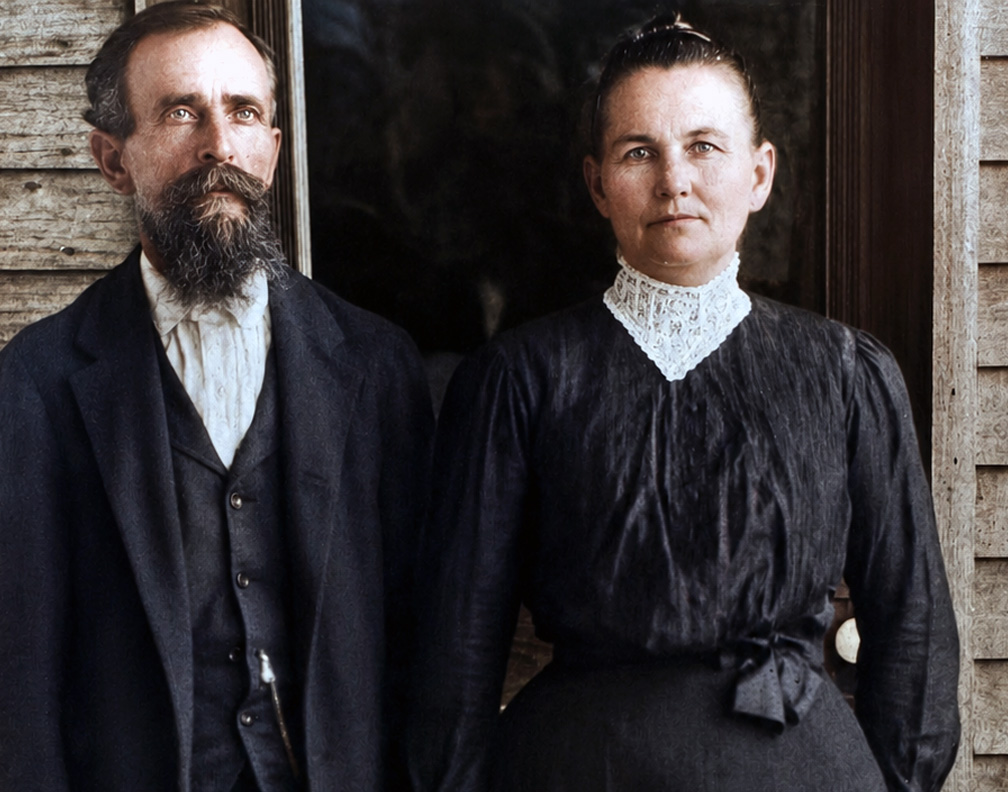
Photo: My second great-grandparents Charlie B. Lovelace and Nancy Jane Yelverton Lovelace
My Yelverton family line offers a fascinating look at colonial North Carolina. That branch, as I currently understand it, runs from John Yelverton Sr. (ca. 1685-1750) the father of John Yelverton Jr. (by 1716-1795); the father of Hardy Yelverton (ca. 1755-1828); the father of Etheldred Yelverton (ca. 1784-1851); the father of Samuel Yelverton (1828-after 1876); the father of Nancy Jane Yelverton Lovelace (1861-1936); the mother of James Luther “Jim” Lovelace (1885-1968); the father of Guy Clinton Lovelace (1916-1997); the father of Shirley Lovelace Williams; who is my mother.
John Yelverton Sr. first appears in northeastern North Carolina in the early 1700s. It appears he married up. His wife, Elizabeth Blount Yelverton (ca. 1685-ca. 1724), belonged to one of the most prominent families in colonial Albemarle, the region of northeastern North Carolina that was the earliest permanently settled part of the colony. Settlers like the Blounts began moving there about the middle of the seventeenth century.
A will dated Feb. 12, 1716, and proved March 27, 1717, gives the strongest evidence for that connection. In it, James Blount (ca. 1655-1717) of Chowan Precinct names his “loving daughter, Elizabeth Yelverton,” along with grandsons James Yelverton and John Yelverton. The same will gives John Yelverton Sr. a role in settling the estate, calls him “over seare,” or overseer, and later records that John proved the will in open court. 1
If the research is correct and Elizabeth’s grandfather is Capt. James Blount (ca. 1620-1686), that would make him my ninth great-grandfather and the ancestor I have confidently tracked back the farthest. Blount moved from Isle of Wight County, Virginia, into the Albemarle colony by 1669. Later North Carolina histories describe him as a member of the Governor’s Council, a burgess from Chowan and a man of influence in what one writer called the “infant and very disorderly Colony.” 2
In the early 1660s, a motley crew of free-thinkers, republican veterans of Oliver Cromwell’s New Model Army, and Quakers would build the freest place in all the English world, the County of Albemarle in northeastern North Carolina. Protected from the north, and incursions by Virginia royalists, by the Great Dismal Swamp, from the east by the treacherous waters of the Outer Banks, and from Indians by the skilled diplomacy of fur trader Nathaniel Batts, the settlers would prosper as small farmers and free tradesmen. Their leaders would include John Jenkins, veteran of Fendall’s Rebellion in Maryland, and a dissident Virginian planter and sheriff named William Drummond. Together they would resist attempts by the proprietors to exert control over their land and lives, and would extend the franchise to all free Englishmen in the colony. —The History of the Americas
It appears Capt. James Blount was also a rebel. During Culpeper’s Rebellion, one colonial complaint described him as “one of the chief among the insurrectors.” 3
The Blount wills are also revealing. Capt. James Blount’s 1685 will describe an estate that included land, houses, livestock, household goods, servants and enslaved people. His son James Blount’s 1716 will shows a smaller but still substantial family network in Chowan Precinct, with land, livestock, tools, family bequests and close ties to the Yelvertons. 4
John and Elizabeth Blount Yelverton also appear in Bertie County land records. A deed abstract shows John Yelverton and wife Elizabeth selling 100 acres on the south side of the Morrattacky River at Flaggy Run to John Steward in 1723. Another deed abstract places James Blount’s sale of 211 acres to his brother-in-law John Yelverton in 1724. These records suggest that John and Elizabeth moved in the same legal and landholding world as the Blounts as settlement pushed beyond Queen Anne’s Creek and Chowan toward the river communities of Bertie and surrounding counties. 5

Portrait traditionally identified as Charles Eden (1673–1722), a British colonial official who served as the second Governor of North Carolina from 1714 until his death in 1722.
Queen Anne’s Creek also deserves a place in the story. The settlement later took the name Edenton after Gov. Charles Eden (1673-1722) died in 1722. That means John and Elizabeth Blount Yelverton lived near one of the political and commercial centers of early North Carolina, not in an isolated backwoods settlement. 6
The result is a more interesting picture than a simple family line. John Yelverton Sr. married into a powerful colonial family, helped settle his father-in-law’s estate, bought and sold land in the expanding Albemarle region and left descendants who eventually carried the Yelverton name from North Carolina into Haywood Coounty, Tennessee.
Footnotes
- J. Bryan Grimes, ed., North Carolina Wills and Inventories Copied from Original and Recorded Wills and Inventories in the Office of the Secretary of State (Raleigh: Edwards & Broughton Printing Co., 1912), will of James Blunt, Chowan Precinct, dated Feb. 12, 1716, proved March 27, 1717. ↩︎
- John H. Wheeler, Reminiscences and Memoirs of North Carolina and Eminent North Carolinians (Columbus, Ohio: Columbus Printing Works, 1884), “The Blount Family.” ↩︎
- Wheeler, Reminiscences and Memoirs of North Carolina, quoting colonial documents on Culpeper’s Rebellion; Lindley S. Butler, “Culpeper’s Rebellion,” NCpedia. ↩︎
- Grimes, North Carolina Wills and Inventories, wills of Capt. James Blounte and James Blunt. ↩︎
- Colonial Bertie County, North Carolina: Abstracts of Deeds, 1720-1725, deed abstracts for John Yelverton and wife Elizabeth to John Steward and James Blount to John Yelverton. ↩︎
- “Charles Eden Dies Near the Town Named in His Honor,” North Carolina Department of Natural and Cultural Resources, March 26, 2016. ↩︎


Leave a Reply