
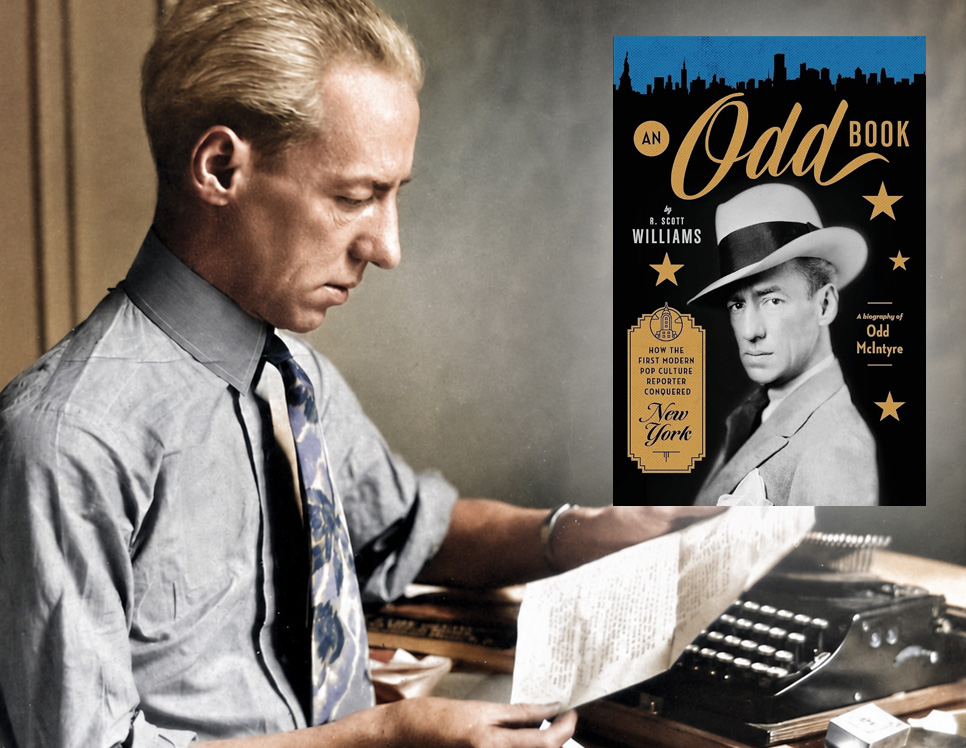
I haven’t blogged much as usual this year because nearly all my spare time has gone into finishing up my biography of Oscar Odd McIntyre (1884-1938), a small-town newspaperman who became one of the most widely read and highly paid writers of his generation.

“An Odd Book: How the First Modern Pop Culture Reporter Conquered New York” will be released on Amazon and in select bookstores on April 1, 2017.
Researching and writing about Odd and Maybelle McIntyre (1884-1985) has been a fascinating experience. I have enjoyed discovering their story, and I look forward to sharing it with everyone.

I am very grateful to The University of Rio Grande and Rio Grande Community College for allowing me to research the collection of Maybelle McIntyre who died in 1985 at age 101. Most of the collection was donated to the university by Maybelle’s cousin Dr. Laura E. Kratz.
They allowed me to have access to photos, letters, scrapbooks and other materials that signifciantly enhanced the story of the couple’s lives and Odd McIntyre’s fasciating career.

Odd and Maybelle McIntyre towards the end of his life
McIntyre’s life is the story of how one man found fame and fortune against incredible odds. It is a story of camaraderie and friendship among some of the most prominent writers, musicians, artists and entertainers of the early 20th century. It is also a love story about a married couple who struggled to reach the top, endured humiliating failures and somehow survived them together.
More than anything, McIntyre’s story demonstrates the power of the written word to “entertain people a little each day,” as he once described his reason for writing.
Through the thousands of articles and columns he wrote during his lifetime, he left behind a unique portrait of American popular culture during one of the most transformative periods in the nation’s history.
A Small-Town Writer Conquers New York

The staff of the Cincinnati Post in 1906: back row from left: Phil Simms, dramatic editor; Will Blenn, make-up editor; Wilson Burke, telegraph editor; Don Allen; Ray Long, managing editor; O.O. McIntyre; front row: H.T. Webster, cartoonist
Born in Missouri and raised by his grandmother in Gallipolis, Ohio, McIntyre began his newspaper career as a young reporter earning only a few dollars a week. He worked his way through newspaper offices in Ohio before arriving in New York in 1912, just as new forms of mass communication and entertainment were beginning to reshape American life.

Odd McIntyre’s boyhood home in Gallipolios, Ohio, photo credit: The University of Rio Grande
When a magazine job that brought him to New York quickly disappeared, McIntyre refused to give up. He began writing a daily letter about life in the city and mailing copies to newspaper editors around the country.
That homemade effort became “New York Day by Day,” one of the most successful syndicated columns in newspaper history.

At the height of his career, writing under the name “O. O. McIntyre,” the column appeared in more than 500 newspapers across the United States, Canada and Mexico. McIntyre produced close to 300,000 words a year and earned an estimated $200,000 annually, an extraordinary income for a writer during the 1920s and 1930s.1
He may have lived in Manhattan, but he never stopped viewing the city through the eyes of a boy from Gallipolis. He wrote about the city’s glamour, eccentricities and characters for readers who might never visit New York themselves. His columns gave millions of people the feeling that they had spent the day walking along Broadway, peering backstage at a theater or watching famous personalities pass through a hotel lobby.
McIntyre understood that readers did not merely want facts. They wanted to know what famous people wore, where they ate, how they behaved and what happened after the curtain came down.
Witness to a Changing World
Odd McIntyre built his career during a period of extraordinary change in communication, politics, art and entertainment. Newspapers and magazines reached enormous audiences while radio and motion pictures emerged as powerful new media.

Follow my new Odd Book Instagram page for pop culture photos from Odd’s era.
New technologies transformed how information traveled. New ideas changed journalism’s role in American politics and society. Odd stood at the center of those changes.
He reported from the New York pier as survivors of the Titanic arrived in the city and began describing the night the supposedly unsinkable ship struck an iceberg. As a young Ohio journalist, he became one of the early reporters to interview Wilbur and Orville Wright as the Dayton bicycle mechanics struggled to convince the world that they had built a flying machine.
McIntyre later worked as a press agent for Florenz Ziegfeld Jr. and watched from backstage as Broadway entertainment evolved beyond vaudeville. He wrote about Tin Pan Alley as songwriters, publishers, musicians and performers created music that spread throughout the country.

Autographed photograph by Margaret Bourke-White showing Odd McIntyre (second from left) with a gathering of Hearst and King Features writers, editors and cartoonists, including Damon Runyon, Bugs Baer, B. C. Forbes, William Soskin, Wally Knickerbocker, Prunella Wood, Alice Hughes, Gilbert W. Gabriel, Lewis Reid and W. J. Enright, circa the mid-1930s.
McIntyre’s assignments and friendships brought him into contact with many of the most influential personalities of the period. His circle included writers Edna Ferber, Ernest Hemingway and F. Scott Fitzgerald; entertainers Fred Astaire, Will Rogers and Florenz Ziegfeld Jr.; composers George Gershwin and Meredith Willson; and actors Rudolph Valentino, Billie Burke and Charlie Chaplin.
He never stopped thinking of himself as a newspaperman. His career developed alongside the work of muckraking journalists who exposed corruption, challenged powerful institutions and expanded the role of the American press.
While the country debated the conflict between traditional small-town values and modern urban life, McIntyre could move comfortably between both worlds. During the Great Depression, he continued to entertain readers while reminding them that moments of humor, kindness and wonder still existed in cities and small towns.
Odd and Maybelle: a love story
Odd’s career was never a one-man operation.
Maybelle provided the encouragement he needed when repeated professional disappointments left him ready to surrender. Once “New York Day by Day” began attracting attention, she managed the business side of his career and negotiated increasingly valuable syndication contracts.
Her work helped transform McIntyre from a struggling freelance writer into a national media personality. Contemporary accounts and later biographical studies consistently credit Maybelle with playing an essential role in building and maintaining his career.2

Odd and Maybelle and friends at one of the many parties they attended in the 1920s. At this New Year’s Eve party Maybelle (bottom row center) was photographed between George Gershwin and Rube Goldberg (reclining). Groucho Marx is on the bottom row, far right of the photograph. Odd is on the back row, third from right, while his friends Ray Long and Roy Howard can be seen fifth and sixth from the left. Photo credit: The University of Rio Grande
They enjoyed the rewards of that success. They lived in expensive New York apartments, traveled extensively, attended fashionable parties and rode through the city in a chauffeur-driven Rolls-Royce. Behind that glamorous public image, however, McIntyre struggled with serious physical and emotional problems.
The outgoing man-about-town his readers imagined bore little resemblance to the intensely private man behind the column. McIntyre feared crowds, avoided daylight and became increasingly reluctant to leave his apartment. He suffered episodes of severe anxiety and depression, and evidence suggests that pernicious anemia may have contributed to his deteriorating physical and mental health.
As his condition worsened, McIntyre depended more heavily on Maybelle. At times, he could write only when she remained in the room. Her brief absence from their apartment could send him into a panic. Maybelle became his business manager, caregiver, protector and essential creative partner. Their relationship gives the story its emotional center. McIntyre possessed the talent, but Maybelle supplied much of the confidence, structure and determination that allowed him to use it.
The Greatest Show on Earth
McIntyre’s newspaper column and his thousands of articles for magazines including Cosmopolitan, Life, McCall’s and The Saturday Evening Post overflowed with celebrity encounters, social observations, pop culture references and vivid descriptions of New York, Paris and Hollywood.
Even today, his writing brings to life the period when modern entertainment, media and celebrity culture were taking shape. A New York Times obituary captured the quality that made Odd’s writing so appealing. His “greatest stock-in-trade,” the newspaper observed, was his intense wonder at a version of New York that existed largely through his own imagination.3
Odd viewed Manhattan as the greatest show on earth, and he gave every reader an aisle seat. He died of a heart attack in his Park Avenue apartment on Feb. 14, 1938, four days before his 54th birthday. Although his name gradually faded from popular memory, his influence survives in nearly every form of modern entertainment journalism. Today’s celebrity reporters, entertainment websites, television programs, social media personalities and pop culture commentators all operate in a sector McIntyre helped define.
The life of Oscar Odd McIntyre is ultimately a story of tenacity. It is about pushing forward despite enormous obstacles, even when success appears impossible. It is about being in the right place at the right time with the right talent, and having the sense to recognize the opportunity. It is the story of a man who, when no one would give him a chance, created his own way to do what he loved. In the process, he produced an extraordinary body of work that preserves the people, places and experiences of an age when celebrity pop culture was being born.
I look forward to sharing Odd and Maybelle’s story when “An Odd Book: How the First Modern Pop Culture Reporter Conquered New York” is released April 1, 2017.
Notes:


Leave a Reply