
I am still new to genealogy research and kept noticing a hole in the census records for my Haywood County ancestors in 1890.
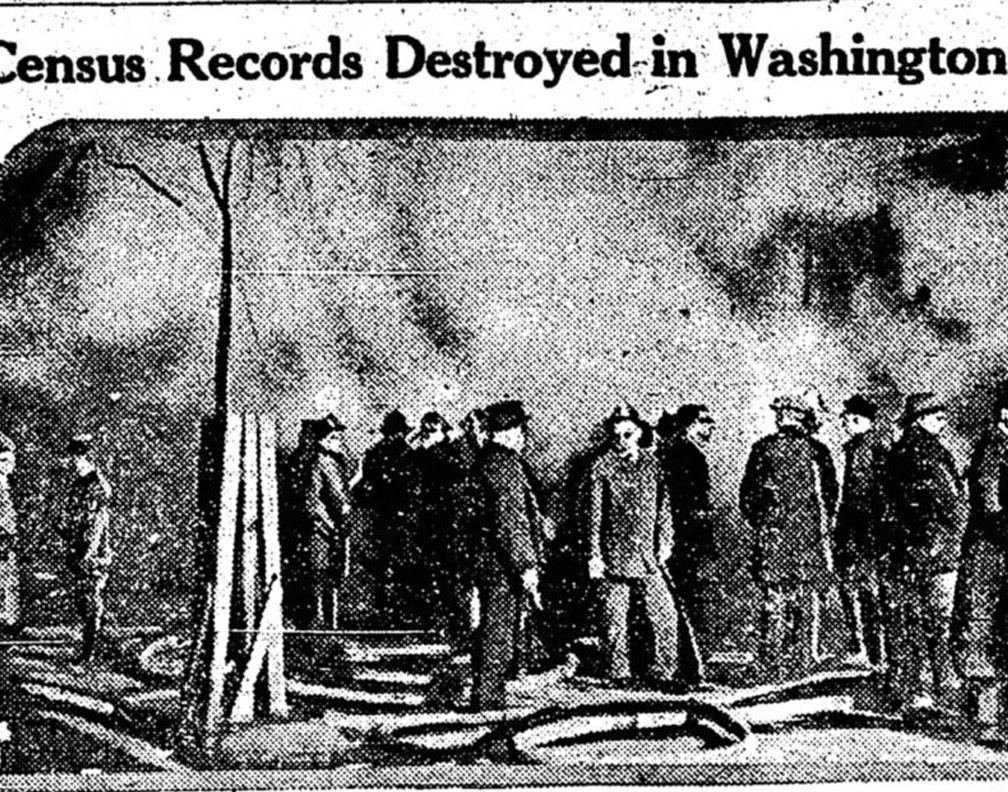
After a little digging, I learned why. Most of the 1890 federal census population schedules were damaged in a fire at the Commerce Department Building in Washington, D.C., on Jan. 10, 1921. Some records survived the fire only to be destroyed later. For genealogists, that loss is frustrating. A lot happens in families in the 20 year gap between 1880 to 1900.
A Great Loss
In 1921, the United States did not yet have a National Archives. Congress would not create one until 1934. Before that, federal records often sat in basements, attics, abandoned buildings and other places that offered little protection. The 1890 census schedules were stored in the basement of the Commerce Department Building at 19th Street and Pennsylvania Avenue NW.
The 1890 census should have been one of the great treasures of American genealogy. It was the first U.S. census to use Herman Hollerith’s electrical tabulation system, which used punched cards to process census data. It also differed from earlier censuses in several important ways. Enumerators prepared a separate schedule for each family. They asked married women how many children they had borne and how many were still living. They also asked about Civil War service, home ownership, immigration, naturalization and the ability to speak English.
Most of that information is gone.
According to a 1996 article in “Prologue,” the magazine of the National Archives, the fire began late in the afternoon of Jan. 10, 1921. A building fireman noticed smoke coming through openings around pipes that ran from the boiler room into the file room. Firefighters arrived quickly, but the smoke made the basement difficult to enter. A crowd of thousands gathered outside as firefighters cut through the concrete floor and poured water into the cellar. The fire never reached the upper floors, but the 1890 census schedules sat outside the basement vault and took the worst of the damage. The Census Bureau initially estimated that 25% of the 1890 schedules had been destroyed and that half of the remaining records had suffered water, smoke or fire damage.
Thankfully, the census schedules from 1790 through 1820 and 1850 through 1870 were stored on the fifth floor of the Commerce Building and reportedly escaped damage.
What happened next may frustrate genealogists even more than the fire itself.
The damaged records were moved to temporary storage while rumors spread that officials might destroy them rather than spend money on restoration. Historians, attorneys, genealogical organizations and groups including the National Genealogical Society and the Daughters of the American Revolution protested. That pressure appears to have stopped any immediate destruction. By May 1921, officials had moved the records back to the Census Bureau so they could be organized and, where possible, bound for reference.
For about a decade, what remained of the 1890 census sat in federal custody, but no serious recovery effort seems to have followed.
In December 1932, the chief clerk of the Census Bureau sent the librarian of Congress a list of papers the bureau no longer needed for current business. The list included “Schedules, Population . . . 1890, Original.” The librarian identified no records on the list as historically permanent. Congress authorized their destruction on Feb. 21, 1933. One report says the 1890 census papers were finally destroyed in 1935, while a note in a Census Bureau file says the remaining schedules were destroyed by the Department of Commerce in 1934.
Today, only fragments of the 1890 population schedules survive. They include records from Alabama, Georgia, Illinois, Minnesota, New Jersey, New York, North Carolina, Ohio, South Dakota, Texas and the District of Columbia. The surviving fragments include only about 6,160 names.
For genealogists, the lesson is painful but useful. When the 1890 census should answer a question and cannot, we have to look elsewhere. Tax lists, court records, deeds, church minutes, local newspapers, state censuses, city directories, school records, probate files and cemetery records can sometimes help rebuild what the missing census would have shown.
Still, there is no real substitute for that lost national snapshot. For my families in Haywood County, the missing 1890 census would have caught the Lovelaces, Brantleys, Castellaws and Williamses and others at a moment of change. Parents were aging. Children were growing. Marriages, deaths, births and moves were reshaping every branch.
The fire in 1921 damaged the records. Government neglect finished the job.
If you are interested in the topic, a National Archives presentation by archivist Constance Potter offers more on how a few records did survive and how they eventually made it to the National Archives.
For more of my genealogy research, visit rscottwilliams.info.


Leave a Reply