
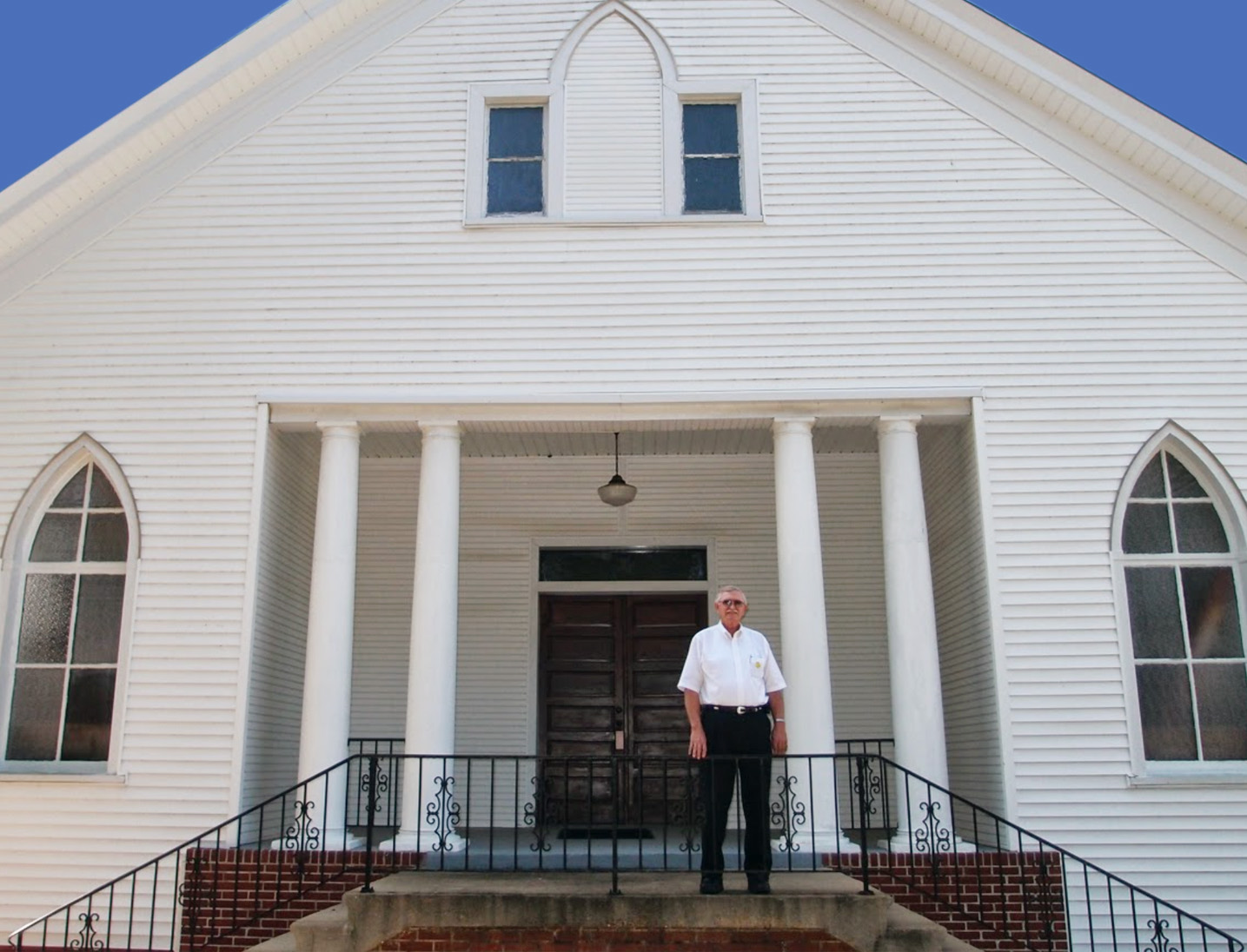
Pastor Bob Williams in front of the First Baptist Church of Stanton, Tennessee /
My dad has a new position as pastor of the historic Stanton Baptist Church in Stanton, Tennessee, a small town in Haywood County. I really appreciate old churches, so I was eager to check it out. A few weeks ago, when we took a break from Washington, D.C. for some time at home, we went on a little detour on our way to the Lovelace family reunion. I got a personal tour from the new pastor himself.
Joseph Blackwell Stanton (1787-1860) moved to what is now Stanton in the 1830s with his wife, Lucy Taylor Stanton (1792-1852), and their daughter, Grace Stanton Adams. After Stanton helped bring the Memphis & Ohio Railroad through his property, Stanton Depot began to grow, and families, businesses, schools and churches moved from nearby Wesley to the new community. According to “Heart of the Tennessee Delta: A Historical Guidebook to Haywood County,” Stanton’s daughter and her husband, Nathan Adams (1810-1881), helped develop the town by selling lots there.1
One of Stanton’s early Civil War stories involves Union Gen. William W. H. L. Wallace (1821-1862). Local history says Gen. Wallace and his troops camped near the property of Corydon Spencer when they were fired on by Confederate troops. Wallace reportedly gave an order to burn the town, but Spencer talked him out of it, saving Stanton from destruction.2

Prince, the black stallion ridden by Union Gen. William H.L. Wallace when Wallace was mortally wounded at the Battle of Shiloh, was photographed in 1885 by W.E. Bowman outside the Wallace residence in Ottawa, Illinois. Bowman staged the aging war horse beside a portrait of Wallace and the Shiloh battle flag, turning Prince into a living memorial to the general and the battle.
Gen. Wallace would not live to see the end of the war. He was wounded at the Battle of Shiloh on April 6, 1862 and died three days later.
As more families moved to Stanton, a small Baptist church in the town of Wesley also decided to move to the growing community. As Stanton grew, Wesley faded. In 1868, the congregation built a church on the spot where the current one stands today.
My dad gave me some information that church members had written for the 150th anniversary of the church in 2002. It included the fact that the original building had two front doors, one for men and one for women. Men and women also sat on different sides of the church.3

Historic photo of First Baptist Church of Stanton, built in 1912
In 1912, the original Stanton Baptist Church building was torn down, and the current church was built. The new building included Doric columns and beautiful Gothic windows.

Next door to the large church building is the Stanton Masonic Lodge and School.
The Greek Revival building next door was built in 1871 by the local Masons as a school for local children. A National Register of Historic Places nomination for the Stanton Masonic Lodge and School describes it as a two-story frame building with Greek Revival detailing. The first floor served as a schoolroom, while the upper floor was used by the Masonic lodge. 4

Stanton Historic Marker
Stepping into the church really is like going back to the 1950s. From the original pews to the light fixtures and ceiling fans, it is one of the best-maintained old churches I have been in.

Very little has changed since the church was built in 1912. The coal-burning stoves that once heated the church have been replaced with gas heaters, and the old kerosene lamps that were mounted on the walls have been replaced with electric light fixtures.

Originally, a large Gothic arch framed an alcove from which the preacher delivered his sermon each Sunday. In 1954, the alcove was made into the baptistry, and a pulpit was installed for the preacher.

If you live near Stanton, you should go check it out one Sunday. Yes, the building is amazing, but I can also highly recommend the new preacher and his wife.

Notes
- Brownsville-Haywood County Bicentennial Committee, Heart of the Tennessee Delta: A Historical Guidebook to Haywood County (Brownsville, TN: Brownsville-Haywood County Bicentennial Committee, 1996). ↩︎
- Brownsville-Haywood County Historical Society, History of Haywood County, Tennessee, 1989 (Brownsville, TN: Brownsville-Haywood County Historical Society, 1989). ↩︎
- History of Tennessee from the Earliest Time to the Present: Together with an Historical and Biographical Sketch of Lauderdale, Tipton, Haywood and Crockett Counties (Nashville: Goodspeed Publishing Co., 1887) ↩︎
- Laura Barnes and Alma D. Johnson, “Stanton Masonic Lodge and School,” National Register of Historic Places Registration Form, National Park Service, 1987, sec. 7, pp. 1-2; sec. 8, pp. 1-3. ↩︎


Leave a Reply