
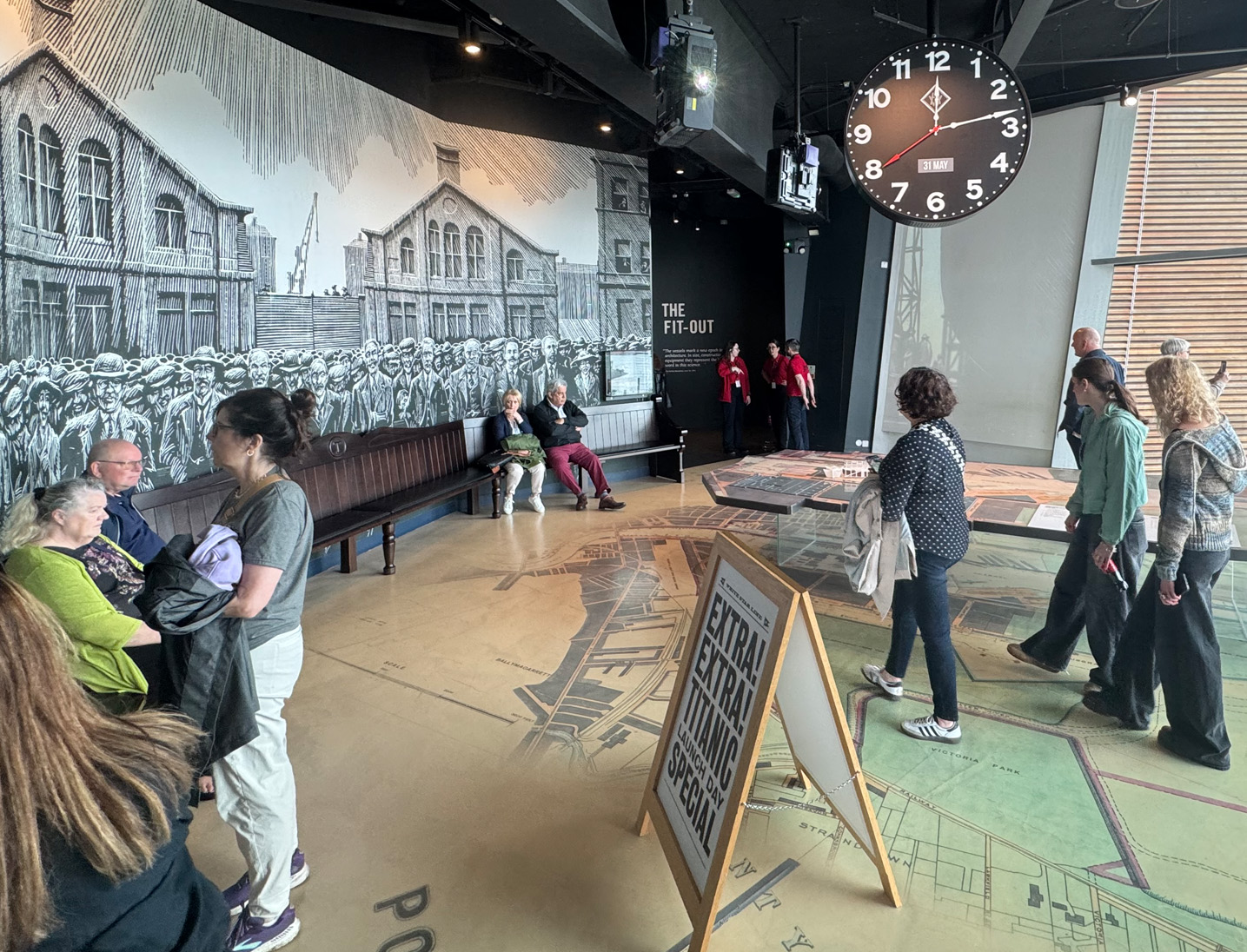
Photo: Titanic Belfast, a world-leading visitor attraction that tells the story of RMS Titanic /
We just returned from an adventurous week with family in Northern Ireland. Our trip included a few days in Belfast followed by the remainder of the time in the “wee seaside town” of Portrush on the Causeway Coast.
While we had plenty of history, museums, castles and “Game of Thrones” sites on our list, the real reason for the trip was much more important. Our youngest daughter, Liv, was marrying her fiancé, Eric. They had selected one of the most spectacular places in the world for the small wedding: a cliff overlooking the ruins of Dunluce Castle and the Atlantic Ocean.
We were there for seven nights, arriving in Belfast on Thursday, Aug. 28, and flying home Sept. 4. We used taxis while we were in Belfast and rented cars when we headed north to Portrush.
Last summer’s visit to Scotland provided a practice run. In Ireland, they also drive on the opposite side of the road, the steering wheel is on the opposite side, and the roundabouts require you to pay attention (and have a really solid co-pilot). Be sure to reserve an automatic. There is already enough going on without adding a stick shift to the experience.

Northern Ireland rain did not hold us back.
Bring a raincoat, layers and good walking shoes. You may experience rain, wind, sunshine and clouds during the same 30-minute period.
Headed to Belfast from Nashville

Our group, including Eric’s parents and our oldest daughter, Alex, met up at the Nashville airport. We arrived so early we had to wait a while to check our luggage. “Better safe than sorry” is my airport arrival policy.

My carry-on luggage was the bag that contained the brides dress, so I was entrusted with great responsibility. Eventually, we checked bags and boarded our flight on British Airways from Nashville through London Heathrow and into George Best Belfast City Airport. Belfast City Airport is only a few miles from the city center.
For our first four nights, we stayed at room2 Belfast, which describes itself as a “hometel.” That’s actually a pretty good description. The rooms are designed for longer stays and include kitchenettes, but there is also a restaurant, bar and plenty of public space downstairs.
After the overnight flight and time change, our goals for the first evening were not ambitious: eat something, stay awake long enough to convince our bodies we were in Ireland and get to bed.
The next morning, we began exploring.

While in Befast, we took advantage of the Hop-on Hop-off bus
Titanic Belfast

Titanic Belfast was built on the site of the Harland & Wolff shipyard where RMS Titanic was constructed.
If you only have time for one attraction in Belfast, I would put Titanic Belfast at the top of the list.

The massive museum stands in the Titanic Quarter on the site of the Harland & Wolff shipyard where RMS Titanic was designed and built. Rather than focusing only on the sinking, the experience tells the much larger story of Belfast’s shipbuilding industry, the people who built the ship, its construction and launch, the voyage and the disaster that followed.
We allowed a couple of hours for the museum, and you could easily spend more.
Admission also included the SS Nomadic, the last surviving White Star Line vessel. Built in Belfast in 1911, the Nomadic served as a tender carrying passengers out to larger liners — including the Titanic.

For someone who enjoys museums and industrial history, the combination makes for a great experience.

Here’s a tip: Before leaving for Belfast, I reread my old copy of “A Night to Remember” by Walter Lord. It’s not a new book — it was first published in 1955 — but it is considered one of the best-known accounts of the sinking of the Titanic. It will help add some context to your visit.
Lord’s book shaped modern understanding of the Titanic disaster and is an early example of the type of books I enjoy writing. I was especially interested in seeing the Belfast side of the Titanic since Odd McIntyre, the subject of my biography, “An Odd Book: How the First Modern Pop Culture Reporter Conquered New York,” interviewed the survivors when they arrived in New York.

From there, we headed across Belfast to C.S. Lewis Square. The walk was way longer than we anticpated and, ultimately, C.S. Lewis Square does not offer much other than seven bronze sculptures inspired by “The Lion, the Witch and the Wardrobe,” including Aslan, Mr. Tumnus and the White Witch.

C.S. Lewis Square in Belfast
I was honestly expecting a small museum or more about the life of C.S. Lewis and his time in Belfast. Lewis was born in Belfast in 1898, and Northern Ireland’s landscape had a profound influence on his imagination.
That would not be our last C.S. Lewis connection of the trip.
Winter Is Coming
Our next day was devoted to something completely different.

We booked a nine-hour Winterfell Trek that took us south of Belfast into County Down to several locations used during the early seasons of “Game of Thrones.” The day included a stop at The Barn Bar & Country Kitchen for lunch.
And yes, there were Stark cloaks, swords and banners involved.

Attempting to look appropriately serious with our fellow travelers while wearing a Stark cloak
One of our stops was the ruins of 12th-century Inch Abbey, used as the location where Robb Stark’s bannermen proclaimed him “King in the North.”
We also visited Castle Ward, which provided the original location for Winterfell in the first season, and Tollymore Forest Park. The forest appeared in the very first episode of the series and was also where the Stark children discovered the direwolf pups. It was pouring rain for part of the time, but we pushed through and loved every minute.

Our guide had actually worked as an extra on “Game of Thrones,” which added a whole other layer to the experience.
I have always enjoyed visiting movie and television locations because you get two experiences for the price of one: You see the place as it really is and then recognize how filmmakers transformed it into someplace that exists only in our imaginations.
A Little More Belfast
We intentionally left some time in Belfast less structured.

St. George’s Market was on our list. The Victorian market building is filled with food vendors, antiques, crafts, books, live music and just about everything else you would expect to encounter at a good public market. I bought a St. Christopher pendant on a chain as my souvenir of the trip.
We also had the Ulster Museum on our list. Like the National Museum of Scotland in Edinburgh, it covers a little of everything — art, natural history, archaeology and the history of Northern Ireland. However, this museum has a twist. Their mission line is: A place to inspire wonder, encourage creativity and to understand the importance of our shared humanity.

Recreation of a chalk board used in the television show Derry Girls
One item on display quickly caught my eye. It is a recreation of a chalk board that was a prop used in the opening episode of Season 2 of “Derry Girls,” broadcast on March 5, 2019.

| In the episode: Catholic schoolgirls and Protestant schoolboys are brought together for a cross-community weekend intended to promote understanding between the two communities. A well-meaning priest asks the teenagers to brainstorm things Catholics and Protestants have in common and things that make them different. The “Differences” board quickly fills up, while the “Similarities” board remains virtually empty. |
While visiting Northern Ireland, you can’t help but see the remnents of “The Troubles,” the violent conflict in Northern Ireland from the late 1960s until the Good Friday Agreement in 1998. The complicated relationship between Northern Ireland and the Republic of Ireland is rooted in religion, politics and competing national identities.
Beginning in the 1600s, the English monarchy encouraged Protestant settlers, particularly from Scotland and England, to move into the northern province of Ulster, where much of the native population was Catholic and Irish. Over time, Protestants generally identified with Britain and wanted to remain part of the United Kingdom, while many Catholics identified as Irish and supported independence and eventual reunification with the rest of Ireland.
When most of Ireland became independent in the early 1920s, six predominantly Protestant counties in the north remained in the United Kingdom, creating Northern Ireland and a border that remains today.
Discrimination, political inequality and deep mistrust eventually contributed to the Troubles, roughly three decades of bombings, shootings and sectarian violence from the late 1960s until the 1998 Good Friday Agreement.
Today, people easily cross the open border and relations are more peaceful, however, British versus Irish identity and Protestant versus Catholic continue to impact their culture and you see it manifested in both subtle and obvious ways.

If you want to understand more about Ireland and the Troubles, you should read “Say Nothing: A True Story of Murder and Memory in Northern Ireland” by Patrick Radden Keefe.
“A masterful history of the Troubles. . . Extraordinary. . . As in the most ingenious crime stories, Keefe unveils a revelation — lying, so to speak, in plain sight.”—Maureen Corrigan, NPR
The book was made into an FX limited series. It explores “the Troubles through the lives of people caught up in republican violence, political struggle and the lasting consequences of that era.” The series premiered on Hulu in November 2024, won a Peabody Award and was popular with viewers and critics.

That afternoon, we spent a little time at Botanic Gardens in Belfast, a 28-acre park that is home to the Palm House. The curved iron-and-glass structure was designed by Charles Lanyon, one of Victorian Belfast’s most influential architects, whose work also includes the landmark Lanyon Building at Queen’s University Belfast and the Custom House.

Its wrought-iron framework was constructed by Richard Turner, a Dublin iron founder and engineer who became one of the great innovators of 19th-century glasshouse construction. Turner later helped create the famous Palm House at Kew Gardens in London. Construction on Belfast’s Palm House began in 1839, making it one of the earliest surviving examples of curvilinear iron-and-glass architecture.
One of the lessons Michelle and I learned during our Scotland trip was not to schedule every minute. Some of the best travel experiences happen because you have enough room in the itinerary to wander into something you didn’t know existed. We spent some of our time just exploring whatever ended up in front of us.
That was especially important on this trip because, by Monday morning, we had a wedding week to get underway.
A bit of video of our visit to Northern Island
Northern Ireland Trip Report: Belfast, Portrush and a Wedding at Dunluce Castle, Part II
For more of my genealogy research, visit rscottwilliams.info.


Leave a Reply