
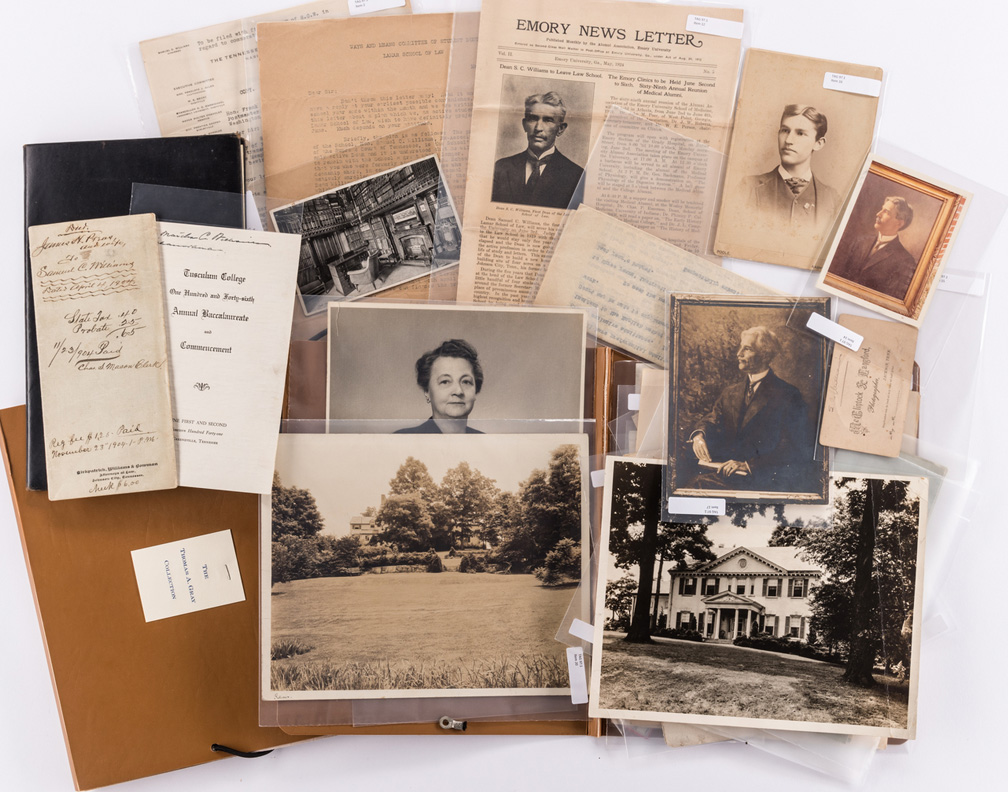
Photo: Collection of Samuel Cole Williams items auctioned off at recent auction /
I’ve long been aware that ancestors on both sides of my family migrated from Bertie County, North Carolina to West Tennessee. They played a role in the earliest years of development in the region following the Chickasaw land cession of 1818.
Several years ago, I ran across “Beginnings of West Tennessee: In the Land of the Chickasaws, 1541-1841,” written by Samuel Cole Williams (1864-1947) and published in 1930. I bought a copy and threw it on my ever-growing stack of books to read “when I get a chance.”

I finally got a chance while on vacation and then, ironically, just saw a collection of Williams’ personal photos and ephemera were recently actioned off by Case Antiques Fine Art and Antiques for less than $1,000. After spending part of my vacation on the beach with Williams and seeing a collection of his personal items, I wanted to know more about the man behind the book.

Photo: Portrait of Samuel Cole Williams; photo credit: Vanderbilt University Photographic Archive
The Historian Behind the Book
Samuel Cole Williams was a lawyer, judge, legal scholar and historian. A Vanderbilt University graduate, he served on the Tennessee Supreme Court from 1913 to 1918. He became the first dean of Emory University’s Lamar School of Law, serving until 1925. He also chaired the Tennessee Code Commission, that revised the state’s laws and produced Tennessee’s first official legal code in many years.
In addition to his legal career, Williams became nationally known as a historian, writing and editing numerous books on Tennessee history, including “History of the Lost State of Franklin,” “Early Travels in the Tennessee Country” and, of course, “Beginnings of West Tennessee” which I recently enjoyed in Virginia Beach.
He also had an early West Tennessee connection. Williams was born Jan. 15, 1864, near Humboldt in Gibson County, Tennessee.

Samuel Cole Williams as a boy; photo credit: Case Auctions Fine Art & Antiques
He graduated from Vanderbilt University’s law school in 1884 and eventually settled in Johnson City, where he established his legal career and became involved in banking, manufacturing, utilities, transportation and hotel development.1

Samuel Cole Williams as a young man; photo credit: Case Auctions Fine Art & Antiques
Williams later served as chancellor of Tennessee’s First Chancery Division and as a justice of the Tennessee Supreme Court. In 1919, he became the first dean of the Lamar School of Law at Emory University in Atlanta, serving until 1924. Under his leadership, the law school gained membership in the Association of American Law Schools.
Despite those accomplishments in the legal world, Williams is best remembered today for his contributions to Tennessee history.

From 1923 through 1930 alone, he published or edited a remarkable series of major works on Tennessee history. That level of productivity is especially impressive when you consider that he conducted his research without online databases, searchable newspapers, digital archives or any of the tools we now take for granted.
In the preface to “Beginnings of West Tennessee,” Williams acknowledged that he had not lived in West Tennessee for more than 40 years. He believed a historian still living in the region would have enjoyed easier access to local records and family materials. Williams shared he attempted to overcome that disadvantage through what he described as “diligent searching of printed volumes, archival materials and files of old newspapers.”2

The Death of Mayne Williams
While he experienced great success in his professional life, Williams also struggled with a terrible personal loss.
In 1892, he married Mary Trimble Mayne (1864-1917). A little over a year later, their son, Mayne (1893-1897) was born. A few years later, on July 1, 1897, their daughter, Gertude, arrived. That same month, Mayne swallowed sugar-coated quinine pills and died only weeks away from his fourth birthday.
The Aug. 5, 1897, edition of the Johnson City newspaper “The Comet” reported that Mayne’s grandmother found him lying on the floor. She said later that when she questioned him, he said, “I took a whole lot of medicine; I’m so sorry.”3 He died within about 40 minutes.
In 1913, Samual and Mary Williams donated property and $10,000 toward the construction of a public library in Johnson City as a memorial to their son. The Mayne Williams Public Library finally opened Jan. 1, 1923. The former library building later became a chapel for Munsey Memorial United Methodist Church.
Mary Williams had an impressive career in her own right. After graduating from Ohio Wesleyan University in Delaware, Ohio, she became involved in the civic, religious and charitable life of Johnson City. She served as president of the Monday Club, district secretary of the Woman’s Missionary Society of the Methodist Episcopal Church, South, and an active member of the John Sevier Chapter of the Daughters of the American Revolution.
On July 20, 1917, on their Silver Wedding Anniversary, Mary died of stomach cancer at age 52. According to her obituary, she fell ill from the disease in New York when she was there as a delegate at a meeting of the National Federation of Women’s Clubs.4

Samuel Cole Williams’ second wife, Isabel “Issie” Hayes Williams; photo credit: Case Auctions Fine Art & Antiques
In 1919, 55-year-old Samuel remarried. His 39-year-old bride was Isabel “Issie” Hayes (1879-1956), and together they had a daughter, Martha Cole Williams (1920-1993).

Samuel Cole Williams in 1924 at the time of his retirement as Dean at Emory University Law School
The Dean of Tennessee Historians
Williams retired to his Johnson City home, Aquone, during the 1920s. The Colonial Revival residence, completed in 1925, was later listed in the National Register of Historic Places because of its architectural significance and its association with Williams.5

In 1941, Williams became chairman of the Tennessee Historical Commission. He served until resigning in 1946, after which the commission designated him chairman emeritus for life.

The Knoxville News-Sentinel, December 15, 1947, 7.
Williams died Dec. 14, 1947, at age 83 and was buried in Monte Vista Memorial Park in Johnson City.
The Tennessee State Library and Archives holds approximately 800 items in the Samuel Cole Williams Papers, spanning the period from 1765 to 1947.

Samuel Cole Williams at the unveiling of an unidentified portrait. Photo credit: Tennessee State Library and Archives
The collection contains correspondence, court documents, genealogical material, land records, photographs, newspaper clippings, research notes and manuscripts. Williams frequently recorded his notes on the backs of letters, canceled checks and scraps of paper. Those scattered notes became the raw material for some of Tennessee’s most important early histories.
Samuel Cole Williams devoted much of his life to reconstructing the Tennessee that my ancestors helped settle. Nearly a century after the publication of his book, those of us doing our own research following the paths of North Carolina families into West Tennessee remain in his debt.
For more of my genealogy research, visit rscottwilliams.info.
Notes:
- Tennessee State Library and Archives, “Samuel Cole Williams Papers, 1765-1947,” biographical note; Tennessee Encyclopedia, “Samuel Cole Williams.” ↩︎
- Williams, Beginnings of West Tennessee, vii. ↩︎
- “A Sad Accident,” The Comet (Johnson City, TN), August 5, 1897. ↩︎
- “Judge Williams’ Wife Dies,” The Commercial Appeal, July 21, 1917, 16. ↩︎
- National Park Service, National Register of Historic Places Registration Form: Aquone, 1993. ↩︎


Leave a Reply