
The Marbury family has kept me busy the last few weeks. There are a lot of men named Francis and Leonard, and once you get back into Maryland, they begin to multiply in a hurry. Add in old naming patterns, Revolutionary War service and genealogy sites that copy from one another, and it can be hard to tell which man belongs to which generation. Still, one line of the family seems interesting enough to explore a little further.

The Ark, from a print in the possession of the Maryland Historical Society, Source: Maryland; stories of her people and of her history, 1905
It appears that one branch of my Marbury ancestors reaches back not just to the Revolution or early Tennessee, but to the founding of colonial Maryland itself. My 10th great-grandfather, Thomas Greene (1609-1652), came to Maryland on the 1633-34 voyage of the Ark and the Dove, the two small ships that carried some of the first settlers of the new colony. It appears he was the son of Thomas Greene (unknown-1630) of Bobbing, Kent, who had been made a Knight Bachelor in 1622, and Margaret Webb (unknown-1614) of Frittenden.
Soon after arriving, Thomas Greene (1609-1652) married Ann Cox, possibly Ann Gerard (unknown-unknown). That marriage is widely described in genealogical research as the “first Christian marriage” in Maryland. Ann is often identified as Ann Gerard, possibly the sister of fellow passenger Richard Gerard (unknown-unknown), but that part of the story seems to rest more on later family accounts than on a contemporary record.
The voyage itself was eventful enough. The Ark and the Dove sailed from Cowes on the Isle of Wight on Nov. 22, 1633. Early in the trip the two ships were separated in a storm, and those aboard the Ark feared the smaller Dove had gone down. It had not. The two were later reunited, and after stops in the Caribbean and at Point Comfort in Virginia, the expedition reached Maryland in March 1634. Maryland sources place the first landing at St. Clement’s Island on March 23, with a now well-known Mass of thanksgiving held there on March 25, the date now remembered as Maryland Day. Two days later the settlers established St. Mary’s City.
Also on the expedition was Leonard Calvert (1606-1647), Maryland’s first governor and a close associate of Thomas Greene (1609-1652). In June 1647, as he lay dying, Calvert named Greene to succeed him. Greene later served as acting governor, though his career did not end especially well. Maryland archives show that Greene was later discharged from office in 1650 for “usurping authority.” The same records also show that Greene married more than once. Ann Cox likely died in 1638, and Greene later married Millicent Browne (unknown-unknown) and then Winifred Seyborn (unknown-unknown).
The Marbury connection appears to come from Thomas Greene’s son Leonard Greene (1636-1688). That line is consistent with widely used compiled genealogy entries showing Leonard Greene, son of Thomas Greene, as the father of Mary Greene (1675-1760). As with many families in the 1600s, the evidence seems to come more from assembled records and genealogical reconstruction than from one simple surviving document, but the connection is consistent enough across sources to be taken seriously.
From there the family begins its long march toward Tennessee, with the same names appearing again and again. Mary Greene (1675-1760) and Francis Marbury (1676-1733) had a son named Leonard Marbury (1708-1794). He named a son Francis Marbury (1730-abt. 1800). Francis then named a son Leonard Marbury (1759-1837). After a while it feels less like a family tree than a shell game. Still, the pattern matters, because it helps connect the Maryland Marburys to the later Tennessee line.

These tintype photos from the collection of Janet Marbury Lewis are unidentified, but they are believed to have been handed down through the family from Robert Green Marbury to his son Rush Marbury, then to Rush’s son Andrew Frances Marbury, and finally to his daughter Alice Marbury Cobb. Tintypes began appearing in the mid-1850s and remained popular into the early 1900s. That raises some interesting questions. Could one of these be Robert Marbury himself? Might one be Benjamin Franklin Marbury? Could the older women be Robert’s sisters? The young man in the fifth photo looks a great deal like a known photo of Andrew Francis Marbury, though it could just as easily be his father, Rush, at a younger age. We will probably never know for certain who these people were. But we do know that the Marburys of Haywood County around this time were well educated, prominent in their community and likely dressed much like the people seen here.
One detail especially caught my attention. Leonard Marbury’s son John Marbury (1783-1861) named one of his sons Robert Green Marbury (1809-1904). That middle name looks like more than a coincidence. By then the spelling had been shortened, but it seems possible that some memory of the Greene family still survived. Maybe John knew exactly what he was doing. Maybe he was simply preserving an old family name whose full story had already faded. Either way, it is hard not to take notice.

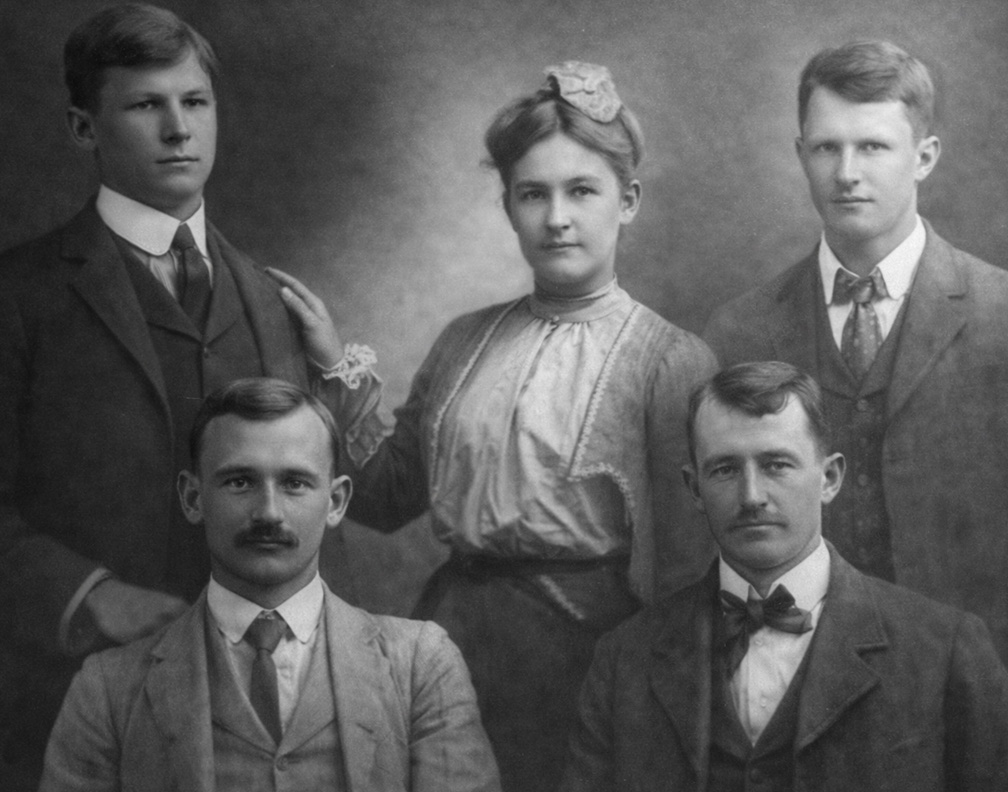
Photo: Betsy S. Waddell / The children of Ben and Mary Marbury. L to R, top row: John W., Rosa, Robert. Bottom row: Hardy Joyner (my second great-grandfather) and Wiley.
Robert Green Marbury (1809-1904) later named a son Benjamin Franklin Marbury (1849-1884), which suggests the family had developed a taste for historically loaded names. Benjamin Franklin Marbury (1849-1884) married Maggie Yelverton (1853-1884), and both are buried at Zion Baptist Church Cemetery in Haywood County. Their son Hardy Joyner Marbury (1872-1932) married Evelena “Lena” Booth (1868-1949), and they had a daughter, my great-grandmother Allie Marbury (1898-1995). By then the family was a long way from St. Mary’s City and the Catholic settlers of Maryland.
One thing I would still leave a little cautious is Leonard Marbury (1759-1837). That date appears on your site lineage chain, but I did not see the full profile in the search snippet the way I did for the others. The rest above matches what I found on your Haywood County Line pages.


Leave a Reply