
Sunday morning, I was up early, researching the Patterson branch of my family tree, when one little leaf led me to a cemetery I had driven past for years yet never seen.

The Bettis Family Cemetery sits off Angelus Street between Madison and Poplar avenues, tucked into a busy retail strip between Home Depot and Cash Saver. It is so close to my house that I can almost see it. I have passed the cemetery hundreds of times and somehow missed both the graves and the historical marker out front.

That little walled burying ground is one of the few visible remnants of a farm that once covered a large piece of what is now Midtown Memphis. According to a 1972 article by longtime Memphis journalist Paul R. Coppock (1907-1983), the Bettis farm once stretched from Poplar Avenue to Union Avenue and from McNeil Street almost to Cooper Street. Coppock reported that the cemetery probably began as the Bettis family garden. 1
After photographing the cemetery Sunday afternoon, I went to the Memphis Public Library to see what else I could find about the Bettis and Patterson families buried there.
The family connection for me is Sarah Patterson Bettis (1750-1840), a daughter of Smith Patterson (about 1720-1788). Sarah was a sister of Young Patterson (1753-1821), my fifth great-grandfather, which makes her my fifth great-aunt. She married William Bettis (1763-1840), and one of their sons was Tillman Patterson “Till” Bettis (1788-1854), whose middle name appears to have carried forward the Patterson side of the family.
Family and local-history accounts say members of the Bettis and Patterson families moved west through North Carolina, Georgia and Middle Tennessee before some of them reached the Mississippi River.

Tillman Patterson “Till” Bettis (1788-1854) and his first wife, Sarah “Sally” Carr Bettis (1784-1826), arrived on the Memphis bluff soon after the Chickasaw treaty of Oct. 19, 1818. The land office had not yet opened, and the new town of Memphis had not yet been laid out. A Memphis city directory later described these early settlers as waiting for the survey of the country and the opening of the land office so they could secure land. 2
Coppock described Tillman Patterson “Till” Bettis (1788-1854) as “a person of considerable standing” in early Memphis. By 1829, he was one of the men named to a commission that divided land previously held by the three proprietors who founded Memphis. He also served on the county court, the primary body responsible for local government in that period.

A much older Memphis history offers a more colorful portrait. In The History of the City of Memphis, published in 1873, James D. Davis remembered “Till” Bettis as sociable, fond of a joke, politically a Whig and religiously a Presbyterian. The same account says he was a good farmer in the difficult early years of settlement. 3
The Bettis family also appears in a historical address delivered at Buntyn Station on July 25, 1867, by Col. Jesse H. McMahon (1812-1869). McMahon singled out Mary Jane Bettis Pittman (1819-1868), daughter of Till Bettis and Sarah “Sally” Carr Bettis, as someone remembered in local tradition as the first white female child born in Shelby County. 4
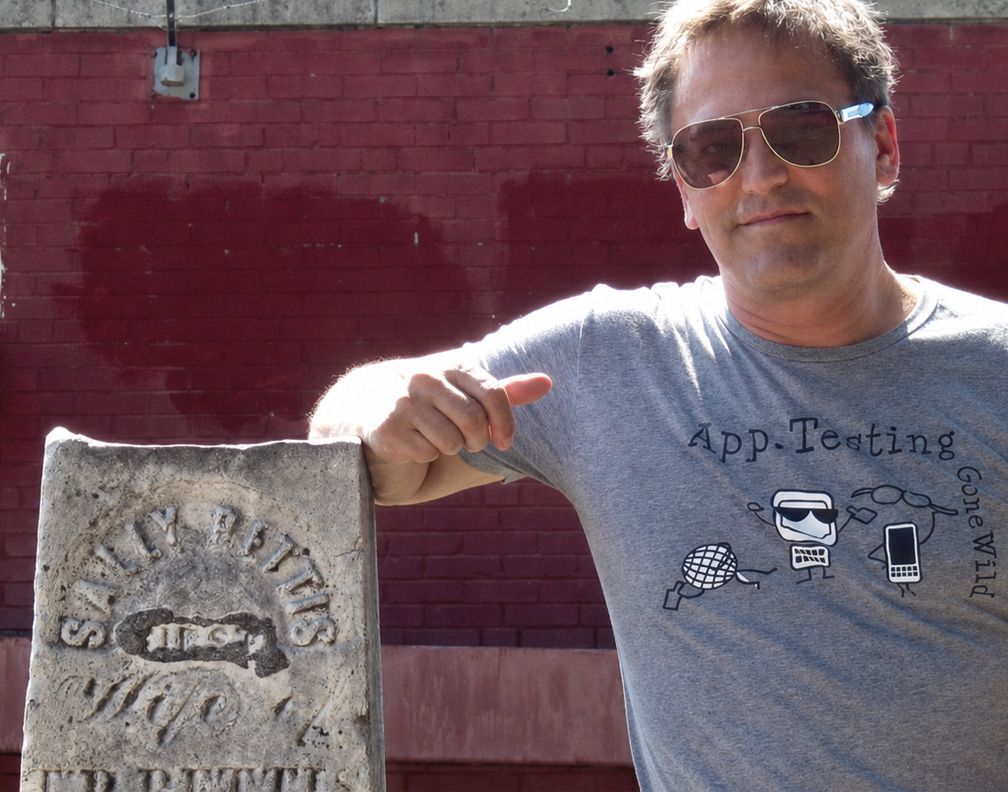
Sarah “Sally” Carr Bettis died after the birth of her ninth child. Her headstone, dated June 19, 1826, has long been described as possibly the oldest marked grave in Memphis or Shelby County. A 1969 newspaper clipping said her grave may originally have been in the early public burial ground at Third and Poplar and later moved to the Bettis family cemetery. 5
After Sally’s death, Till Bettis married Sarah Harkleroad Gribbin Bettis (1799-1860), a widow who had children from her previous marriage. Together, they had more children, bringing the total number of Bettis children in the household to 16, according to Coppock’s account.
Only a few markers remain readable today, but the newspaper articles, cemetery records and surviving stones identify or mention several people buried there or once marked there:
- Sarah “Sally” Carr Bettis (1784-1826)
- Tillman Patterson “Till” Bettis (1788-1854)
- Drury Lyon Bettis (1814-1854)
- Martha Bettis (1822-1839)
- Samuel Bettis (1828-1841)
- Thomas A. Bettis (1845-1846)
- Daniel Harkleroad (1803-1845)
- Margaret Harper (unknown-1855)
- Mary Matilda Horne (1854-1854)
The articles also make clear that the cemetery once contained more markers than are visible now. Some stones had already disappeared by 1969 and 1972. Coppock wrote that there were more graves than markers and that the cemetery was larger than the brick-walled plot visible to shoppers and passersby.
For many years, the cemetery was part of the Bettis farm. As Memphis moved east, the farm was divided and sold. The surrounding land later became associated with the Convent of the Good Shepherd. The nuns farmed land nearby before the area developed into a retail district.
By the 1960s, the Montesi and Belz families were involved in development around the old cemetery. Montesi’s supermarket was built near the graveyard, and a Zayre department store operated close by. Store names changed, buildings came down and new ones went up. Today, the cemetery survives in the shadow of Home Depot, hemmed in by traffic, parking lots and the backs of stores.
That is what makes the place so easy to miss and so important to remember.
A cemetery like this can disappear one generation at a time. First the farm goes. Then the family stories fade. Then the headstones crack, vanish or become unreadable. Eventually, people drive past without knowing that one of the early families of Memphis is buried a few yards away.
I was one of those people until Sunday.
The next time you are on Angelus Street near Madison Avenue, slow down and look for the little walled cemetery. It is not just an odd patch of green between stores. It is a surviving piece of early Memphis, a remnant of the Bettis farm and, for me, a reminder that family history sometimes sits hidden in plain sight.
For more of my genealogy research, visit rscottwilliams.info.
- Paul R. Coppock, “Small Cemetery Is All That’s Left of Huge Farm,” The Commercial Appeal (Memphis, Tennessee), Oct. 29, 1972, clipping, Memphis Public Library and Information Center. ↩︎
- Memphis city directory, 1855, quoted in Bettis family research file, Memphis and Shelby County Room, Memphis Public Library; Coppock, “Small Cemetery Is All That’s Left of Huge Farm.” ↩︎
- James D. Davis, The History of the City of Memphis: Being a Compilation of the Most Important Documents and Historical Events Connected with the Purchase of Its Territory, Laying Off of the City and Early Settlement; Also, The “Old Time Papers” (Memphis: Hite, Crumpton & Kelly, 1873), 304. ↩︎
- Jesse H. McMahon, historical address delivered at Buntyn Station, Memphis, July 25, 1867, Bettis family research file, Memphis and Shelby County Room, Memphis Public Library. ↩︎
- “The Oldest?,” Memphis Press-Scimitar (Memphis, Tennessee), April 4, 1969, clipping; “The Bettis Family Cemetery. Montesi’s on Madison in Background,” newspaper clipping, Memphis Public Library and Information Center. ↩︎


Leave a Reply