
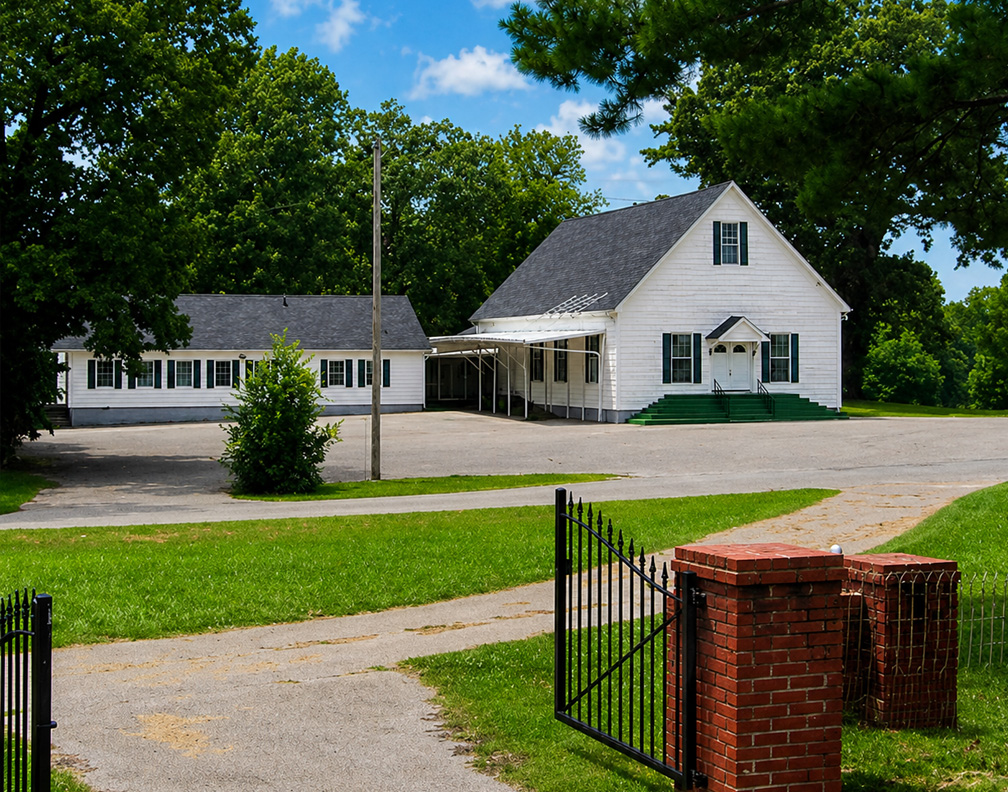
I had just read on my BlackBerry that a couple of escaped convicts were being chased by police through Madison County, Tennessee. The news caught my attention because I had just been researching my grandfather’s maternal line, the Williamsons, who settled in Madison County near the Haywood County line and helped shape the rural community around what is now Providence United Methodist Church.
The Williamson family story is relevant to those of us interested in genealogy because of the connection to the cemetery at Providence. My third great-grandfather, Beverly M. Williamson, moved from Franklin County, Tennessee, at some point before 1850, likely with land obtained through a grant or early land purchase. His farm was in Madison County near the site where Providence Methodist Church stands today.

Inscription of her book to my grandmother, Virginia Brantley Lovelace, by Martha Jones, auther of “A Journey into Yesteryears”
According to Martha Jones in “A Journey into Yesteryears,” a portion of Williamson’s property was already known as a “burial ground,” with some graves reportedly dating back to the 1700s. Jones wrote that each fall, a man named Mr. Adams came to visit Williamson, and the two men would trap animals for fur. During one of those visits, Adams became ill and died. Williamson allowed him to be buried “on the hill in the burial ground,” and, according to the tradition preserved by Jones, that burial helped establish the site as an official cemetery.
On April 19, 1869, Beverly M. Williamson deeded the land to Providence Methodist Church. The cemetery that had begun, at least in part, as a family and community burial ground became tied permanently to the church.
When Williamson died in 1877, he was buried there with his two wives. In the generations that followed, Providence Cemetery became the final resting place for much of the Williamson family.
Eventually, Williamson’s children, Bob, John, Mary, Tom, James, Clark, Bee and my second great-grandfather Joe Williamson, were all buried there, along with many of their spouses and children. For Joe Williamson, the cemetery became painfully familiar.

Jo Williamson Reid, daughter of Joe and Mary Elizabeth Joyner Williamson on the steps of Providence. Aunt Jo was the aunt of my paternal grandfather, Bo Williams. She and her husband lived across the street from grandparents when I was a child.
Joe’s wife, Mary Elizabeth Joyner Williamson, died on January 16, 1898, at the age of 36. She left him with five daughters, ages 15, 13, 10, 7 and 2. In 1901, Joe deeded one acre of land his father had left him so a school could be built near the church and cemetery.
Then, in 1905, his daughter Jessie died at age 20. That same year, Joe donated three more acres to the church. Part of the land lay between the church and the cemetery, and another portion was on the south side of the cemetery.
Two years later, in 1907, Joe’s daughter Nannie died at age 24. By then, Joe had buried his mother, father, stepmother, wife and two daughters at Providence.
Joe himself died on January 22, 1909, at age 51, and he too was laid to rest there.
Only five years later, his daughter Janie, my great-grandmother, died at age 27. She left behind her 4-year-old son, my grandfather Bo Williams, who would grow up without his mother until his father remarried. Like so many members of her family before her, Janie was buried at Providence.
The church itself has deep roots in the community. By the late 1800s, Providence had become a center of life for families living in that part of Madison and Haywood counties. It was where people worshipped, gathered, sent their children to school and buried their dead.
That connection continued into my own lifetime. In the 1980s, my grandmother, Elizabeth Williams, joined a group of women from the church who gathered each week to sew and raise money for Providence. It was a small act of service, but also part of a much longer story of families caring for the church, the cemetery and one another.
When my grandfather died at age 97, he was buried at Providence beside my grandmother and near the graves of his son Jess Williams, his mother, his grandparents and his great-grandparents.
That is why Providence has become an important place in my research. It helps connect the Williamson family to a specific community in Madison County and shows how one rural church and cemetery served the same families for generations.
More:


Leave a Reply