
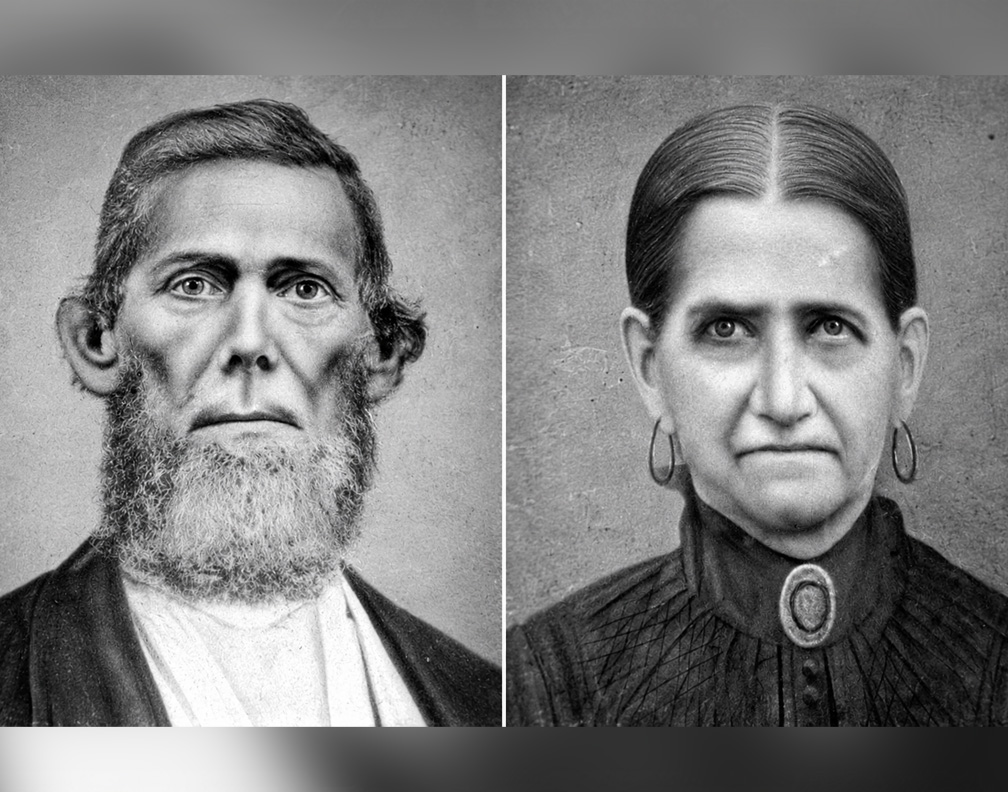
Photo: Thomas A. Lovelace (1812-1876) and Quincy A. Shirley Lovelace
I recently met my distant cousin Joan in Bells, Tennessee, and she connected me with another family member, Diane, who also had some ancestor photos I have not seen.
Among the Lovelace photographs I hope to share later, Diane had something I never expected to see: photos of my third great-grandparents, Thomas A. Lovelace (1812-1876) and Quincy A. Shirley Lovelace (1828-1898).


Headstones of Thomas A. Lovelace and Quincy A. Shirley Lovelace in Zion Baptist Church Cemetery, Haywood County, Tennessee.
Until recently, I knew them only as two names carved into a couple of the more ancient-looking headstones at Zion Baptist Church Cemetery in Haywood County, Tennessee. I had walked past them, studied them and probably tripped over them more than once while looking for other relatives. The headstones told me where Thomas and Quincy ended up. The photographs made them real.
I had already done a little research so I knew the basic facts of their story. Still, photographs really make them come alive (so to speak).
Thomas Alexander Lovelace began life in Iredell County, North Carolina, on Oct. 1, 1812. His parents were Thomas A. Lovelace (1772-1829) and Amelia Dyson (1777-1829).
He later made his way to Haywood County, Tennessee, where he married Quincy A. Shirley. Quincy came from a family with deep roots in the area. Her parents, Uriah Shirley (about 1789-before November 1843) and Unity Wells Shirley (1794-1869), had settled in Haywood County early enough to place the family among the area’s earliest pioneers.
I would love to know if my maternal grandmother named my mother Shirley because it was a family name.
By 1860, Thomas had established himself as a farmer in District 5 of Haywood County. The 1860 census lists him as 47, Quincy as 33 and their two sons, Lynn Boyd Lovelace (1855-1928) and Charles Buchanan Lovelace (1858-1938), as 5 and 3.
The same household also included William C. Byrd, a 52-year-old carpenter from North Carolina. Thomas listed $3,400 in real estate and $3,820 in personal property, a sign that he had achieved a measure of prosperity before the Civil War.
That prosperity came with a hard truth that also belongs in the family story. The 1860 federal slave schedule records Thomas Lovelace as the enslaver of two children, a 14-year-old girl and a 13-year-old boy. The record gives their ages and sex, but not their names.
Charles Buchanan Lovelace would grow up to become the grandfather of my grandfather, Guy Clinton Lovelace (1916-1997).
The years after the Civil War brought enormous change to the Lovelace household and to every farm family in the region. By the 1870 census, Thomas listed both his real estate and personal estate at $2,000 each, a decline from his 1860 figures. The census does not tell us exactly how he managed the farm after emancipation, but he no longer had enslaved labor and had only a few children old enough to help.
The 1870 household included Lynn, 15; Charles, 13; and Thomas A. Lovelace Jr. (1861-1919), 8. Those boys almost certainly spent much of their childhood working on the farm.
Thomas and Quincy also endured terrible loss in those years. John Alford Lovelace (1865-1866) died before his first birthday. William Wilbert Lovelace (1867-1867) died when he was about two months old. Another infant child came in 1868 and apparently did not survive long. Those three small graves tell their own story about the fragility of family life in the 19th century.
Thomas died Oct. 22, 1876, at age 64.
The 1877 D.G. Beers map of Haywood County shows Shirley family land near Zion Church, including Norfleet Shirley, Lunsford Shirley and John Shirley, and it also shows Quincy Lovelace as “Mrs. A. Lovelace.” Thomas had died in 1876, so the map appears to capture Quincy as a widow still living on or associated with the family land.
By 1880, Quincy headed her own household. The census lists her as 50. Lynn, then 25, still lived with her, as did Thomas, then 18. Charles had married Nancy Jane Yelverton Lovelace (1861-1936) and moved next door. Charles and Nancy already had two daughters, Addie and Dora.
Quincy lived more than 20 years after Thomas’ death. She died Feb. 8, 1898, and family buried her beside Thomas and other relatives in Zion Baptist Church Cemetery.
| Mrs. Quincy A. Lovelace The sad messenger, death, with its silent tread, has again invaded our community and taken from our midst a beloved sister, mother in Israel, in the person of Mrs. Quincy A. Lovelace, nee Shirley, who departed this life, February 8, 1898. Her funeral was preached by her pastor, Rev. C.J. Mauldin, to a large company of relatives and friends, on the morning of the 9th, and her reamins were interred in the Old Zion Cemetery to await the resurrection morn. Sister Lovelace was born and reared in Haywood County, Tennessee, which has been her home through life. In young womanhood, she was happily married to Thomas A. Lovelace, who with several children preceded her to the Glory Land. She believed in and enjoyed the old time reigion. Though rather a timid woman, she rarely ever failed to stand up and declare herself a witness for Jesus, when an opportunity was offered. On the 13th of October, 1897, she passed her sixty-nineth birthday. She leaves three sons with their family, two brothers and hosts of friends to mourn her loss, but we sorrow not as those who have no hope. Her tears of joy and frequent shouts of victory, together with her true Christian character lure us onward towards the home of the true and faithful. Chestnut Grove, Feb. 10, 1898. |
Thomas and Quincy once existed in my mind mostly as names in a cemetery. Now, thanks to these photos, they feel much more real.
For more of my genealogy research, visit rscottwilliams.info.


Leave a Reply