
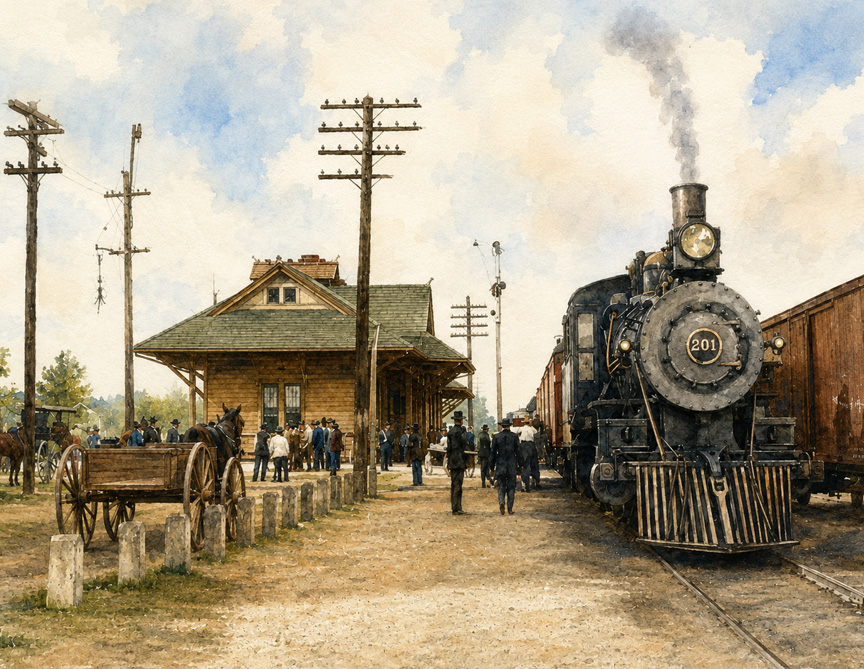
Photo: Rendering of the Louisville & Nashville Railroad’s Gautier, Mississippi train station /
When I was in the Genealogy Room at the Elma Ross Library recently, I ran across an old newspaper clipping that captured my attention, so I saved it for a rainy Saturday in Washington, D.C.
That day finally came. First the article, then a bit of observation.

| KILLED BY A TRAIN Unfortunate Stranger Meets a Horrible Death. On Christmas Day train No. 103, south-bound, due to arrive here at 1:40 p.m. (but one hour late that day) ran over and killed a man who was lying on the track near the water tank at the south fork of the Forked Deer, between Jones and Bells. The train was stopped and the corpse placed in the baggage car and brought to Brownsville. An investigation of his injuries showed that his skull was crushed on the left side of his head and his right leg cut off just above the shoe top. The party killed is a white man about 25 to 28 years old and about 5 feet 9 inches high; dark complexion; very black hair; weight, about 190 pounds. Coroner S. H. Clark summoned a jury and held an inquest on the remains Monday evening at 8 o’clock. In the pockets of the dead man were found a stone cutter’s chisel and rule and a railroad brakeman’s time book. Several names and accounts were written on almost every page, but nothing that would give a clue to the identity of the man. The names occurring most frequently in the book were W. H. Jordan and L. M. Potts. Among the other names were Robt. Amos, Joe Workley, S. B. Workley, Susan Payne, Viola Payne and Angie Wallace, the latter’s address being given as 270 Hadden Ave., Memphis. Elbert Murrell testified that the man got off a freight train at the coal chute early Christmas morning and went into the engine room to warm, telling Murrell that he was so cold he could not go any further. He said that he was a stonecutter, that he had friends in Humboldt and expected to get work in the marble yards there. After getting thoroughly warm he left the coal chute and went to the depot. The agent and others saw him hanging around the depot for some time, but no one knows how or when he left town. As there were no indications that he was drunk or had even been drinking, the natural supposition is that he boarded the north-bound freight train which passed here about noon and either fell off or was kicked off and then started to walk, falling unconscious from exhaustion at the point where the passenger train struck him. The remains were prepared for burial at Undertaker Cox’s establishment and interred in Oakwood cemetery at 2 o’clock p.m., Tuesday, appropriate services being conducted by Rev. H. B. Johnston in the presence of a goodly number of our sympathetic citizens. |
I have written about Jones Station before.
Many of my Booth ancestors lived there around the time this article was written. The Jones community was next to the Holly Grove community, near the north end of Dr. Hess Road.

Railroad tracks from Brownsville toward Bells ran through the area before the Civil War. Edward R. Jones (1802-1874) allowed four acres of his land to be used as a train stop. Small businesses soon began to spring up around the station. As more potential customers passed through the area, the community developed and grew.
There is something especially sad about a stranger in need dying on Christmas Day. The southbound Louisville & Nashville passenger train, No. 103, struck and killed him on the tracks “near the water tank at the South Fork of the Forked Deer River, between Jones and Bells.”
The accident likely happened near the old L&N railroad crossing of the South Fork of the Forked Deer River, just southwest of Bells, near the modern U.S. 70A/79 bridge. The old water tank mentioned in the article was probably a railroad water tank placed near the river crossing so steam engines could take on water.
His body was placed in the baggage car and he was taken to Brownsville.
The article gives enough detail to make the scene feel vivid more than 120 years later. The victim was described as a white man, about 25 to 28 years old, about 5 feet 9 inches tall, with a dark complexion, very black hair and a weight of about 190 pounds. In his pockets were found a stonecutter’s chisel, a rule and a railroad brakeman’s time book. The book contained names and accounts written on almost every page, but nothing that gave authorities enough information to identify him.

Overtly racist ad for marble yard in Humboldt, Tenn. in 1889 in a catalog of nurseries
Those objects are the most interesting clues. Before his death, the man reportedly told Elbert Murrell that he was a stonecutter, had friends in Humboldt and hoped to find work in the marble yards there. That detail appears to have been plausible. Humboldt did have an active marble business during that period, and the chisel and rule found in the man’s pockets support the idea that he was a skilled laborer traveling in search of work. He may have been one of many men who moved from town to town by rail, taking jobs where they could find them.
I have tried to look up a few of the names mentioned in the article through online cemetery records and other available sources, but so far none has led to a clear identification. That time book may have belonged to him, or it may have belonged to someone else. Either way, it remains the best surviving clue.
The article’s reference to train No. 103 is also worth noting. That was the train’s scheduled number, not the number painted on the locomotive. The engine itself could change from trip to trip. In 1902, No. 103 would have been a steam-powered passenger train running on the Louisville & Nashville line through West Tennessee. The fact that the body was placed in the baggage car confirms this was a passenger train, not a freight train.
The coroner, S.H. Clark, held an inquest that Monday evening. The newspaper concluded that the man may have boarded a northbound freight train after leaving the depot, then either fallen off or been forced off before trying to walk along the tracks. With no evidence that he had been drinking, the writer assumed he collapsed from exhaustion before the passenger train reached him.
The most touching part of the article comes at the end. The remains were prepared at Undertaker Cox’s establishment and buried the next day in Oakwood Cemetery in Brownsville. Rev. H.B. Johnston conducted the service, and the newspaper reported that “a goodly number” of sympathetic citizens attended. They did not know his name, his family or where he came from, but they still gathered to see that he was buried with dignity.
For more of my genealogy research, visit rscottwilliams.info.


Leave a Reply