
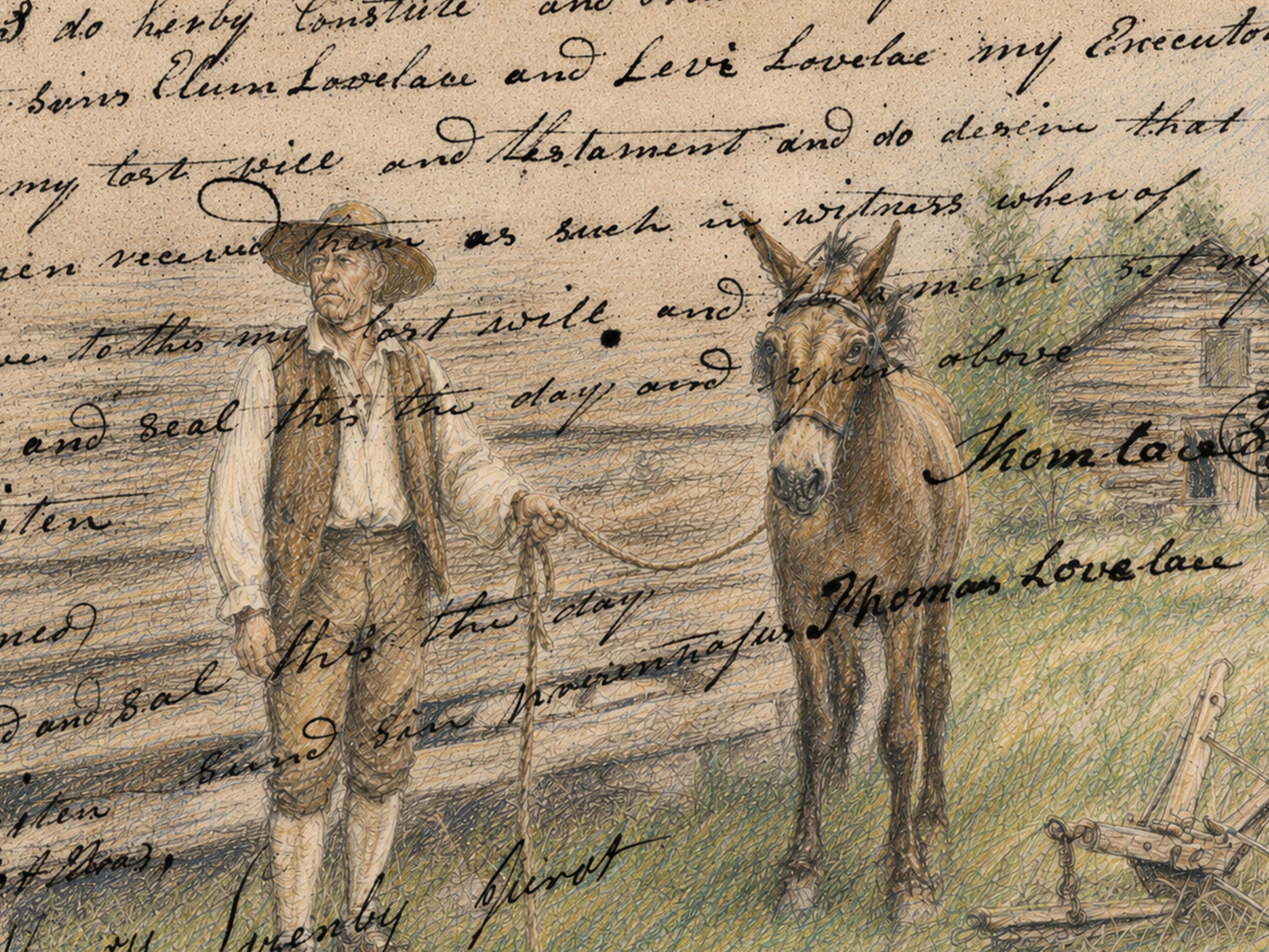
Thank goodness for wills. Of course, a diary with frequent entries about a person’s day-to-day life would be an easier way to learn about one’s ancestors. Since that rarely happened, an individual’s will can provide a little clarity about who they were and the life they lived. The will of my fourth great-grandfather, Thomas Lovelace (1772-1829), is dated Jan. 22, 1829 and was probated Aug. 17, 1829.
What can we figure out about someone born before the Revolutionay War from a look at his will? Not as much as we would be able to learn from a diary, but quite a lot. We can get an idea of Thomas’s possessions, the structure of his family, his economic standing, his expectations for his children and a little something of the world in which he and his family lived.
The opening says Thomas was “weak in body butt of sound and perfect mind and memory.” Some of that is conventional will language I see a lot, particularly the assertion that he was mentally competent. Even back then, they didnt want their wills contested because they were “mentally not of sound mind.” But “weak in body” was a good indication he was already quite ill. Thomas made the will Jan. 22 and would be dead by that summer. Thomas survived only about six months after making the will.
Thomas was a substantial landholder
This is one of the most obvious conclusions. He gives Erasmus 76 acres, Levi 150 acres and Dyson 100 acres. That is 326 acres explicitly identified in only three bequests. Then there is an additional tract he called the “home plantation where I now live.” The unspecified number of acres was divided between sons Thomas and William.
So Thomas Lovelace owned more than 326 acres, possibly substantially more when you factor in his plantation.
Also revealing is his phrase “where he now lives.” Sons Erasmus, Levi and Dyson were apparently already occupying separate farms given to them by their father.
The 1796 will of Thomas’s own father, Charles Lovelace, had given Thomas a mill and 200 acres of land. Consequently, the 1829 will captures the next stage in a cycle that had already begun a generation earlier: Charles transferred farmland to Thomas, and Thomas in turn divided land among his sons.

In 1988, Mildred Miller, a founding member and former officer for the Genealogical Society of Iredell County, created an early landowners map which shows the names and locations of the early families, landowners, and pioneers in Iredell County. In the upper northeast corner of the map, you can see The Lovelace Mill near the property of Thomas Pratner, the family into which Thomas’ daughter Anna would marry.
The Lovelace Mill
Thomas’s father, specifically left him “my Mill and Two Hundred Acres of Land” in his 1796 will, making Thomas the owner of a valuable piece of the local agricultural economy when he was only about 24 years old. Although more research is needed to prove that the mill shown on Miller’s map is the same mill Thomas inherited, the evidence strongly suggests that it is. The mill was probably water-powered and likely used to grind corn or other grain for neighboring farmers, making it an important gathering places and commercial center. The mill helps explain how Thomas began adulthood with substantial property and how, by the end of his life, he had accumulated enough land to establish several of his sons on farms of their own.
What is a plantation?
While Thomas used the word “plantation,” it did not necessarily carry the meaning we now associate with the large Southern plantations of the “Gone with the Wind” antebellum era. At the time, the term could simply refer to a tract of land or farm where crops were grown and agricultural work took place.
Thomas possessed hundreds of acres, several horses, cattle, beds, furniture, saddles, a desk and other property. Most importantly, he enslaved human beings whose forced labor also formed part of the family’s wealth.
If you visited North Carolina’s antebellum countryside during Thomas’ era, you would primarily ordinary farmers rather than the very wealthy planter class; the farm was the fundamental economic and social unit, while truly enormous plantations were exceptional. So, about Thomas, I think we can safely say:
| Thomas Lovelace was a substantial and apparently prosperous slaveholding landowner and farmer, probably part of the upper portion of Iredell County’s rural agricultural society, but not a member of North Carolina’s planter elite. |
Slavery was part of the foundation of his family’s economic position
In his will, Thomas specifically names at least three people he held in slavery:
Jerry, described in the document as an “old Negro Boy,” was left to Archibald. The word “boy” should not automatically be interpreted as meaning Jerry was a child; slaveholding records frequently used infantilizing language for Black males whose actual ages were greater.
An enslaved girl whose name is difficult to decipher was given to Sarah Davis.
Emeline, also described as an enslaved girl, was given to Elvira.
These people are listed among livestock, land and household goods because under North Carolina law Thomas legally owned them as property. Land passed from father to sons while enslaved people were often transferred individually to sons and daughters.
The Lovelaces were living in a county where slavery was already deeply established. Iredell County counted 2,988 enslaved people in 1820.
From the perspective of African American genealogy, Jerry and Emeline’s names may ultimately be among the most valuable pieces of information in the entire document. The federal census did not name enslaved people, and even the 1850 and 1860 slave schedules generally recorded only age, sex and the enslaver’s name. A will that actually names an enslaved person creates a trail that sometimes can be followed through estate sales, deeds, the records of the receiving child and ultimately into the 1870 census. If I run across the names of the people my ancestors enslaved, I include them in my blog to help the descendants of those enslaved people working on their own genealogies.
There is a heartbreaking element in these bequests of people that is not present should the bequest be for land or furniture. Thomas was assigning individuals to different children. If Jerry, Emeline and the other enslaved girl belonged to families of their own, which is entirely possible, Thomas’ will could separate those individuals from their own loved ones.
Thomas was a widow
Thomas’ wife, Millie, died Jan. 16, 1829 around age 52, so Thomas made his will six days after his wife’s death. As he was “weak in body,” he knew it was time to “put his affairs in order.”
The two boys
The family Bible gives Thomas Jr.’s birth as Oct. 1, 1812 and William’s as May 29, 1814. That means when their father wrote the will they were approximately 16 and 14 years old. Thomas calls them “the two boys.”
They were not yet men like Erasmus, Levi and Dyson. Thomas knew his death would put them at a great disadvantage so he gave them much more than simply farmland. They were to divide the home plantation, and each was to receive a saddle and bridle, good clothing, a bed and a cow and calf. William also appears to receive a colt, and they share an interest in a gray filly.
Thomas was preparing his young sons for adulthood.
Then comes the interesting phrase about “Learning such as the other” children had received. I believe this means Thomas wanted the younger boys to receive an education comparable to what he already provided to their older brothers. North Carolina did not establish its statewide public school system until 1839, a decade after Thomas’s death. Education in 1829 was generally something a family had to arrange through a tutor or a private school. Iredell County did have academies for boys; Ebenezer Academy, for example, had been established in the county in 1822.

According to a story by Statesville.com, published on July 28, 2022, the 200-year-old Ebenezer Academy in Iredell County is in urgent need of structural repairs, prompting the Iredell County Historical Society to step in with critical fundraising efforts. Built in 1823 as a one-room log schoolhouse, this National Register of Historic Places landmark stands as the county’s oldest educational structure. Decades of weathering have taken a toll on its original framing, making community support vital to saving this irreplaceable piece of local heritage before it is lost to time. I am unaware of the school’s current condition.
The girls
The sons receive the land. Sarah receives an enslaved girl, a mare and a cow and calf. Elvira receives Emeline, an animal valued at $65, a desk, a bed and household furniture, a cow and additional property I could not read.
Elvira was probably only about 13 or 14 when Thomas died and not yet married. Her father was providing things she could carry into a future household rather than a separate farm. The land passed through the male heirs.
Another daughter, Anna, received $5. She had married Hiram Henry Prather, and while a $5 bequest seems small even for then, married children were often given property during their parents’ lifetimes.
Thomas then says the rest of his estate is to be “Equal divided between all my Children.” So Anna apparently still participated in the final division.
Thomas trusted Elam and Levi with his business affairs
Thomas appoints sons Elam and Levi as his “true and trusty sons” and executors.
Executors had to collect debts, pay creditors, sell property, settle claims and distribute the estate. Thomas was assigning considerable responsibility to them.
I do not see a specific property bequest to Elam anywhere in the will, yet he receives this position of trust. Charles, the eldest son listed in the family Bible, likewise receives no clearly visible specific bequest. That most likely means, like he had for Anna, Thomas had already provided for them during his lifetime.

Thomas Lovelace’s headstone in the Lewis Cemetery in present-day Cool Spring Township of Iredell County, North Carolina. It served as an early cemetery for New Hope Baptist Church.
North Carolina Piedmont
Thomas was living in the North Carolina Piedmont, in a county formed from Rowan County only in 1788. Statesville became the county seat the following year. The railroad would not reach Iredell County until 1858, nearly 30 years after Thomas died.
So his 1829 world was not yet the railroad-connected, cotton-dominated South that would emerge in the decades ahead. His was a largely rural world of farms linked by dirt roads, horses and wagons, country stores, gristmills, and churches. Like Thomas, many of the families who had settled this part of the North Carolina Piedmont were of Scots-Irish ancestry, and traces of their speech, customs, religious traditions and strong kinship ties remained part of the culture Thomas Lovelace and his family knew.

Mary Elinor Lazenby, Lewis Grave Yard with Mention of Some Early Settlers Along Fifth Creek, Iredell County, N.C. (Statesville, NC, 1944). Source
Thomas and Amelia were buried in the Lewis Cemetery along Fifth Creek, an old settlement area east of Statesville. A 1944 history specifically devoted to the Lewis Grave Yard describes it in connection with early settlers like the Lovelace family.
While I still do not know as much about Thomas as I would if he had left a diary behind, his will provides a little peek at his family and a some of what their life was like in early 1800s North Carolina.
The complete will of Thomas Lovelace
Iredell County, North Carolina
Written Jan. 22, 1829; probated Aug. 17, 1829
Note: Original spelling and capitalization have generally been retained. Punctuation has been added for readability. Words supplied or uncertain because of fading, damage or difficult handwriting appear in brackets.
In the Name of God Amen. I Thomas Lovelace of the County of Iredell and State of North Carolina being weak in body butt of sound and perfect mind and memory do this the twenty second day of January in the year of our Lord one thousand Eight hundred and twenty Nine Make and pronounce this my last will and testament in the manner and forme as following, that is to say principally and first.
I Recommend my soul to Almighty God who gave it and my body to be Buried in a decent and orderly manner at the discretion of my Executors. And touching such Worldly Estate as it has pleased God to bless me with in this my Life I dispose of in the manner following —
Item I give and bequeath unto my beloved Son Eramus [Erasmus] Lovelace 76 acres of Land where he now lives.
Item I give and bequeath unto my beloved Son Levy [Levi] Lovelace one hundred and fifty Acres where he now lives.
Item I give and bequeath unto my beloved Son Dyson Lovelace one hundred Acres where he now lives.
Item I give and bequeath unto my beloved Son Archabald [Archibald] Lovelace one old Negro Boy Jerry.
Item I give and bequeath unto my beloved Daughter [name faded; probably Anna Prather] five Dollars.
Item I give and bequeath unto my grandson Thomas H. Prather one red cow and calf.
Item I give and bequeath unto my beloved Daughter Sarah Davis one Negro girl Name [illegible], also one mare which [she] has now and one cow and calf also in possession.
Item I give and bequeath unto my beloved sons Thomas Lovelace and William Lovelace the home plantation where I now live on to be Equal divided between them, also [uncertain words], also William to have one colt named [“Red Fidle” or similar], & also one gray filly to be Equal divided between the two boys Thomas and William Lovelace; also one Saddle and Bridle apiece and one sute of Clothes of good Cloth and Learning such as the other [sons have had]; also one bed apiece, also one cow and calf apiece.
Item I give and bequeath unto my beloved Daughter Elvira Lovelace one Negro girl Name Emeline, also one beast worth sixty five Dollars and one Desk and bed and furniture, one cow [remainder of clause partly illegible], [and ___] to have Learning.
Item all the balance of my Property to be sold including Every thing that is not willed and to pay my just debts and the balance to be Equal divided between all my Children.
And I do hereby Constitute and ordain my true and trusty sons Elam Lovelace and Levi Lovelace my Executors of this my last will and testament and do desire that all men receive them as such. In witness whereof I have to this my last will and testament set my hand and seal this the day and year above written.
Written signed in presence of us —
Thomas Lovelace [seal]
Henry Lazenby, Jurat
For more of my genealogy research, visit rscottwilliams.info.


Leave a Reply