
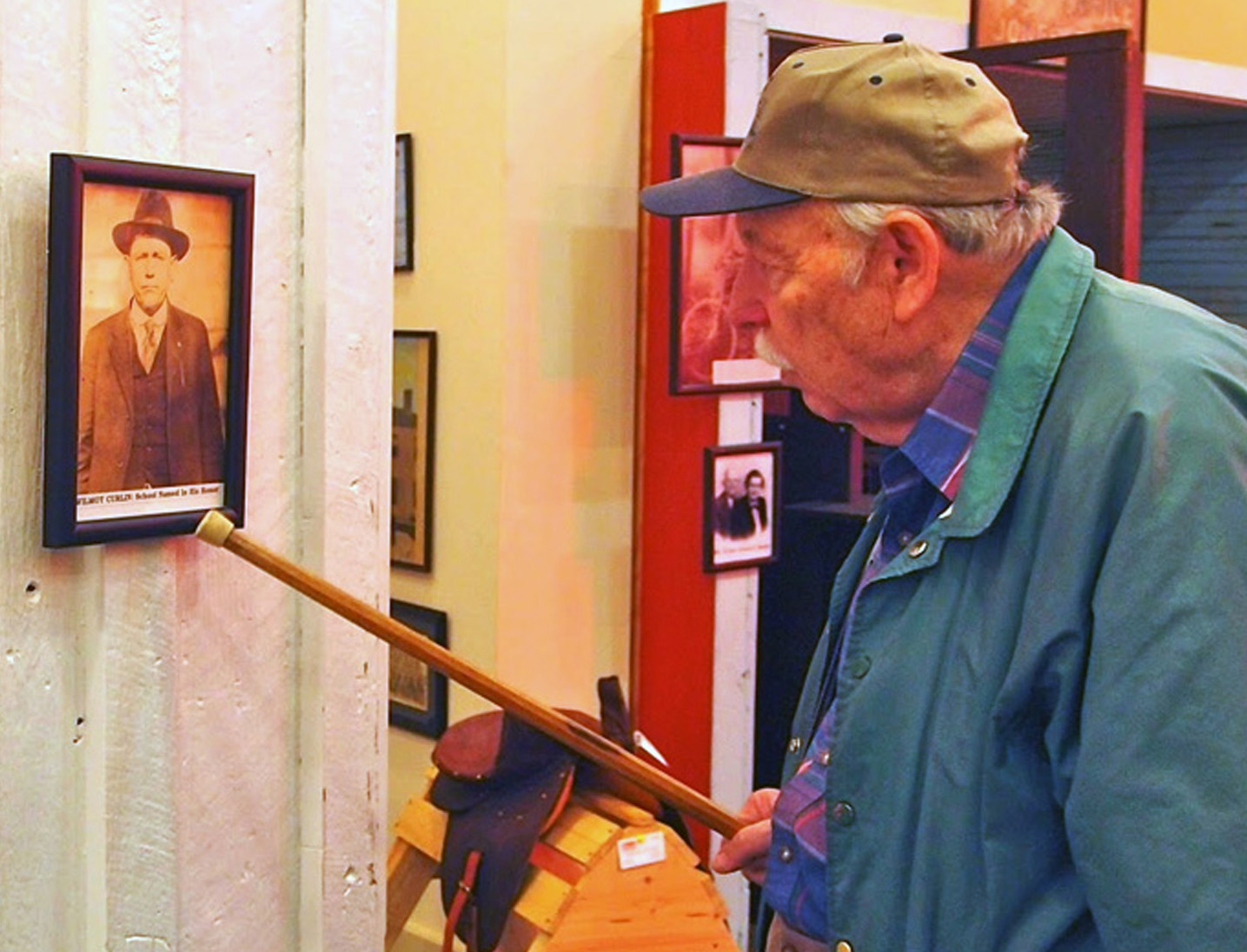
Lynn Shaw at the Haywood County History Museum, Brownsville, Tennessee /
I was recently working on a research project and needed a little Haywood County, Tennessee, history lesson, so Sonia Outlaw-Clark helped arrange an afternoon at the Haywood County History Museum with county historian Lynn Shaw.
Sonia runs the must-see West Tennessee Delta Heritage Center just off Exit 56 in Brownsville, and we also share several mutual Haywood County ancestors.
I was not sure what to expect at the Haywood County History Museum, but I was impressed.
Of course, it helped that I was exploring my own personal heritage, about which I have an obvious interest. But anyone fascinated by the history of West Tennessee could spend hours exploring the rooms of this museum.
Open since 1991, it is operated by the Haywood County Historical Society and managed by volunteers. Below is just a small sample of what is inside.

The Haywood County History Museum is in the College Hill Center at 127 N. Grand Ave. in Brownsville, Tennessee. The building was originally Brownsville Baptist Female College, which opened in the 1850s. Haywood County later bought the building, and it served as Haywood County High School from 1911 until 1970. Today, that historic building houses the museum.

Previous graduating classes from Haywood County High School
As you enter the second floor of the museum, where the artifacts are on display, you can see framed photos of graduating classes from the high school. I recognized many family friends and relatives, including my own parents, Shirley Lovelace Williams and Bobby Williams.

My mother and father, Shirley Lovelace and Bobby Williams, center left and right, in their Haywood County High School senior pictures.
Sports have always been an important part of the culture and history of Brownsville, and that story is well represented in the museum with photos, newspaper articles and actual artifacts from generations of Haywood County athletics.

Sports memorabilia at the Haywood County History Museum
Yes, Haywood County is the home of Tina Turner (1939-2023) and Sleepy John Estes (c. 1899-1977), but it is also where Tony Delk (1974-present) and Rockey Felker (1953-present) learned to play.
Delk, who was born in Covington and raised in Brownsville, became a 10-year NBA veteran after starring at Haywood High School and the University of Kentucky. He helped lead the 1996 Kentucky Wildcats to the NCAA men’s basketball championship, was named the NCAA tournament’s Most Outstanding Player and went on to play for eight NBA teams over 10 seasons. He also has worked as a college assistant coach, broadcaster and scout.
Felker was a standout athlete at Haywood High School before playing quarterback at Mississippi State University. In 1974, he led Mississippi State to a 9-3 season and a Sun Bowl victory over North Carolina. He later served as Mississippi State’s head football coach and worked for decades in college football.

1929 Haywood High School basketball team: Top row, from left: Robert Smith, Leslie Cain, Clarence Berson, Glen Scott and Charles Sherman; Second row, from left: Marshall Mulherin, Milton Wilson, unidentified player and Joe Mulherin; Bottom row, from left: John Chambers Jr., John Woodson Keathley, Bob Berson and Craig White
The young Haywood County High School players in this photo look like they could have been hitting the court last week. However, if any of these players were alive today, they would be more than 100 years old.

Gas pump from Lawrence Cobb’s grocery store
This artifact also has a personal connection for me. It is the first Stewart and Sons gas pump in Haywood County and was installed at Lawrence Amherst Cobb’s (1904-1989) grocery store in 1947.
His store was just down the road from my Lovelace grandparents’ house, and many times I walked or rode a bike with my aunts, Darlene and Dawn, to get one of those sour, powdery suckers.
Lawrence Cobb was the son of Simeon Amherst “Sim” Cobb (1840-1927), who was a brother of William Thomas Cobb (1833-1898), my second-great-grandfather. Lawrence Cobb was included in a blog entry from February 2011 that featured photos from a Cobb Family Cemetery cleanup day.

The post office at Jones Station
Another small exhibit that was really fun to see in person was the Jones Station Post Office. Because of so many family connections, I have blogged about the town and post office many times, so it was especially fun to see a bit of it in person.
Many of my Booth and Castellaw ancestors lived at Jones Station in the late 1800s and early 1900s. It was located next to the Holly Grove community on the north end of Dr. Hess Road. The post office opened in 1869.
The exhibit was donated to the museum by Marilyn Booth in memory of Vernon C. Booth (1879-1963), who was postmaster from 1914 until his retirement in 1945, and Olive M. Booth, who was postmaster from 1946 until the post office closed in 1953.

R.A. White and Doc, 1904, photo credit: Harrell Clement
Included in the Jones Station exhibit is a photo of R. A. White delivering the mail on his horse, Doc, in 1904. The White and Booth families became connected through marriage when William G. “Billy” Booth married Mary Elizabeth “Eliza” White in the mid-1850s. They were the parents of my second-great-grandmother, Lena Booth Brantley.

Vernon C. Booth and Jim Watridge, 1904, photo credit: Harrell Clement
It is likely that the Jim Watridge shown in this photo with Vernon Booth was the son of William Henry Watridge and Zilpha Elizabeth Castellaw Watridge and the grandson of James Watridge, my third-great-grandfather.

Haywood County historian Lynn Shaw
It was especially fun getting to tour the museum with Lynn Shaw. He was instrumental in preserving the history and stories of Haywood County and in the creation of the museum.

A portion of the Wilmot School
The Wilmot School, named after Wilmot Curlin, was a one-room schoolhouse on Estanaula Road in the southeastern part of Haywood County near the Madison County line. In the list of teachers, I quickly recognized several names from my family tree, including Mary Bond, Jessie Mae Reid Castellaw and Eunice Joyner. The school closed in 1949.

Bust of Hiram Bradford sculpted by Tommy Lynn
Of course, the Civil War was a big part of the history of Haywood County. The museum includes an exhibit of busts created by photographer and sculptor Tommy Lynn. One that caught my eye was Hiram Bradford (1797-1862), often remembered as one of Haywood County’s early entrepreneurs.

A reunion of the Bridge Company, CSA, around 1900
Another interesting photo that caught my eye was from a reunion of the Bridge Company that took place around 1900. In 1861, early in the Civil War, the company was formed to guard the railroad bridge over the Big Hatchie River near Brownsville. The bridge was an important connection between Memphis and the Confederate army, so it mattered for both supplies and communication.

Men of the Bridge Company
The men were mostly older or married, so they were not among the first to join the actual fighting. They furnished their own horses, uniforms and rations and protected the bridge until the route was no longer used by the Confederates. In June 1862, the men burned the bridge and disbanded.
According to a notation with the photo in the museum, an article about the company written around the time of the reunion in 1900 concluded by saying, “They were well worthy of the honor and respect accorded to veterans of the lost cause.”
That line is very much of its time, but it is also part of what makes old local-history displays worth studying carefully. They preserve not only facts and faces, but also the language and attitudes people used when remembering the past.

Neon sign from the Ritz Theatre
Ask my father about the Ritz Theatre and he will tell you about one of the few times his family spent the money to go to a movie theater when he was a boy. The theater had advertised a rare personal appearance by Lash LaRue (1917-1996). LaRue was a popular cowboy star famous for tricks performed with a bullwhip. Apparently, LaRue did not bring his A game to the Ritz Theatre in Brownsville that day, and my father remembers being disappointed. At the very least, he had hoped to see the cowboy cut a cigarette in half while it was in someone’s mouth.
He had to leave without even getting an autograph.

An assortment of Haywood County artifacts
I appreciate all those who have worked so hard to preserve the history of the county for future generations. You currently need an appointment to see the museum, and according to the Tennessee Tourism website, you can get more information by contacting the Brownsville-Haywood County Chamber of Commerce or calling 731-772-4883.
I highly recommend checking it out for yourself if you can.
For more of my genealogy research, visit rscottwilliams.info.
Update:
Lynn Shaw died Oct. 8, 2019 at age 78 leaving behind a legacy of history preservation. He served as Haywood County Historian, President of the Haywood County Historical Society, and founder and curator of the Haywood County Museum for many years, and was past president of the Brownsville Jaycees and member of the Order of Knights of Pythias. Shaw established the local Sons of Confederate Veterans, Colonel W.L. Duckworth Camp, and was a National Commander of both the Sons of Confederate Veterans and Military Order of the Stars and Bars as well as a reenactor. He was a member of the Society of the War of 1812, the Sons of the Revolution, and the George Washington Family Descendants.
His niece, Beth Tripp, wife of artist Billy Tripp, has taken over the role of Haywood County historian.


Leave a Reply