
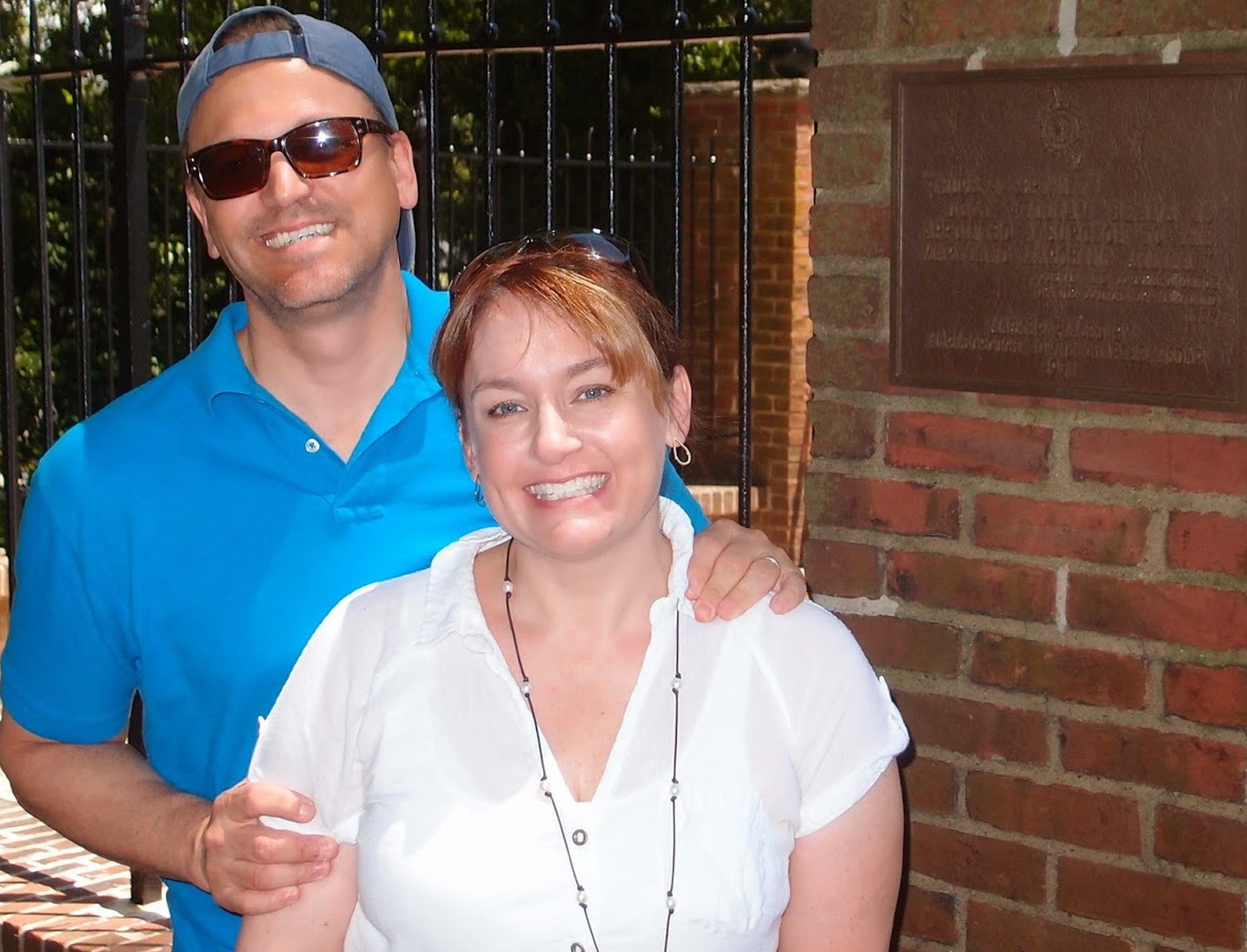
My niece and her fiance were visiting for the week, so we decided to celebrate Independence Day with a family road trip to find the grave of Dr. William Beanes (1749-1828).

Beanes is not a direct ancestor, but he is connected to our family through the Marbury line. He also played a fascinating role in the story behind “The Star-Spangled Banner,” which made this a pretty good way to celebrate the Fourth of July. His story was one of my very first blog posts back in 2010.
Our family connection to Beanes is distant, but that is part of what makes genealogy fun. One connection leads to another, then suddenly you are standing in a small cemetery in Upper Marlboro, Maryland, thinking about the War of 1812, Francis Scott Key (Aug. 1, 1779-Jan. 11, 1843) and our country’s national anthem.
Our Marbury line goes this way:
- My mother is Shirley Lovelace Williams (1939-present).
- Her mother was Virginia Brantley Lovelace (1917-2007).
- Her mother was Allie Marbury Brantley (1898-1995).
- Her father was Hardy Joyner Marbury (1872-1932).
- His father was Benjamin Franklin Marbury (1849-1884).
- His father was Robert Green Marbury (1809-1904).
- His father was John Marbury (1783-after 1850).
- His father was Leonard Marbury (1759-1839).
- His father was Francis Marbury (ca. 1730-ca. 1800).
- His father was Leonard Marbury Sr. (1708-1794).
- His father was Francis Marbury (ca. 1663-1734).
The connection to Beanes comes through the family of Leonard Marbury Sr. His brother, Luke Marbury Sr. (1710-1758), was the father of Col. Luke Marbury (ca. 1745-1809), who served in the Revolutionary War. The Maryland State Archives identifies Col. Luke Marbury as the husband of Elizabeth Beanes (ca. 1747-?), who was the sister of Dr. William Beanes. The same source also identifies Luke and Elizabeth as first cousins, which makes the Beanes and Marbury families closely connected even if Beanes is not in my direct line. 1

Small cemetery containing the graves of Dr. William Beanes and Sarah Hawkins Hanson Beanes
Col. Luke Marbury commanded the Lower Battalion of the Prince George’s County Militia during the Revolutionary War. A 1914 account in The Patriotic Marylander says Marbury and Beanes served with the Maryland troops at the Battle of Long Island and were among the Marylanders who escaped by “swimming across the sound of Long Island.”2
Beanes served as a physician during the Revolutionary War. In 1773, he married Sarah Hawkins Hanson Beanes (1750-1822). She also has an interesting connection to American history. She was the niece of John Hanson (1721-1783), who was elected president of Congress under the Articles of Confederation in 1781.

Headstones of Dr. William Beanes and Sarah Hawkins Hanson Beanes
In 1814, during the War of 1812, the British army passed through Upper Marlboro, where Beanes lived. British officers used his home as headquarters on their way to Bladensburg and Washington. After the British burned Washington, D.C., some soldiers passing back through the area reportedly began looting local farms. Beanes helped organize the capture of several of them and had them held in the Prince George’s County jail.
That did not go over well with the British.
Gen. Robert Ross (1766-1814) and Adm. George Cockburn (1772-1853) ordered Beanes arrested. Other men taken with him were released, but the British held Beanes, believing he had acted as a spy or had broken his promise not to interfere with British operations.
Because Beanes was so respected in the community, Francis Scott Key and prisoner exchange agent John Stuart Skinner (1788-1851) went to the British fleet to negotiate his release. The British agreed to let Beanes go, but because Key, Skinner and Beanes had seen too much of the fleet’s plans, they were not allowed to leave until after the attack on Fort McHenry.
That attack became the Battle of Baltimore.
The rest of the story is the part most Americans know. On the morning of Sept. 14, 1814, Key saw the American flag still flying over Fort McHenry and was inspired to write the poem first known as “Defence of Fort M’Henry.” It later became “The Star-Spangled Banner” and, in 1931, the national anthem of the United States.3
Whitney Houston gave what many consider the most famous vocal performance of “The Star-Spangled Banner” at Super Bowl XXV in 1991. Jimi Hendrix’s 1969 Woodstock version may be the anthem’s most famous instrumental reinterpretation.
In a 1914 article titled “The Seizure and Imprisonment of Dr. Beanes,” William L. Marbury wrote that Beanes’ temper and reputation helped set the whole story in motion. Marbury called him a “choleric old gentleman,” but also a man whose character and standing in the community made others determined to secure his release.4

Historic markers mounted to the columns at the cemetery
Finding the cemetery was a little tricky because we were not exactly sure where to look. If you decide to visit, head to Upper Marlboro and look for the small cemetery at Elm Street and Governor Oden Bowie Drive. It is listed at 14554 Elm St. and contains the graves of Beanes and his wife, Sarah.

Historic markers mounted to the columns at the cemetery
Upper Marlboro is a historic town and a fun stop if you are interested in the Revolutionary War, the War of 1812 or early Maryland history. The area was settled around 1695, became a tobacco port town in 1706 and has served as the seat of Prince George’s County since 1721.
In addition to the Beanes cemetery, you can explore other historic sites, including Darnall’s Chance House Museum. The house was built in 1742 and is now operated as a historic house museum.

School House Pond, Upper Marlboro, Maryland
You will also want to save time for School House Pond, which is right behind the cemetery. The 12-acre pond and surrounding park include a fishing pier, photo blind, picnic area, nature trail and a three-quarter-mile boardwalk.[9]
For the full Upper Marlboro experience, we stopped at the Olde Towne Inn. We stumbled onto it, happened to be hungry and went in for lunch. This is one of those times when taking a chance paid off. The food was great, and if you go, you might as well order the Maryland crab cakes.

Our little Independence Day family road trip paid off big. We found our family connection to the national anthem, explored a historic town, hiked along a nature trail, discovered a good restaurant and spent time together as a family.
That sounds like a pretty good way to celebrate our nation’s freedom.
Notes
- Edward C. Papenfuse et al., A Biographical Dictionary of the Maryland Legislature 1635-1789, Archives of Maryland, vol. 426, 573. ↩︎
- William L. Marbury, “The Seizure and Imprisonment of Dr. Beanes,” The Patriotic Marylander 1, no. 1 (First Quarter, September 1914): 13-15. ↩︎
- National Park Service, Fort McHenry National Monument and Historic Shrine, “Francis Scott Key” and “The Negotiation for Dr. Beanes”; American Battlefield Trust, “Dr. William Beanes.” ↩︎
- Marbury, “The Seizure and Imprisonment of Dr. Beanes,” 13. ↩︎


Leave a Reply