
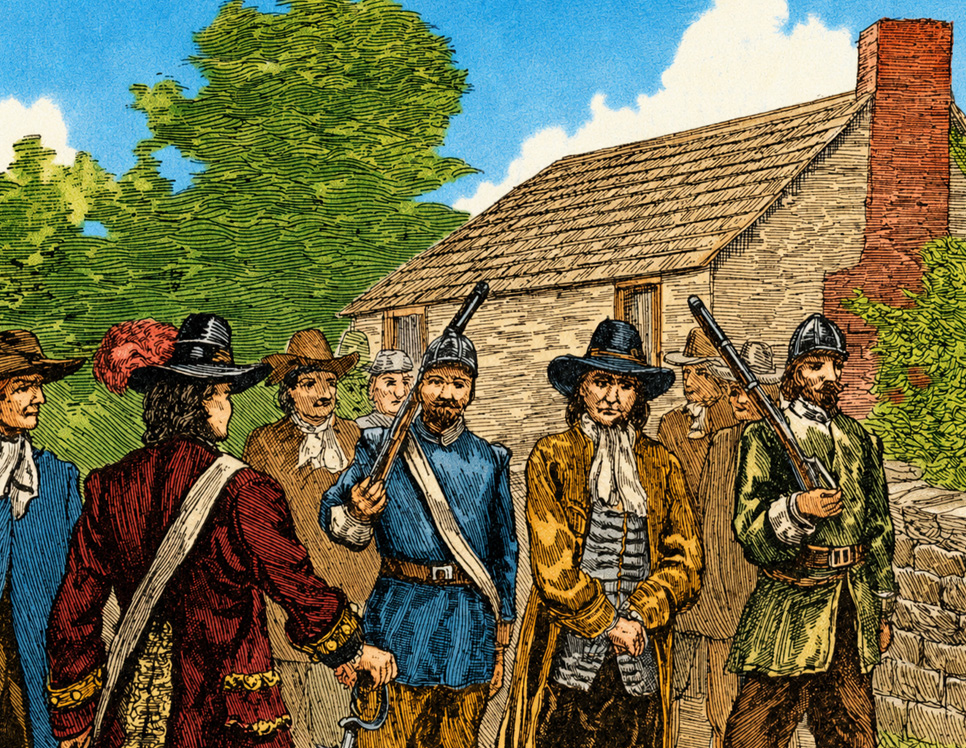
My 10th great-grandfather, Capt. James Blount (c. 1620-1686), appears in the early records of Virginia and the Albemarle region of Carolina as a planter, landowner, council member, legislator and justice.
You can also add political rebel to his resume. He helped overthrow a colonial government, served in the government that replaced it and later returned to public office when lawful proprietary rule was restored.
Blount died nearly a century before the Declaration of Independence was signed, so he was not fighting for American independence. He did, however, participate in disputes over issues like unfair taxation and trade that would lead to the American Revolution.
From James Blount to Me
The line from Capt. James Blount to me runs through the Blount, Yelverton, Marbury, Brantley, Lovelace and Williams families:
- Capt. James Blount (c. 1620-1686) was the father of
- James Blount II (c. 1655-1717), who was the father of
- Elizabeth Blount Yelverton (c. 1685-after 1723), who married John Yelverton Sr. (c. 1685-c. 1750) and was the mother of
- John Yelverton Jr. (born by 1716-1795), who was the father of
- Hardy Yelverton (c. 1754-1829), who was the father of
- Etheldred Yelverton (c. 1784-1851), who was the father of
- Samuel W. Yelverton (c. 1828-after 1870), who was the father of
- Margaret “Maggie” R. Yelverton Marbury (c. 1853-1884), who was the mother of
- Hardy Joyner Marbury (1872-1932), who was the father of
- Allie Ern Marbury Brantley (1898-1995), who was the mother of
- Virginia Brantley Lovelace (1917-2007), who was the mother of
- Shirley Lovelace Williams (1939-), who is the mother of me.
From England to Virginia
Family tradition places Capt. James Blount’s birth around 1620 near Astley in Worcestershire, England. Some family trees identify his father as another James Blount and his mother as a woman from the Clare family.
The first reliable record places Blount in Isle of Wight County, Virginia, in 1660. Sometime during the next nine years, he moved south into the Albemarle region, the northern part of the area of Carolina that eventually became North Carolina.
By April 21, 1669, Blount was a member of the Albemarle council. He appears again in records as a council member in 1672, 1677, 1679, 1681 and 1684. Although you cannot tell if his service was continuous from the records, it is certainly possible.
In 1677, Blount was one of the burgesses representing Chowan Precinct. A burgess was an elected representative in the lower house of the colonial Assembly, making the position roughly comparable to that of a modern state representative. The council served as the legislature’s upper house, but it also advised the governor, exercised executive authority and sometimes acted as the colony’s highest court. Its responsibilities therefore combined functions now divided among the state Senate, the governor’s Cabinet and the court system.
Contemporary records called him “Captain,” probably indicating that he held a rank in either the Virginia or Albemarle militia.1
Trouble in Albemarle
By the mid-1670s, the Albemarle colony was divided by political rivalries, uncertainty over land titles and growing resentment toward the Lords Proprietors, the eight Englishmen who controlled Carolina under a royal charter.
Trade restrictions made matters worse.
The Plantation Duty Act of 1673 required colonists to pay a duty of one penny per pound on tobacco shipped from one English colony to another. The law was intended to force more colonial trade through England, where the government could regulate and tax it.
That was especially damaging in Albemarle. Because dangerous shoals and inlets made direct trade with England difficult, the colonists depended heavily on merchants from New England. Those merchants carried tobacco and other products north and returned with goods the isolated colony needed.
Strict enforcement of the duty threatened that trade and the economic survival of many colonists.
Into this already unstable situation stepped Thomas Miller (c. 1649-1685), a merchant, customs collector and political ally of Thomas Eastchurch (birth year unknown-1678). The Lords Proprietors had appointed Eastchurch governor, but he stopped in the West Indies on his return from England and sent Miller ahead to govern until he arrived.
Eastchurch did not have clear legal authority to make Miller acting governor. Miller nevertheless assumed control of Albemarle and initially received at least grudging acceptance from much of the colony. That acceptance did not last. Miller rigidly collected customs duties, seized ships and cargoes, restricted voting, imposed fines and ordered the arrests of political opponents. Even historians who credit him with administrative ability describe him as domineering, intemperate and prone to reckless statements.
By December 1677, Albemarle was ready to explode.2

Historic marker on South Water Street near East Church Street in Elizabeth City, North Carolina, in Pasquotank County.
Culpeper’s Rebellion
The uprising that followed became known as Culpeper’s Rebellion, although it seems John Culpeper (c. 1633-c. 1692) was only one of several men who led it, history gave him credit.
Others included George Durant (1632-1694), John Jenkins (birth year unknown-1681) and my ancestor Capt. James Blount. In fact, evidence suggests Culpeper had been away from Albemarle during much of the period when the revolt was being planned.
The rebellion began in December 1677 after Miller arrested a popular New England sea captain and attempted to arrest Durant. Armed colonists freed Miller’s prisoners, arrested Miller and several of his officials and seized the colony’s records and official seal.

Darjees Teabox Company offers a coffee inspired by the rebellion. From their website: “Wake up to a new revolution starting with your coffee! Whole bean roasted from the Florida Treasure Coast, specifically formulated to reduce acidity, Darjees brings you Culpeper’s Rebellion Roast. Origins from Panama, these beans naturally contain hints of citrus and cinnamon from the soil. Certified Fair-Trade coffee ready to be freshly ground and freshly made by you, a true coffee patriot.” Order online
Blount was very involved in the rebellion. One hostile report described him as one of the “chief persons” among the insurrectionists and accused him of helping bring Chowan Precinct into the rebellion.3
The rebels then elected an 18-member Assembly, sometimes called the rebel Parliament. James was one of those 18 members. John Jenkins took control of the government, while Culpeper replaced Miller as customs collector.
Blount received an even more consequential assignment. The Assembly named him as one of six judges selected to try Miller on charges that included blasphemy and treason. The trial was halted before a verdict could be reached, and Miller remained imprisoned. For approximately 18 months, the rebel council and Assembly governed Albemarle. Blount served in both the rebel Parliament and the council.4
While this was not a revolution for democracy, Culpeper’s Rebellion was one of the earliest successful uprisings against the established colonial government in English North America. It showed that colonists could indeed replace a government they considered unlawful or abusive.

An 1890 illustration depicts colonial official Thomas Miller imprisoned during Culpeper’s Rebellion in North Carolina, 1677-1679. It was published in “The American Continent and Its Inhabitants Before Its Discovery by Columbus.” Photo credit: The New York Public Library, Miriam and Ira D. Wallach Division of Art, Prints and Photographs.
The Rebellion Ends
Miller eventually escaped and reached England, where he pressed charges against Culpeper. English authorities arrested Culpeper and tried him for treason, accusing him of unlawfully seizing the king’s customs and encouraging Albemarle’s inhabitants to resist royal and proprietary authority.
Culpeper was acquitted after Anthony Ashley Cooper, first earl of Shaftesbury (1621-1683) and one of the Lords Proprietors, testified that Miller had taken control of Albemarle without proper legal authority. If Miller’s government had never been lawful, Shaftesbury argued, overthrowing it could not constitute treason against the king or the Proprietors.
The Proprietors re-established their government in Albemarle in 1679. It appears Captain Blount suffered no lasting punishment for his role in the uprising. He returned to the council and served during at least 1679, 1681 and 1684. He was also a justice of the Albemarle County Court in 1682 and 1683.
His return to office suggests that the Proprietors understood they could not govern Albemarle without the cooperation of men such as Capt. James Blount, even when those same men had recently helped overthrow their government. We take our freedom as American’s for granted, so its hard to imagine what it was like for the men and women before the revolution who were required to be loyakl to England.
Historic marker for Culpeper’s Rebellion on Water Street in Elizabeth City, North Carolina.
Land in Chowan Precinct
Blount lived in Chowan Precinct, where he owned about 300 acres during the 1670s. In 1684, he received a grant for an additional 660 acres.
At least part of the property became associated with the family plantation known as Mulberry Hill. Blount’s son John Blount (1671-1726) inherited a 640-acre tract along Albemarle Sound in 1686 and later expanded the plantation to more than 1,600 acres.5
Capt. James Blount was married twice. His first wife, whose name remains unknown, was the mother of at least five children:
James Blount II (c. 1655-1717)
Thomas Blount (c. 1655-1706)
John Blount (1671-1726)
Ann Blount Slocum (birth and death years unknown)
Elizabeth Blount Hawkins (birth and death years unknown)
The birth years assigned to James II and Thomas are estimates. Both men were married and had proved their own headrights by 1680, suggesting they were probably born during the 1650s.
Capt. James Blount’s first wife was still living Sept. 27, 1670, when she appeared as a witness in court. She had died by June 13, 1683, when records show that he had married again.
Blount’s second wife was Anna Willix Riscoe Blount Sothel Lear (c. 1640-before May 1695), whom he called Ann in his will. She was the widow of Robert Riscoe (birth year unknown-before June 13, 1683), an Albemarle mariner and part owner of the small trading vessel Good Hope. Blount and Anna probably married shortly before June 13, 1683, when he obtained authority to administer Riscoe’s estate “in right of his wife.” to Anna.
The Will of James Blount
Capt. James Blount signed his will July 9, 1685, and added a codicil March 10, 1686. He died sometime between that date and July 17, 1686, when the will was proved. The document offers one of the clearest pictures of his family and property.
Blount left one shilling to his son James. He left 12 pence each to Thomas and his daughters Ann and Elizabeth. Those small, symbolic gifts mean his adult children may already have received land or other property during their father’s lifetime.
He gave a cow and calf to each of four grandchildren: James and Sarah Blount (dates unknown), children of Thomas; Ann Slocum (dates unknown), daughter of Ann; and John Hawkins (dates unknown), son of Elizabeth.
The remainder of the estate went to his wife, Anna, for the rest of her life. She could use the land, houses, livestock, household goods and other property without interference. She also received the authority to distribute property worth £60 to anyone she chose.
After Anna’s death, most of the estate was to pass to Blount’s youngest son, John, who was still a minor. The codicil attempted to keep the land within the male Blount line if John died without a son.
The will is also a reminder of how Blount and the wealthy planters of his day accumulated and preserved much of their wealth. In describing the residue of his estate, he included “negroes” and servants among the property left under Anna’s control.
The document does not name or count the enslaved people in his estate. It does, however, establish that Blount enslaved people and regarded them legally as property.6

Clement Blount built the house for his family. In the nineteenth century, the house was owned by the Wood family.7 View
Mulberry Hill
Blount was buried at Mulberry Hill, as were his son John, John’s wife Elizabeth Davis Blount (birth year unknown-1733) and other members of the family.
I have not found a surviving gravestone or inscription for my ancestor. However, the identification of Mulberry Hill as his burial place appears in the “Dictionary of North Carolina Biography,” which cites Blount family papers, church history and colonial records.8
Mulberry Hill remained associated with Capt. James Blount’s descendants for generations and became the home of one of colonial North Carolina’s most prominent families.

The Blount coat of arms reprinted in “Reminiscences and memoirs of North Carolina and Eminent North Carolinians” written by John H. Wheeler, John, 1806-18829
The Blount Coat of Arms
A family story concerning Blount’s coat of arms appeared in John Hill Wheeler’s (1806-1882) “Reminiscences and Memoirs of North Carolina and Eminent North Carolinians,” published in 1884.10
Wheeler reported that Capt. James Blount brought a copper plate engraved with the Blount coat of arms from England. According to Wheeler, the plate remained in the possession of Blount’s descendants until about 1840, when James B. Shepard of Raleigh destroyed it. Fortunately, someone had already made an impression from the plate, allowing Wheeler to reproduce the design in his book.
Later family stories claim Shepard destroyed the plate to prove he was not “too aristocratic,” but there is no proof of that.
Helen Malvina Blount Prescott, in an unpublished family manuscript, wrote that the plate was “said to have been taken from his tomb.”
The Blount coat of arms as reproduced in John Hill Wheeler’s 1884 “Reminiscences and Memoirs of North Carolina and Eminent North Carolinians.”
Anna Blount’s Later Life
After Blount’s death, Anna married Seth Sothel (birth year unknown-c. 1694), one of the Lords Proprietors of Carolina and governor of both the northern and southern portions of the province.
Sothel became known as one of the most corrupt governors in Carolina history. He confiscated property, imprisoned opponents and used his office to enrich himself. In 1689, Albemarle colonists arrested him. The Assembly convicted him of numerous abuses, banished him for one year and barred him from holding office in the colony again.
After Sothel’s death, Anna married John Lear (birth year unknown-1695), a wealthy Virginia planter and member of the Virginia council. That marriage was brief. Anna died before May 1695, and Lear died later that year.
The Mystery of Tuscarora Leader Tom Blount
One fascinating family tradition attempts to connect the English Blount family with Tom Blount (c. 1675-c. 1739), a prominent leader of the Tuscarora people.
Tom Blount’s parentage is unknown. In Tuscarora society, which traced clan identity through the mother, he rose to leadership through his mother’s family and the Bear Clan.
Some family accounts claim he was an orphan adopted by the English Blounts. Others suggest he was the son of a Native American woman and one of James Blount’s sons. I have found no surviving record proving either story.
The shared surname is intriguing, and historians have noted that he bore the same name as James’ son Thomas. Tom may have taken the name because of trade, diplomacy, friendship, admiration or some connection that has been lost to history.
During the Tuscarora War of 1711-1713, Tom initially kept the Upper Towns neutral. Near the end of the war, however, he actively assisted the colonial government by capturing and surrendering leaders of the hostile Lower Towns. His people later received a reservation in what became Bertie County.
A Complicated Colonial Life
Capt. James Blount was a wealthy planter, landowner and enslaver who belonged to Albemarle’s political elite. His opposition to Thomas Miller was rooted in a complicated mixture of constitutional concerns, economic interests, personal rivalries and resistance to taxation and executive power.
Still, when Blount believed the government was acting unfairly, he did more than complain. He helped overthrow it. He joined an alternative legislature, served on the council that governed in its place and sat as a judge in the proposed trial of the man his allies had removed from power. Then, when the Proprietors regained control, Blount returned to their council and continued participating in colonial government.
That combination of rebel and officeholder captures the unsettled political world of early Carolina. Authority was far away in England and they depended heavily on the cooperation of influential local men like Blount. That arrangment worked for a while, but the revolution was only a generation in the future.
Notes:
- Mattie E.E. Parker, “Blount (Blunt), James,” in Dictionary of North Carolina Biography, ed. William S. Powell, 6 vols. (Chapel Hill: University of North Carolina Press, 1979-96), published online by NCpedia ↩︎
- Lindley S. Butler, “Culpeper’s Rebellion,” in Encyclopedia of North Carolina, ed. William S. Powell (Chapel Hill: University of North Carolina Press, 2006), published online by NCpedia, accessed July 23, 2026; Hugh F. Rankin, Upheaval in Albemarle: The Story of Culpeper’s Rebellion, 1675-1689 (Raleigh: Carolina Charter Tercentenary Commission, 1962), 24-43. ↩︎
- “Representation to the Lords Proprietors of Carolina Concerning the Rebellion in That Country, to Be Made Use of in Further Examinations,” undated, in William L. Saunders, ed., The Colonial Records of North Carolina, vol. 1 (Raleigh: P. M. Hale, Printer to the State, 1886), 259-60. ↩︎
- Rankin, Upheaval in Albemarle, 41-43, 68-69. Rankin identifies Blount as one of the 18 members of the rebel Assembly and one of six judges chosen to try Miller. ↩︎
- Parker, “Blount (Blunt), James”; John B. Flowers III and Jaquelin Drane Nash, “Blount, John,” in Dictionary of North Carolina Biography, ed. William S. Powell, published online by NCpedia, accessed July 23, 2026. ↩︎
- J. Bryan Grimes, ed., North Carolina Wills and Inventories Copied from Original and Recorded Wills and Inventories in the Office of the Secretary of State (Raleigh: Edwards & Broughton Printing Co., 1912), 53-54. ↩︎
- “View, Mulberry Hill, Chowan County, North Carolina,” 1972, black-and-white photograph, State Historic Preservation Office Collection, item SHPO-N-72-1-1335, North Carolina State Historic Preservation Office, Built Heritage, North Carolina State University Libraries. ↩︎
- Flowers and Nash, “Blount, John.” ↩︎
- John H. Wheeler, Reminiscences and Memoirs of North Carolina and Eminent North Carolinians (Columbus, OH: Columbus Printing Works, 1884), 88. ↩︎
- John Hill Wheeler, Reminiscences and Memoirs of North Carolina and Eminent North Carolinians (Columbus, OH: Columbus Printing Works, 1884), lvii. The assertion that the plate came from the tomb appears in the later unpublished manuscript of Helen Malvina Blount Prescott ↩︎


Leave a Reply