
My 50th birthday last week was a great excuse to visit a few places I’ve read about for years but had never seen in person. I gathered content I’ll be posting on my blog for months, but for now I wanted to share a quick overview and some photos.

Wilson Library at the University of North Carolina at Chapel Hill
Our first stop was the University of North Carolina at Chapel Hill so I could visit the Southern Historical Collection on the fourth floor of Wilson Library. The collection includes unique primary sources about the U.S. South, including materials especially useful for community, family and regional history.
The two collections I wanted to explore were the Jonathan Jacocks Papers and the Hayes Collection. I was especially interested in letters to Jonathan Jacocks of Bertie County, North Carolina, from family members in Haywood County, Tennessee, and letters from Penelope Johnston Dawson (c. 1741-after 1774) to her cousin Samuel Johnston (1733-1816).

Letters from family in Haywood County, Tennessee, to Jonathan Jacocks of Bertie County, North Carolina
I only had four hours before we needed to check out of the hotel, so I photographed what I found faster than I could read it. I still don’t know exactly what is in all of these letters, but it will be fun sorting them out and posting the names and dates in the coming months. I have several connections in my family tree to the Jacocks family of Bertie County, so I will sort all the connections out in a future blog.

Letter from Penelope Johnston Dawson to her cousin Samuel Johnston, written June 26, 1758
I am still trying to connect John Dawson Castellaw (1780-1859) and his mother, Margaret Dawson (c. 1755-after 1813), to Penelope Johnston Dawson of Eden House. I am hopeful her letters may provide some clues. I was only able to get through two of more than 20 archival boxes and took photos of many letters and documents.
In multiple places online, I have found comments that John Castellaw (c. 1723-1813) “married a Dawson from Eden House.” If I can prove that connection, it could connect those of us with John Dawson Castellaw ancestry to Gabriel Johnston (1699-1752), a defining figure in early North Carolina history.

Reproduction of the early 19th-century library from Hayes Plantation
I found a library inside the library.
The possible family connection with Gabriel Johnston made this discovery even more exciting.
Gabriel Johnston and his brother, Samuel Johnston Sr. (died 1757), both collected books. The Hayes library is thought to have begun with books originally owned by Charles Eden (1673-1722), proprietary governor of North Carolina from 1714 to 1722. Johnston married Eden’s stepdaughter, Penelope Golland Johnston (c. 1710-1751). Later generations continued the collection at Hayes Plantation in Edenton, North Carolina, and the Wood family eventually donated it to Wilson Library.

Backstage with cast members from “The Lost Colony”

Backstage meeting Algonquian chief Pemisapan whose character would be beheaded by the English later in the evening. That’s show business.
That night, after dropping off our things at our beach house in Nags Head, we headed to a performance of “The Lost Colony,” the nation’s longest-running outdoor symphonic drama. It was a great experience all of us would highly recommend. I was especially surprised by the quality of the production.

It’s nice to be a VIP.
I would suggest taking advantage of the behind-the-scenes tour before the show begins. That’s where you learn more about the history of the actual lost colony and discover some interesting facts about the show itself.
For example, what television actor got his start playing Sir Walter Raleigh (c. 1552-1618) in “The Lost Colony” in the early 1950s?
Answer: Andy Griffith.
We began the next morning in Edenton, North Carolina, with a visit to St. Paul’s Episcopal Church and Cemetery. The early service was just ending, so I got a quick video of the cemetery with music provided by the congregation.

St. Paul’s Church, Edenton, is a historic parish church in Edenton, North Carolina. The building, which dates from 1760, is listed on the National Register of Historic Places.

Charles Eden, Thomas Pollock, Gabriel Johnston, Penelope Golland Johnston and other possible ancestors are buried in the cemetery, but their headstones have worn away, so I couldn’t identify any of them.

Wooden bridge to Hayes Plantation
Because I had seen the old library at UNC-Chapel Hill, I wanted to see Hayes Plantation. However, you have to drive over a wooden bridge and down a driveway that is clearly marked: “Do not drive down our driveway.”
This was as close as I got, but you can see photos of the house here.

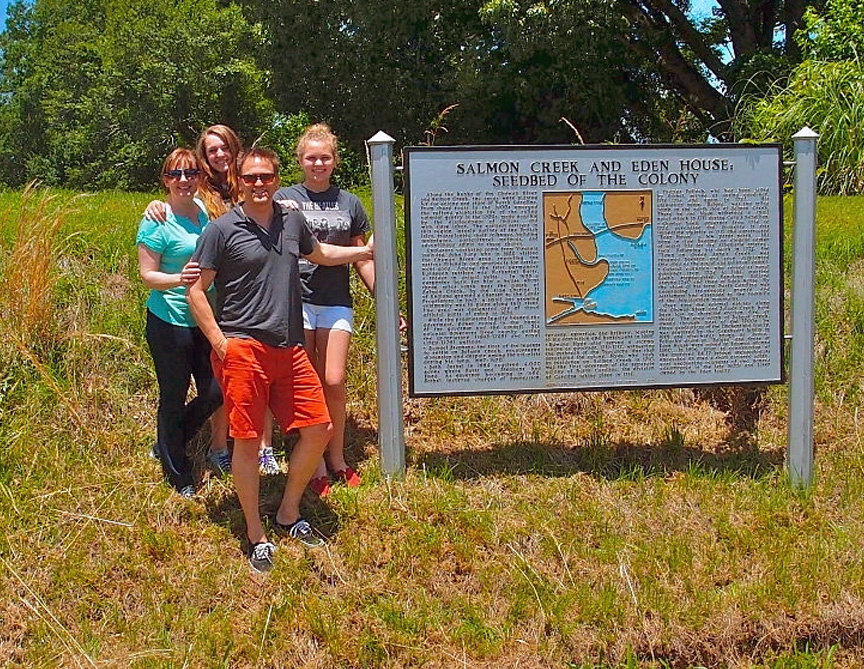
Salmon Creek and Eden House, Seedbed of the Colony historic marker
On the way to Bertie County, we stopped by Eden House. Nothing remains there but this historical marker. Erected in June 2001, the large marker replaced four older markers that were scrapped when construction began on the U.S. 17 bridge we used to drive across the Chowan River.
| “Along the banks of the Chowan River and Salmon Creek, the seeds were planted for the colony and state of North Carolina. From these roots in the 1600s emerged the refined plantation life of the ruling colonial gentry in the 1700s, made possible by the displacement of Indians and with slave labor. The earliest settlers in this region, largely natives of the British Isles, transplanted their folkways, building techniques, agricultural methods, and adventurous spirit to these shores.” Read the complete marker |
Although Eden House is no longer there, I recently blogged about an interesting archaeological project that came about because of a highway project designed to widen U.S. 17 and replace the bridge over the Chowan River.

Me at Capeharts Baptist Church
I’ve been reading about this church since I first became interested in genealogy. Located in Merry Hill, North Carolina, in Bertie County, Capeharts Baptist Church began Dec. 10, 1824. My fifth great-grandparents, John Dawson Castellaw and his wife, Zilpha Spruill Castellaw (c. 1783-1842), helped start this church.

Capeharts Baptist Church, was organized in 1823 in Merry Hill, Bertie County, North Carolina. This building was dedicated in 1918.

Other family names among the original members that are also in my line include Cobb, Williams, Butterton, Dempsey and Hardy.
Many of these families loaded up 10 years later and followed John Dawson Castellaw to Haywood County, Tennessee, where they helped settle the area.

Colerain Baptist Church
Beginning as Wiccacon Baptist in 1757, Colerain Baptist Church was established as a mission of Cashie Baptist Church in Windsor, North Carolina. A few of my ancestors left this church to help start Capeharts Baptist Church.

Some of these same church members started Zion Baptist Church when they arrived in Haywood County and later Holly Grove Baptist Church.

Clary sage growing in a field in Bertie County, North Carolina
One thing I will always remember about this trip is the sage. There was clary sage growing in nearly every field we passed, and I had never seen it before. We had to search online to figure out what it was. Northeastern North Carolina has been called the unofficial sage-growing capital of the world, and it certainly looked that way from the road. That, combined with all the old wooden houses with tin roofs, created some amazing photo opportunities.

I know my very patient daughters and wife were ready for the history portion of the road trip to end and beach time to begin. Of course, the best part of my 50th birthday genealogy road trip was spending time with my current family!
For more of my genealogy research, visit rscottwilliams.info.


Leave a Reply