
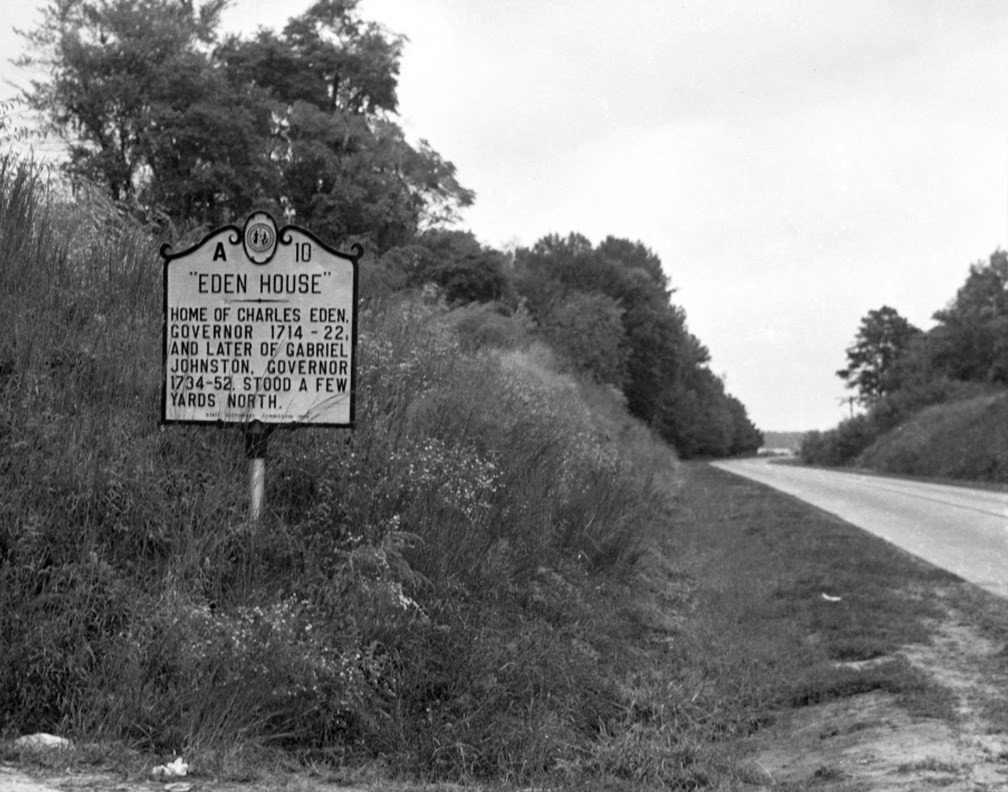
Photo: Eden House historical marker located along the Westshore Chowan River, 1952. Charles Brantley ‘Aycock’ Brown (1904-1984), State Archives of North Carolina Source /
As the North Carolina Department of Transportation began preparing for work on the U.S. 17 bridge over the Chowan River in the late 1990s, the department knew it was working near one of Bertie County’s most historic places. Eden House, once home to an assortment of the 18th century’s version of politicians and socialites, was already well known to those who study the early history of the Albemarle region.
Still, a surprise was waiting underground. During work connected to the bridge project, archaeologists found evidence of a previously unknown 17th-century colonial settlement near the place where Eden House itself once stood. The discovery drew front-page attention in the Roanoke-Chowan News-Herald, which reported that the Bertie County site was being described as “second only” to the Lost Colony in historical significance. The article also noted that the artifacts dated to the 1660s, decades before Gov. Charles Eden made the property famous.¹

For the next four months, Coastal Carolina Research Inc., led by Loretta Lautzenheiser, excavated the site. Archaeologists uncovered and preserved thousands of artifacts, adding a new layer to the story of the early Albemarle Sound region of North Carolina.
In 1719, Gov. Charles Eden (1673-1722) purchased land that included the earlier buildings later discovered during the NCDOT project. He then constructed what The Archaeological Conservancy has described as “a large manor house” that likely was completed around 1720.² A 1929 newspaper account by J.H. Etheridge said Eden “brought brick from England” and built “a handsome residence at Eden House” that burned during the Civil War.³ Modern marker language is more cautious, noting that the old colonial estates along the Chowan River and Salmon Creek were lost over time to shoreline erosion, fire or decay.⁴
Although archaeologists have never uncovered a complete foundation plan of Charles Eden’s main house and no full architectural description of the house appears to have survived, the 1996 excavation provides a clearer idea of what it may have been like.
The earliest buildings on the property were not huge brick mansions with large columns, but wooden structures, including a 24-by-16-foot house with two rooms, a barn or outbuilding and a later dwelling built over a 16.5-by-12.5-foot stone-lined cellar. Even so, these were not crude frontier shacks. The first house had expensive glass windows and Dutch tiles showing biblical scenes. The later dwelling appears to have had a slate roof, brick chimney, plastered walls and possibly wooden paneling. Archaeologists also found traces of fences, gardens, work areas, a privy, a well, trash pits, a small animal pen and what may have been part of a defensive stockade.⁵
The evidence suggests Eden House was added to an older, well-developed plantation where the main dwelling, kitchen, outbuildings, gardens, landing and workspaces were arranged along the Chowan River. By the standards of the early 1700s, the property would have looked substantial and refined to early settlers who lived in small wooden houses with few imported finishes and little furniture, if any.

Perquimans County, North Carolina is home to the Newbold-White House, the state’s oldest known brick house, dating back to 1730. Built by early English Quakers, the house and surrounding grounds offer an unvarnished glimpse into 18th-century life in the Albemarle region.
The best nearby comparison may be the Newbold-White House in Hertford, North Carolina, the state’s oldest known brick house. It was built in 1730, only about a decade after Eden House, and belongs to the same Albemarle world of rivers, plantations and early settlers.⁶
Eden House was probably built to reflect Eden’s rank and authority. Although he is sometimes called a royal governor, North Carolina was still a proprietary colony during his administration. The Lords Proprietors recommended him for the office, Queen Anne approved the appointment and Eden later served under George I. His title was grand: “Governor, Captain-General, and Commander-in-Chief, in and over His Majesty’s Colony of North Carolina, and Vice-Admiral of the same.” In office, Eden called assemblies, worked with the Council, enforced colonial law, oversaw defense and tried to bring order to a colony still dealing with rebellious colonists, Native peoples, pirates and weak transportation networks.⁷
One challenge in particular ended Eden’s time as governor. He died of yellow fever at Eden House on March 26, 1722, probably around age 48. He was buried there, but in 1889, his remains and gravestone were moved to St. Paul’s Churchyard in nearby Edenton.⁸
Eden House was built by a powerful man, but its story continued through powerful women. It passed through several important colonial families because of three women each named Penelope. The first was Gov. Eden’s wife, Penelope Golland Eden, who had two children from an earlier marriage before she married the governor. One of those children was Penelope Golland. Gov. Eden’s stepdaughter became one of the most prominent women in colonial North Carolina through a series of marriages, deaths and inheritances.
The second Penelope seemed to attract powerful men. She first married William Maule, a surveyor general and major landholder. She later married John Lovick, the colonial secretary who had inherited Eden House from Gov. Eden. After Lovick’s death, she married George Phenney, a former governor of the Bahamas, then Gov. Gabriel Johnston, royal governor of North Carolina. Through those marriages, she became Penelope Golland Maule Lovick Phenney Johnston and introduced Eden House into Johnston’s household. Gabriel Johnston lived there, died there in 1752 and was buried there.
A 1949 article in The Herald described Gabriel Johnston as “one of the outstanding Colonial governors of North-Carolina” and emphasized that he “lived, died and was buried here in this county.” The same article called Penelope “a most remarkable woman,” a phrase that still seems right for a woman whose marriages, inheritances and household ties carried Eden House from one powerful colonial family to another.⁹
Gov. Gabriel Johnston and the second Penelope had a daughter, also named Penelope. That daughter, Penelope Johnston, later married Col. John Dawson after what was remembered as an elopement in 1758. The couple returned to Eden House, where they lived for about 12 years and raised their family. Their children included William Johnston Dawson, who later became a member of Congress and helped select the site of Raleigh. Through Penelope Johnston Dawson, Eden House continued into another generation of one of North Carolina’s most connected colonial families.
Note: I began researching Eden House because my fifth great-grandmother Margaret Dawson Castellaw (1755-1813) was said to be “a Dawson from Eden House.” I am still no closer to identifying her, and it seems that designation may be a mistake.
Endnotes
- Annette Pierce, “Bertie Historical Site Is ‘Second Only’ to Lost Colony in Significance,” Roanoke-Chowan News-Herald (Ahoskie, NC), November 16, 1996, 1.
- The Archaeological Conservancy, “Conservancy Site Spotlight, Eden House,” Instagram, April 15, 2026.
- J.H. Etheridge, “Some Notes on Tar Heel History,” The Herald [Hertford County Herald] (Ahoskie, NC), September 19, 1929, 3.
- North Carolina Department of Natural and Cultural Resources, “Salmon Creek and Eden House, Seedbed of the Colony,” North Carolina Highway Historical Marker Program, marker A-10, November 30, 2023.
- North Carolina Department of Transportation, The Eden House Site: An Early Albemarle Settlement on the Chowan River, archived public archaeology exhibit, accessed June 29, 2026.
- Visit North Carolina, “Newbold-White House,” accessed June 29, 2026.
- Dennis F. Daniels, “Eden, Charles,” NCpedia, 2005; Marshall De Lancey Haywood, “Governor Charles Eden,” The North Carolina Booklet 3, no. 8 (1903).
- Daniels, “Eden, Charles.”
- John Sward Tyler, “Gabriel Johnson, Early Colonial Governor; Resident Of Bertie County,” The Herald [Hertford County Herald] (Ahoskie, NC), July 26, 1949, 4.


Leave a Reply